Thank you for visiting SNEWPapers!
Sign up free
Literary
December 7, 1888
The Weekly Union Times
Union, Union County, South Carolina
What is this article about?
An essay exploring the nature of dreams, their unpredictability, common experiences, influences like senses and digestion, and why they evade control, drawing on observations and quotes.
Clipping
OCR Quality
95%
Excellent
Full Text
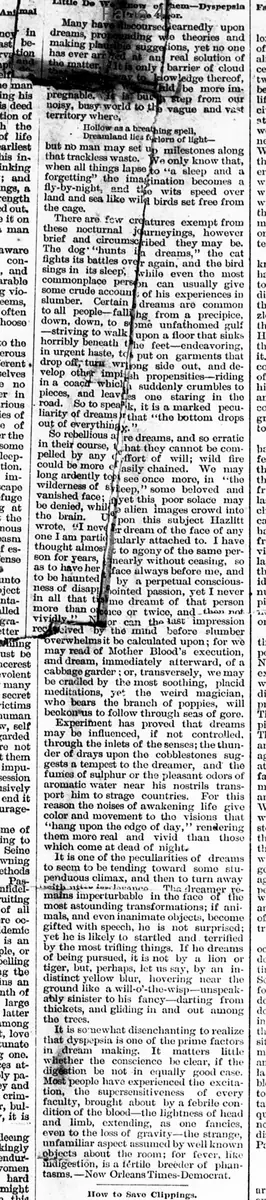
Many have discoursed learnedly upon dreams, propounding wild theories and making plausible suggestions, yet no one has ever arrived at a real solution of the matter. It is only a barrier of cloud way to knowledge thereof, would be more impregnable. It is but a step from our noisy, busy world to this vague and vast territory where,
Hollow as a breathing spell,
Dreamland lies forlorn of light—
but no man may set up milestones along that trackless waste. We only know that, when all things lapse to "a sleep and a forgetting" the imagination becomes a fly-by-night, and the wits speed over land and sea like wild birds set free from the cage.
There are few creatures exempt from these nocturnal journeyings, however brief and circumscribed they may be. The dog "hunts in dreams," the cat fights its battles over again, and the bird sings in its sleep, while even the most commonplace person can usually give some crude account of his experiences in slumber. Certain dreams are common to all people—falling from a precipice, down, down, to some unfathomed gulf—striving to walk upon a floor that sinks horribly beneath the feet—endeavoring, in urgent haste, to put on garments that drop off, turn wrong side out, and develop other impish propensities—riding in a coach which suddenly crumbles to pieces, and leaves one staring in the road. So to speak, it is a marked peculiarity of dreams that "the bottom drops out of everything."
So rebellious are dreams, and so erratic in their course, that they cannot be compelled by any effort of will; wild fire could be more easily chained. We may long ardently to see once more, in the wilderness of sleep, some beloved and vanished face; yet this poor solace may be denied, while alien images crowd into the brain. Upon this subject Hazlitt wrote, "I never dream of the face of any one I am particularly attached to. I have thought almost to agony of the same person for years, nearly without ceasing, so as to have her face always before me, and to be haunted by a perpetual consciousness of disappointed passion, yet I never in all that time dreamt of that person more than once or twice, and then not vividly."
Nor can the last impression received by the mind before slumber overwhelms it be calculated upon; for we may read of Mother Blood's execution, and dream, immediately afterward, of a cabbage garden; or, transversely, we may be cradled by the most soothing, placid meditations, yet the weird magician, who bears the branch of poppies, will beckon us to follow through seas of gore.
Experiment has proved that dreams may be influenced, if not controlled, through the inlets of the senses; the thunder of drays upon the cobblestones suggests a tempest to the dreamer, and the fumes of sulphur or the pleasant odors of aromatic water near his nostrils transports him to strange countries. For this reason the noises of awakening life give color and movement to the visions that "hang upon the edge of day," rendering them more real and vivid than those which come at dead of night.
It is one of the peculiarities of dreams to seem to be tending toward some stupendous climax, and then to turn away. The dreamer remains imperturbable in the face of the most astounding transformations; if animals, and even inanimate objects, become gifted with speech, he is not surprised; yet he is likely to be startled and terrified by the most trifling things. If he dreams of being pursued, it is not by a lion or tiger, but, perhaps, let us say, by an indistinct yellow blur, hovering near the ground like a will-o'-the-wisp—unspeakably sinister to his fancy—darting from thickets, and gliding in and out among the trees.
It is somewhat disenchanting to realize that dyspepsia is one of the prime factors in dream making. It matters little whether the conscience be clear, if the digestion be not in equally good case. Most people have experienced the excitation, the supersensitiveness of every faculty, brought about by a febrile condition of the blood—the lightness of head and limb, extending, as one fancies, even to the loss of gravity—the strange, unfamiliar aspect assumed by well known objects about the room; for fever, like indigestion, is a fertile breeder of phantasms.—New Orleans Times-Democrat.
Hollow as a breathing spell,
Dreamland lies forlorn of light—
but no man may set up milestones along that trackless waste. We only know that, when all things lapse to "a sleep and a forgetting" the imagination becomes a fly-by-night, and the wits speed over land and sea like wild birds set free from the cage.
There are few creatures exempt from these nocturnal journeyings, however brief and circumscribed they may be. The dog "hunts in dreams," the cat fights its battles over again, and the bird sings in its sleep, while even the most commonplace person can usually give some crude account of his experiences in slumber. Certain dreams are common to all people—falling from a precipice, down, down, to some unfathomed gulf—striving to walk upon a floor that sinks horribly beneath the feet—endeavoring, in urgent haste, to put on garments that drop off, turn wrong side out, and develop other impish propensities—riding in a coach which suddenly crumbles to pieces, and leaves one staring in the road. So to speak, it is a marked peculiarity of dreams that "the bottom drops out of everything."
So rebellious are dreams, and so erratic in their course, that they cannot be compelled by any effort of will; wild fire could be more easily chained. We may long ardently to see once more, in the wilderness of sleep, some beloved and vanished face; yet this poor solace may be denied, while alien images crowd into the brain. Upon this subject Hazlitt wrote, "I never dream of the face of any one I am particularly attached to. I have thought almost to agony of the same person for years, nearly without ceasing, so as to have her face always before me, and to be haunted by a perpetual consciousness of disappointed passion, yet I never in all that time dreamt of that person more than once or twice, and then not vividly."
Nor can the last impression received by the mind before slumber overwhelms it be calculated upon; for we may read of Mother Blood's execution, and dream, immediately afterward, of a cabbage garden; or, transversely, we may be cradled by the most soothing, placid meditations, yet the weird magician, who bears the branch of poppies, will beckon us to follow through seas of gore.
Experiment has proved that dreams may be influenced, if not controlled, through the inlets of the senses; the thunder of drays upon the cobblestones suggests a tempest to the dreamer, and the fumes of sulphur or the pleasant odors of aromatic water near his nostrils transports him to strange countries. For this reason the noises of awakening life give color and movement to the visions that "hang upon the edge of day," rendering them more real and vivid than those which come at dead of night.
It is one of the peculiarities of dreams to seem to be tending toward some stupendous climax, and then to turn away. The dreamer remains imperturbable in the face of the most astounding transformations; if animals, and even inanimate objects, become gifted with speech, he is not surprised; yet he is likely to be startled and terrified by the most trifling things. If he dreams of being pursued, it is not by a lion or tiger, but, perhaps, let us say, by an indistinct yellow blur, hovering near the ground like a will-o'-the-wisp—unspeakably sinister to his fancy—darting from thickets, and gliding in and out among the trees.
It is somewhat disenchanting to realize that dyspepsia is one of the prime factors in dream making. It matters little whether the conscience be clear, if the digestion be not in equally good case. Most people have experienced the excitation, the supersensitiveness of every faculty, brought about by a febrile condition of the blood—the lightness of head and limb, extending, as one fancies, even to the loss of gravity—the strange, unfamiliar aspect assumed by well known objects about the room; for fever, like indigestion, is a fertile breeder of phantasms.—New Orleans Times-Democrat.
What sub-type of article is it?
Essay
What keywords are associated?
Dreams
Imagination
Nocturnal Journeys
Dyspepsia
Phantasms
What entities or persons were involved?
New Orleans Times Democrat
Literary Details
Author
New Orleans Times Democrat
Form / Style
Prose Reflection On Dreams
Key Lines
Hollow As A Breathing Spell,
Dreamland Lies Forlorn Of Light—
When All Things Lapse To "A Sleep And A Forgetting"
The Bottom Drops Out Of Everything.