Thank you for visiting SNEWPapers!
Sign up free
Gazette Of The United States And Daily Evening Advertiser
Philadelphia, Philadelphia County, Pennsylvania
What is this article about?
U.S. House of Representatives proceedings on February 28 and March 2, featuring debates on amendments allowing pursuit of hostile Indians across lines, provisions for public debt subscriptions, and passage of bills on Indian trade, land grants, carriage duties, and arms export regulations amid neutrality concerns.
Merged-components note: These three components form a single continuous report on congressional proceedings from Saturday, February 28, to Monday, March 2, with sequential reading orders (26, 27, 28) and flowing text content across pages 2 and 3.
Clippings
1 of 2
OCR Quality
Full Text
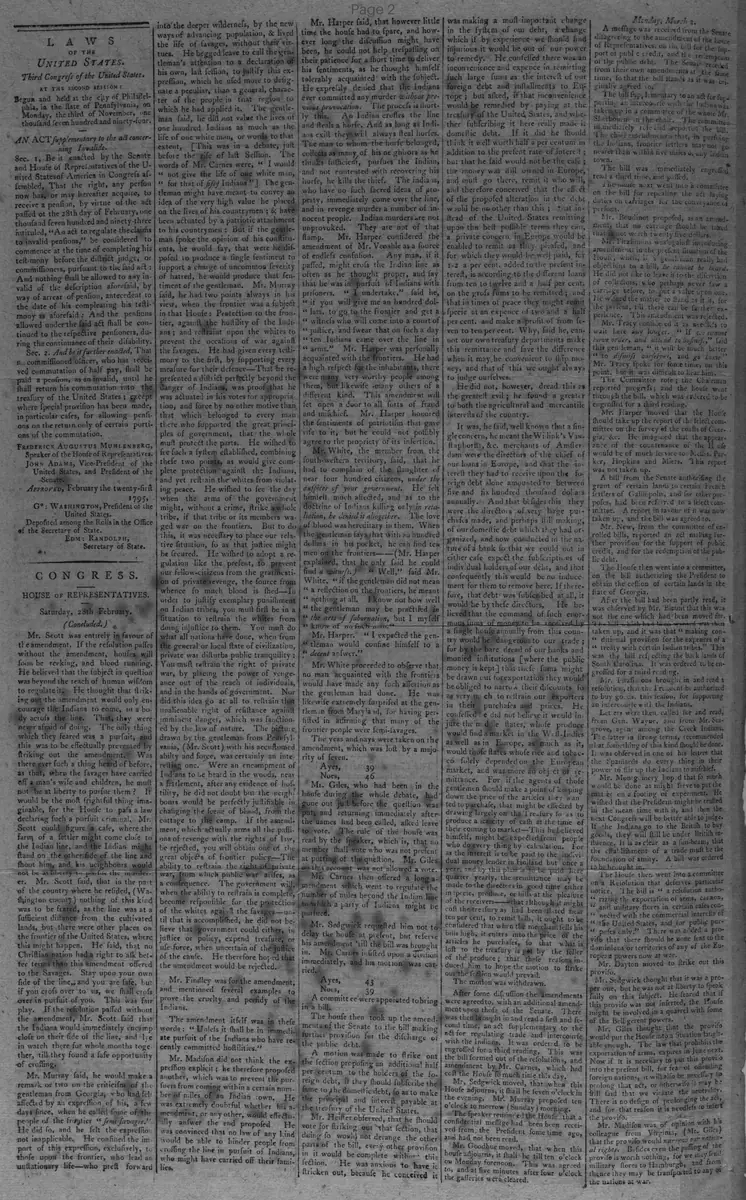
HOUSE OF REPRESENTATIVES.
Saturday, 28th February.
(Concluded.)
Mr. Scott was entirely in favour of the amendment. If the resolution passes without the amendment, houses will soon be reeking, and blood running. He believed that the subject in question was beyond the reach of human wisdom to regulate it. He thought that striking out the amendment would only encourage the Indians to come, in a body across the line. That, they were never afraid of doing. The only thing which they feared was a pursuit, and this was to be effectually prevented by striking out the amendment. Was there ever such a thing heard of before, as that, when the savages have carried off a man's wife and children, he must not be at liberty to pursue them? It would be the most rightful thing imaginable, for the House to pass a law declaring such a pursuit criminal. Mr. Scott could figure a case, where the farm of a settler might come close to the Indian line, and the Indian might stand on the other side of the line and shoot him, and his neighbours would not be at liberty to pursue the murderer. Mr. Scott said, that in the part of the country where he resided, (Washington county) nothing of this kind was to be feared, as the line was at a sufficient distance from the cultivated lands, but there were other places on the frontier of the United States, where this might happen. He said, that no Christian nation had a right to ask better terms than this amendment offered to the Savages. Stay upon your own side of the line, and you are safe, but if you cross over to us, we shall cross over in pursuit of you. This was fair play. If the resolution passed without the amendment, Mr. Scott said that the Indians would immediately encamp close on their side of the line, and lie in watch there for whole months together, till they found a safe opportunity of crossing.
Mr. Murray said, he would make a remark or two on the criticism of the gentleman from Georgia, who had felt affected by an expression of his, a few days since, when he called some of the people of the frontier "semi-savages." He did so, and he felt the expression not inapplicable. He confined the import of this expression, exclusively, to those upon the frontier, who lead an unstationary life—who press onward into the deeper wilderness, by the new ways of advancing population, & lived the life of savages, without their virtues. He begged leave to call the gentleman's attention to a declaration of his own, last session, to justify this expression, which he used more to designate a peculiar, than a general, character of the people in that region to which he had applied it. The gentleman said, he did not value the lives of one hundred Indians as much as the life of one white man, or words to that extent. This was in a debate, just before the rise of last Session. The words of Mr. Carnes were, "I would not give the life of one white man, for that of fifty Indians." The gentleman might have meant to convey an idea of the very high value he placed on the lives of his countrymen; & have been actuated by a patriotic attachment to his countrymen: But if the gentleman spoke the opinion of his constituents, he would say, that were he disposed to produce a single sentiment to support a charge of uncommon severity of hatred, he would produce that sentiment of the gentleman. Mr. Murray said, he had two points always in his view, when the frontier was a subject in that House: Protection to the frontier, against the hostility of the Indians; and restraint upon the whites to prevent the occasions of war against the savages. He had given every testimony to the first, by supporting every measure for their defence—That he represented a district perfectly beyond the danger of Indians, was proof that he was actuated in his votes for appropriation, and force by no other motive than that which belonged to every man there who supported the great principles of government, that the whole must protect the parts. He wished to see such a system established, combining these two points, as would give complete protection against the Indians, and yet restrain the whites from violating peace. He wished to see the day when the arms of the government might, without a crime, strike a whole tribe, if that tribe or its members waged war on the frontiers. But to do this, it was necessary to place our relative situation, so as that justice might be secured. He wished to adopt a regulation like the present, to prevent our fellow-citizens from the gratification of private revenge, the source from whence so much blood is shed—In order to justify exemplary punishment on Indian tribes, you must first be in a situation to restrain the whites from doing injustice to them. You must do what all nations have done, when from the general or local state of civilization, private war disturbs public tranquility: You must restrain the right of private war, by placing the power of vengeance out of the reach of individuals, and in the hands of government. Nor did this idea go at all to restrain that unalienable right of resistance against imminent danger, which was sanctioned by the law of nature. The picture drawn by the gentleman from Pennsylvania, (Mr. Scott) with his accustomed ability and force, was certainly an interesting one. Were an encampment of Indians to be heard in the woods, near a settlement, after any evidence of hostility, he did not doubt but the neighbours would be perfectly justifiable in changing the scene of blood, from the cottage to the camp. If the amendment, which actually arms all the passions of revenge with the rights of law, be rejected, you will obtain one of the great objects of frontier policy—The ability to restrain the right of private war, from which public war arises, as a consequence. The government will, when the ability to restrain is complete, become responsible for the protection of the whites against the savages—until that is accomplished, he did not believe that government could either, in justice or policy, expend treasure, or use force, when uncertain of the justice of the cause. He therefore hoped that the amendment would be rejected.
Mr. Findley was for the amendment, and mentioned several examples to prove the cruelty and perfidy of the Indians.
The amendment itself was in these words: "Unless it shall be in immediate pursuit of the Indians who have recently committed hostilities."
Mr. Madison did not think the expression explicit; he therefore proposed another, which was to prevent the pursuers from coming within a certain number of miles of an Indian town. He was extremely doubtful whether his amendment, or any other, would effectually answer the end proposed. He was convinced that no law of any kind would be able to hinder people from crossing the line in pursuit of Indians, who might have carried off their families.
Mr. Harper said, that however little time the house had to spare, and however long the discussion might have been, he could not help trespassing on their patience for a short time to deliver his sentiments, as he thought himself tolerably acquainted with the subject. He expressly denied that the Indians ever committed any murder without previous provocation. The process is shortly this. An Indian crosses the line and steals a horse. And as long as Indians exist they will always steal horses. The man to whom the horse belonged, collects as many of his neighbors as he thinks sufficient, pursues the Indian, and not contented with recovering his horse, he kills the thief. The Indians, who have no such sacred ideas of property, immediately come over the line, and in revenge murder a number of innocent people. Indian murders are not unprovoked. They are not of that stamp. Mr. Harper considered the amendment of Mr. Venable as a source of endless confusion. Any man, if it passed, might cross the Indian line as often as he thought proper, and say that he was in pursuit of Indians with prisoners. "I undertake," said he, "if you will give me an hundred dollars, to go to the frontier and get a witness who will come into a court of justice, and swear that on such a day ten Indians came over the line in arms." Mr. Harper was personally acquainted with the frontiers. He had a high respect for the inhabitants, there were many very worthy people among them, but likewise many others of a different kind. This amendment will set open a door to all sorts of fraud and mischief. Mr. Harper honored the sentiments of patriotism that gave rise to it, but he could not possibly agree to the propriety of its insertion.
Mr. White, the member from the south-western territory, said, that he had to complain of the slaughter of near four hundred citizens, under the auspices of your government. He felt himself much affected, and as to the doctrine of Indians killing only in retaliation, he denied it altogether. The love of blood was hereditary in them. When the gentleman says that with an hundred dollars in his pocket, he can find ten men on the frontiers—(Mr. Harper explained, that he only said he could find a witness.) "Well," said Mr. White, "if the gentleman did not mean a reflection on the frontiers, he meant nothing at all. I know not how well the gentleman may be practiced in the arts of subornation, but I myself know of no such"
Mr. Harper. "I expected the gentleman would confine himself to a decent answer."
Mr. White proceeded to observe that no man acquainted with the frontiers would have made any such assertion as the gentleman had done. He was likewise extremely surprised at the gentleman from Maryland, for having persisted in affirming that many of the frontier people were semi-savages.
The yeas and nays were taken on the amendment, which was lost by a majority of seven.
Ayes, 39
Noes, 46
Mr. Giles, who had been in the house during the whole debate, had gone out just before the question was put, and returning immediately after the names had been called, asked leave to vote. The rule of the house was read by the speaker, which is, that no member shall vote who was not present at putting of the question. Mr. Giles on this account was not allowed a vote.
Mr. Carnes then offered a long amendment which went to regulate the number of miles beyond the Indian line to which a party of Indians might be pursued.
Mr. Sedgwick requested him not to delay the house at present, but reserve his amendment 'till the bill was brought in. Mr. Carnes insisted upon a division immediately, and his motion was carried.
Ayes, 43
Noes, 39
A committee were appointed to bring in a bill.
The house then took up the amendments of the Senate to the bill making further provision for the discharge of the public debt.
A motion was made to strike out the section proposing an additional half per centum to the holders of the foreign debt, if they should subscribe the same to the domestic debt, so as to make the principal and interest payable at the treasury of the United States.
Mr. Heister observed, that he should vote for striking out that section, that doing so would not derange the other parts of the bill, every other provision in it would be complete without this section. He was anxious to have it stricken out, because he conceived it was making a most important change in the system of our debt, a change which if by experience we should find injurious it would be out of our power to remedy. He confessed there was an inconvenience and expense in remitting such large sums as the interest of our foreign debt and installments to Europe; but asked, if that inconvenience would be remedied by paying at the treasury of the United States, and whether subscribing it here really made it domestic debt. If it did he should think it well worth half a per centum in addition to the present rate of interest: but that he said would not be the case; the money was still owned in Europe, and must go there, remit it who will. And therefore conceived that the effect of the proposed alteration in the debt would be no other than this; at instead of the United States remitting upon the best possible terms they can, a private concern in Europe would be enabled to remit as they pleased, and for which they would be well paid, for 1-2 a per cent. added to the present interest, is according to the different loans from ten to twelve and a half per cent. on the gross sums to be remitted; and that in times of peace they might remit specie at an expense of two and a half per cent. and make a profit of from seven to ten per cent. Why, said he, cannot our own treasury departments make this remittance and save the difference when it may be convenient to ship money, and that of this we ought always to judge ourselves.
He did not, however, dread this as the greatest evil; he found a greater to both the agricultural and mercantile interests of the country.
It was, he said, well known that a single concern, he meant the Willink's Van Staphorsts, &c. merchants of Amsterdam were the directors of the chief of our loans in Europe, and that the interest they had to receive upon the foreign debt alone amounted to between five and six hundred thousand dollars annually. And that besides this they were the directors of very large purchases made, and perhaps still making, of our domestic debt which they had organized, and now conducted in the nature of a bank so that we could not in either case expect the subscriptions of individual holders of our debt, and that consequently this would be no inducement for them to remove here. If therefore, that debt was subscribed at all, it would be by these directors. He believed that the command of such enormous sums of money to be received by a single house annually from this country would be dangerous to our trade; for by the bare dread of our banks and monied institutions [where the public money is kept] that these sums might be drawn out for exportation they would be obliged to narrow their discounts so as very much to restrain our exporters in their purchases and prices. He confessed he did not believe it would injure the northern states, whose produce would find a market in the W. Indies as well as in Europe, as much as it would those states whose rice and tobacco solely depended on the European market, and was more an object of remittance. For if the agents of those gentlemen should make a point of keeping down the price of the articles they wanted to purchase, that might be effected by drawing largely on the Treasury so as to produce a scarcity of cash at the time of their coming to market—This he believed himself, might be expected from people who do every thing by calculation. For as the interest is to be paid to the individual money lender in Holland but once a year, and by this plan is to be paid here quarter yearly, the remittance may be made to the directors in good time either in specie, produce, or bills at the pleasure of the receivers that although it might cost the treasury as has been stated near ten per cent, to remit bills, it ought to be considered that when the merchant sells his bills high, it enters into the price of the articles he purchases, so that what is lost to the treasury is got by the seller of the produce; that these reasons induced him to hope the motion to strike out the section would prevail.
The motion was withdrawn.
After some discussion the amendments were agreed to, with an additional amendment upon those of the Senate. There was then brought in and read a first and second time, an act supplementary to the act for regulating trade and intercourse with the Indians. It was ordered to be engrossed for a third reading. This was the bill formed out of the resolutions, and amendment by Mr. Carnes, which had cost the House so much time this day.
Mr. Sedgwick moved, that when this House adjourns, it shall be seven o'clock in the evening. Mr. Murray proposed ten o'clock to morrow (Sunday) morning.
The speaker reminded the House that a confidential message had been received from the President some time ago, and had not been read.
Mr. Goodhue moved, that when this house adjourns, it shall be till ten o'clock on Monday forenoon. This was agreed to, and at five minutes after four o'clock the galleries were cleared.
Monday, March 2.
A message was received from the Senate disagreeing to the amendment of the house of Representatives, on the bill for the support of public credit, and the redemption of the public debt. The Senate receded from their own amendments at the same time, so that the bill stands as it was originally agreed to.
The bill supplementary to an act for supporting an intercourse with the Indians was taken up in a committee of the whole, Mr. Sherburne in the chair. The committee immediately rose and reported the bill. The chief amendment is that, in pursuing the Indians, frontier settlers may not go nearer than within five miles of any Indian town.
The bill was immediately engrossed, read a third time, and passed.
The house next went into a committee on the bill for repealing the act laying duties on carriages for the conveyance of persons.
Mr. Boudinot proposed, as an amendment, that no carriage should be taxed that is not worth twenty five dollars.
Mr. Fitzsimons was against introducing amendments in the present situation of the House, when, if a gentleman really had objections to a bill, he cannot be heard. He did not like to leave it to the discretion of collectors, who perhaps never saw a carriage before, to put a value upon one. He wished the matter to stand as it is, or the present, till there can be further experience. This amendment was rejected.
Mr. Tracy considered it as needless to wait here any longer. "If we cannot have order, and attend to business," said this gentleman, "it will be much better to dismiss ourselves, and go home."
Mr. Tracy spoke for some time, on this point, but it was difficult to hear him.
The Committee rose; the Chairman reported progress; and the house went through the bill, which was ordered to be engrossed for a third reading.
Mr. Harper moved that the House should take up the report of the select committee on the survey of the coasts of Georgia, &c. He imagined that the appearance of the countenance of the House would be of much service to Messrs. Parker, Hopkins and Miers. This report was not taken up.
A bill from the Senate authorizing the grant of certain lands to certain French settlers of Galliopolis, and for other purposes, had been referred to a select committee. A report in favour of it was now taken up, and the bill was agreed to.
Mr. New, from the committee of enrolled bills, reported an act making further provision for the support of public credit, and for the redemption of the public debt.
The House then went into a committee, on the bill authorizing the President to obtain the cession of certain lands in the state of Georgia.
After the bill had been partly read, it was observed by Mr. Blount that this was not the one which had been moved for.
The bill which had been wanted was then taken up, and it was that "making conditional provision for the expenses of a treaty with certain Indian tribes." This was the bill rejecting the back lands of South Carolina. It was ordered to be engrossed for a third reading.
Mr. Fitzsimons brought in and read a resolution, that the President be authorized to buy goods, this season, for supporting an intercourse with the Indians.
Letters were then called for and read, from Gen. Wayne, and from Mr. Seagrove, agent among the Creek Indians.
The latter in strong terms, recommended that something of this kind should be done.
It was observed in one of his letters that the Spaniards do every thing in their power to stir up the Indians to mischief.
Mr. Montgomery hoped that so much would be done as might serve to put the matter on a footing of experiment. He wished that the President might be trusted in the mean time with it, and then the next Congress will be better able to judge. If the Indians go to the British to buy goods, they will still be under British influence. It is as clear as a sun-beam, that the establishment of a trade must be the foundation of amity. A bill was ordered to be brought in.
The House then went into a committee on a Resolution that deserves particular notice. The bill is "a resolution authorizing the exportation of arms, cannon, and military stores in certain cases connected with the commercial interests of the United States, and for public purposes only." There was added a proviso that there should be none sent to the dominions or territories of any of the European powers now at war.
Mr. Dayton moved to strike out this proviso.
Mr. Sedgwick thought that it was a proviso fully on this subject. He feared that if this proviso was not inserted, the House might be involved in a quarrel with some of the Belligerent powers.
Mr. Giles thought that the proviso would narrow our national rights. Besides even the passing of the proviso is worth nothing, for we may send military stores to Hamburg, and from thence they may be transported to any of the nations at war.
Mr. Madison was of opinion with his colleague from Virginia, (Mr. Giles) that the proviso.
There is no design of prolonging the act, and for that reason it is needless to insert the proviso.
The law that prohibits the exportation of arms, expires in June next. Now if it is necessary to put this proviso into the present bill, for fear of offending foreign nations, it will also be necessary to prolong that act, otherwise it may be said that we violate the neutrality.
Mr. Sedgwick said that the House would put the House into a situation laughable enough.
Mr. Goodhue saw this matter in a particular light. This exportation was governmental, and if a man of war meet this vessel, the proviso will prevent a jealousy.
A motion for striking it out was carried.
Ayes 35.
Noes 30.
The committee then rose, and progress was reported.
The question on the amendment was put.
Mr. B. Bourne hoped that this amendment would not be agreed to. It might have serious consequences.
Mr. Sedgwick. If the amendment itself has any meaning, it is authorizing the President to send military stores to nations at war.
Mr. Giles did not see the use of so much delicacy. The military stores are for a nation that is actually at war, and that, as Mr. Giles believed, always will be at war.
The amendment was carried. It was then moved to strike out the word Resolved, and to put into its place, Be it enacted.
This was agreed to. The resolution was thus turned into a bill.
Mr. Harper again moved to go into a committee of the whole, on the report of the select committee, as to surveying the coasts.
The motion was negatived.
The bill respecting compensations to clerks in public offices, was passed with an amendment.
A message was received from the President of the United States, Stating that it would be necessary to have a consul at Morocco, a second at Algiers, and a third at Tunis or Tripoli. The message was referred to a committee of three members.
The amendments of the Senate to the bill for continuing and regulating the military establishment of the United States, were agreed to.
The bill empowering the Secretary at War to place certain persons therein named on the invalid pension list, was read a third time, and passed.
The House, after passing the carriage bill, adjourned till seven o'clock in the evening.
What sub-type of article is it?
What keywords are associated?
What entities or persons were involved?
Domestic News Details
Event Date
Saturday, 28th February To Monday, March 2
Key Persons
Outcome
amendment on indian pursuit lost 39-46; public debt motion withdrawn; indian intercourse bill passed with 5-mile limit; carriage duties bill progressed; land grant to gallipolis passed; arms export resolution passed without belligerent proviso 35-30; various other bills passed or agreed.
Event Details
House debates amendment allowing immediate pursuit of hostile Indians across lines, with arguments on frontier protection, white restraint, and Indian provocations; discusses striking section on foreign debt subscription incentives, concerns over remittances and trade impacts; passes supplementary Indian trade bill limiting pursuits; handles carriage tax repeal, land cessions, Indian goods purchase resolution, and arms export authorization amid neutrality debates.