Thank you for visiting SNEWPapers!
Sign up free
The Key West Citizen
Key West, Monroe County, Florida
What is this article about?
In a memorandum published by India's Congress party, Prime Minister Nehru urges India to develop its own economic and political path, critiquing both communism and capitalism for their inadequacies in addressing modern challenges, especially for underdeveloped nations like India with 380 million people and low per capita income.
Clipping
OCR Quality
Full Text
View Of Both
Systems
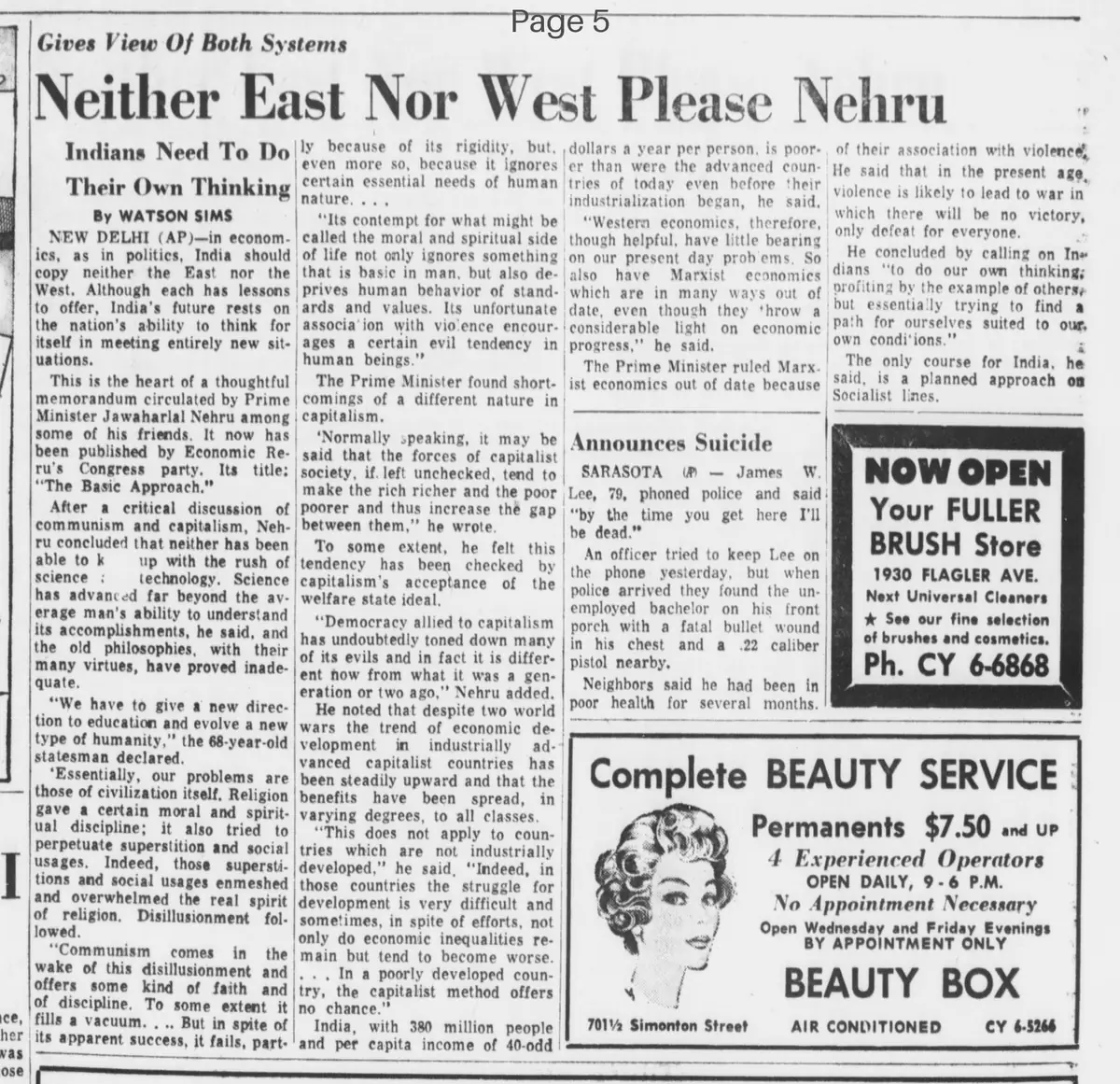
Neither
East
Nor
West
Please
Nehru
Their Own Thinking
By Watson Sims
NEW DELHI (AP)- In economics, as in politics, India should copy neither the East nor the West. Although each has lessons to offer, India's future rests on the nation's ability to think for itself in meeting entirely new situations.
This is the heart of a thoughtful memorandum circulated by Prime Minister Jawaharlal Nehru among some of his friends. It now has been published by Nehru's Congress party. Its title: "The Basic Approach."
After a critical discussion of communism and capitalism, Nehru concluded that neither has been able to keep up with the rush of science and technology. Science has advanced far beyond the average man's ability to understand its accomplishments, he said, and the old philosophies, with their many virtues, have proved inadequate.
"We have to give a new direction to education and evolve a new type of humanity," the 68-year-old statesman declared.
Essentially, our problems are those of civilization itself. Religion gave a certain moral and spiritual discipline; it also tried to perpetuate superstition and social usages. Indeed, those superstitions and social usages enmeshed and overwhelmed the real spirit of religion. Disillusionment followed.
"Communism comes in the wake of this disillusionment and offers some kind of faith and of discipline. To some extent it fills a vacuum... But in spite of its apparent success, it fails, partly because of its rigidity, but even more so, because it ignores certain essential needs of human nature....
"Its contempt for what might be called the moral and spiritual side of life not only ignores something that is basic in man, but also deprives human behavior of standards and values. Its unfortunate association with violence encourages a certain evil tendency in human beings."
The Prime Minister found shortcomings of a different nature in capitalism.
"Normally speaking, it may be said that the forces of capitalist society, if left unchecked, tend to make the rich richer and the poor poorer and thus increase the gap between them," he wrote.
To some extent, he felt this tendency has been checked by capitalism's acceptance of the welfare state ideal,
"Democracy allied to capitalism has undoubtedly toned down many of its evils and in fact it is different now from what it was a generation or two ago." Nehru added.
He noted that despite two world wars the trend of economic development in industrially advanced capitalist countries has been steadily upward and that the benefits have been spread, in varying degrees, to all classes.
"This does not apply to countries which are not industrially developed," he said. "Indeed, in those countries the struggle for development is very difficult and sometimes, in spite of efforts, not only do economic inequalities remain but tend to become worse.
... In a poorly developed country, the capitalist method offers no chance.
India, with 380 million people and per capita income of 40-odd dollars a year per person, is poorer than were the advanced countries of today even before their industrialization began, he said,
"Western economics, therefore, though helpful, have little bearing on our present day problems. So also have Marxian economics which are in many ways out of date, even though they throw a considerable light on economic progress," he said.
The Prime Minister ruled Marxist economics out of date because of their association with violence
He said that in the present age, violence is likely to lead to war in which there will be no victory, only defeat for everyone.
He concluded by calling on Indians "to do our own thinking, profiting by the example of others but essentially trying to find a path for ourselves suited to our own conditions."
The only course for India, he said, is a planned approach on Socialist lines.
What sub-type of article is it?
What keywords are associated?
What entities or persons were involved?
Where did it happen?
Foreign News Details
Primary Location
New Delhi
Key Persons
Event Details
Prime Minister Jawaharlal Nehru circulated a memorandum titled 'The Basic Approach' among friends, now published by his Congress party, advising India to neither copy Eastern communism nor Western capitalism in economics and politics but to think for itself. He critiques both systems for failing to keep pace with science and technology, notes communism's rigidity and ignorance of human nature's moral and spiritual needs, and capitalism's tendency to widen inequalities especially in underdeveloped countries like India. Nehru calls for a new direction in education, a planned socialist approach suited to India's conditions, and warns against violence leading to war.