Thank you for visiting SNEWPapers!
Sign up free
Alexandria Gazette & Daily Advertiser
Alexandria, Virginia
What is this article about?
U.S. Congressional proceedings on Tuesday, January 22, covering Senate discussions on militia fines from the War of 1812, bills for land remittances and territorial government, and various memorials; House reports on petitions, bankruptcy opposition, and duty remissions.
Merged-components note: Merged congressional proceedings across pages 2 and 3 with accompanying tables on militia numbers and fines assessed, as they form a single coherent report on the topic.
Clippings
1 of 2
OCR Quality
Full Text
From the National Intelligencer.
Tuesday, January 22.
IN SENATE.
Mr Ruggles, from the committee of Claims, made an unfavorable report on the petition of Rebecca Hodgson; which was read.
MILITIA FINES.
Agreeably to notice, Mr. Lowrie asked leave to introduce a bill to vest in the respective states the right of the U. States to all fines assessed for the non-performance of militia duty during the last war.
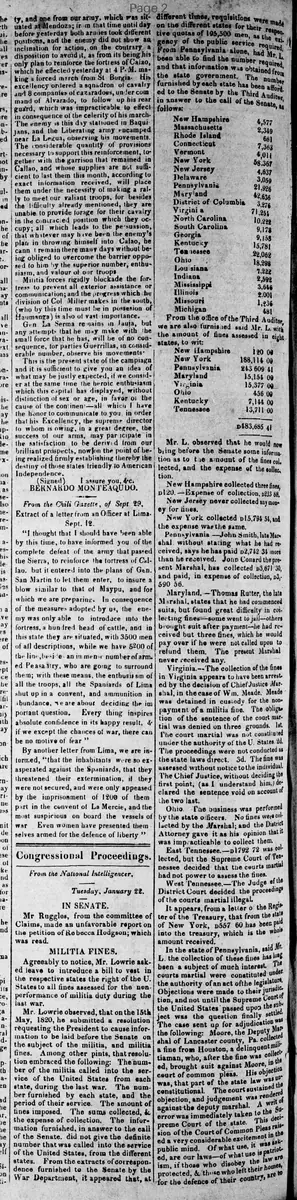
Mr. Lowrie observed, that on the 15th May, 1820, he submitted a resolution requesting the President to cause information to be laid before the Senate on the subject of the militia, and militia fines. Among other points, that resolution embraced the following: The number of the militia called into the service of the United States from each state, during the last war. The number furnished by each state, and the period of their service. The amount of fines imposed. The sums collected, & the expense of collection. The information furnished, in answer to the call of the Senate, did not give the definite number that was called into the service of the United States, from the different states. From the extracts of correspondence furnished to the Senate by the War Department, it appeared that, at different times, requisitions were made on the different states for their respective quotas of 195,500 men, as the exigency of the public service required. From Pennsylvania alone, had Mr. L. been able to find the number required, and that information was obtained from the state government. The number furnished by each state has been afforded to the Senate by the Third Auditor, in answer to the call of the Senate, as follows:
From the office of the Third Auditor, we are also furnished said Mr. L. with the amount of fines assessed in eight states, to wit:
$483,685 41
Mr. L. observed that he would now bring before the Senate some information as to the amount of the fines collected, and the expense of the collection.
1.
New Hampshire collected three fines, $120. -Expense of collection, $233 88.
New Jersey never collected any money for fines.
New York collected $15,794 54, and the expense was the same.
Pennsylvania --John Smith, late Marshal, without stating what he had received, says he has paid $2,742 31 more than he received. John Conard the present Marshal, has collected $3,679 30, and paid, in expense of collection, $3,590 56.
Maryland. -Thomas Rutter, the late Marshal, states that he had commenced suits, but found great difficulty in collecting fines--some went to jail--others brought suit after payment--he had received but three fines, which he would pay over if he were not called upon to refund them. The present Marshal never received any.
Virginia.--The collection of the fines in Virginia appears to have been arrested by the decision of Chief Justice Marshall, in the case of Wm. Meade. Meade was detained in custody for the non-payment of a militia fine. The obligation of the sentence of the court martial was denied on three grounds. 1st. The court martial was not constituted under the authority of the U. States 2d. The proceedings were not conducted as the state laws direct, 3d. The fine was assessed without notice to the individual. The Chief Justice, without deciding the first point, (as I understand him,) declared the sentence void on account of the two last.
Ohio. The business was performed by the state officers. No fines were collected by the Marshal: and the District Attorney gave it as his opinion that it was impracticable to collect them.
East Tennessee. -$1792 72 was collected, but the Supreme Court of Tennessee decided that the courts martial had not power to assess the fines.
West Tennessee. -The Judge of the District Court decided the proceedings of the courts martial illegal.
It appears, from a letter of the Register of the Treasury, that from the state of New York, $557 60 has been paid into the treasury, which is the whole amount received.
In the state of Pennsylvania, said Mr. L. the collection of these fines has long been a subject of much interest. The courts martial were constituted under the authority of an act of the legislature,
Objections were made to their jurisdiction, and not until the Supreme Court of the United States passed upon the subject was the question finally settled.
The case sent up for adjudication was the following:
Moore, the Deputy Marshal collected a fine from Houston, a delinquent militia man of Lancaster county, Pa. Houston, who, after the fine was collected, brought suit against Moore, in the court of common pleas. His objection was, that part of the state law was unconstitutional. The court sustained the pleas. A writ of error was immediately taken to the Supreme Court of the state. This decision led a very considerable excitement in the public mind. Of what use, it was asked, are our laws--of what use is patriotism, if those who disobey the law for the defence of their country, are to protected, & those who left their homes, are to be oppressed? The Supreme Court reversed the decision of the Court of Common Pleas raising the question of the constitutionality of the state law.
| New Hampshire | 4,577 |
| Massachusetts | 2,349 |
| Rhode Island | 681 |
| Connecticut | 7,363 |
| Vermont | 4,011 |
| New York | 58,367 |
| New Jersey | 4,637 |
| Delaware | 3,059 |
| Pennsylvania | 21,926 |
| Maryland | 42,636 |
| District of Columbia | 3,276 |
| Virginia | 71,251 |
| North Carolina | 10,222 |
| South Carolina | 9,178 |
| Georgia | 9,158 |
| Kentucky | 15,781 |
| Tennessee | 22,062 |
| Ohio | 18,298 |
| Louisiana | 7,222 |
| Indiana | 2,592 |
| Mississippi | 3,646 |
| Illinois | 2,001 |
| Missouri | 1,236 |
| Michigan | 481 |
| New Hampshire | 120 00 |
| New York | 188,114 00 |
| Pennsylvania | 243 609 41 |
| Maryland | 15,154 00 |
| Virginia | 15,377 00 |
| Ohio | 456 00 |
| Kentucky | 7,144 00 |
| Tennessee | 13,711 00 |
be subjected to fines, and penalties, and lature, then in session, participated largely in these feelings. Petitions were presented, from the deputy marshals & trespassers. The people ing the interference & protection of the martial officers of an entire brigade informed the governor that, if this decision was could longer their commissions. There was, however, no direct manner by which the le- gislature could act upon the subject. They passed an act directing the Su- preme Court to decide upon the writ of error, and that Court accordingly met immediately and reversed the decision of the court below. A writ of error was then taken to the Supreme Court of the United States. Mr. L. went into examination of the opinion of the Supreme Court; and read extracts from the case as reported in 5th Wheaton's reports, affirming some of the most important facts of Pennsylvania. These, said Mr. Lowrie, now offer to the consideration of the Senate. I am aware that this is not the proper stage of the bill to offer any arguments in favor of its passage. My object is to make a favorable impression on the mind of the Senate. Pennsylvania is deeply interested in this measure. During the last war she furnished all the men required of her—she furnished more. The number called for was 20,387, the number furnished was 21,926, being 1,539 more than the requisition. If, in addition to this, you collect from her citizens a quarter of a million of dollars, her case will be a hard one. But I will leave these remarks till the bill shall come up for consideration in the Senate. Leave was granted, and the bill received its first reading. Mr. Thomas, from the committee on the Public Lands, reported a bill to authorize the Commissioner of the General Land Office to remit the instalments due on certain lots in Shawneetown in Illinois: which was read. Mr. King, of Ala. presented a memorial from the Legislature of the state of Alabama, respecting a connection of the waters of the Tennessee & Alabama rivers; which was referred to the committee on Roads and Canals. Mr. Barton presented a memorial of the Legislature of Missouri, praying the payment to the state of three fifths of five percent. on all sales of public lands made subsequently to the 19th of July, 1821; and it was referred. Mr. Walker laid before the Senate certain resolutions of the Legislature of Alabama, instructing her Senators in Congress to endeavor to obtain an annexation to the state of Alabama of that part of West Florida lying west of the Apalachicola river: and (after some opposition on the part of Mr. Eaton, who deemed it improper to refer such papers not addressed to the Senate) the memorial was, on motion of Mr. Walker, referred to the committee on the Judiciary. Mr. Barton submitted the following resolution for consideration which he accompanied by some remarks explanatory of its object: Resolved, That the Committee on Public Lands be instructed to inquire whether any further legislation be necessary to perfect the titles to lands which have been located by virtue of warrants issued under the act of the 17th day of Feb, 1815, entitled "an act for the relief of the inhabitants of the late county of New Madrid, in the Missouri territory, who suffered by earthquakes." The resolution submitted yesterday by Mr. Benton was taken up and agreed to. The report made yesterday by the committee on the joint rules of the two houses, was taken up, and the amendments proposed therein were adopted.
HOUSE OF REPRESENTATIVES.
Among the petitions this day presented, was a Memorial by Mr. Barstow, from sundry inhabitants of the town of Danvers, in the State of Massachusetts, against the passage of a law to establish an uniform system of Bankruptcy; which was referred to the committee of the whole on that subject. Mr. Rhea, from the Committee of Pensions and Revolutionary Claims, reported unfavorably upon the respective petitions of Isaac P Young and Elizabeth which reports were severally concurred in. Mr. Smith, of Maryland, from the Committee of Ways and Means reported to remit the duties on a sword imported United States to be presented to Macdonough of the United States Navy, which was twice read and committed. Mr. Sergeant, from the Committee on the Judiciary reported a bill for the establishment of Territorial Government in Florida; which was twice read and committed. Mr. Smith, of Md. from the Committee of Ways and Means reported a bill which was twice read and committed. Mr. Campbell, from the Committee on Private Land Claims reported a bill for the legal representatives of John Girault which was twice read and committed. Mr. Newton, from the Committee on Commerce reported a bill of the port of entry and delivery for the
What sub-type of article is it?
What keywords are associated?
What entities or persons were involved?
Where did it happen?
Domestic News Details
Primary Location
Washington
Event Date
Tuesday, January 22
Key Persons
Event Details
Senate proceedings included an unfavorable report on Rebecca Hodgson's petition, Mr. Lowrie's bill on vesting militia fines in states with detailed discussion on collections and legal challenges from the War of 1812, reports on land bills, memorials from Alabama and Missouri legislatures, resolutions on land titles and Florida annexation. House presented petitions against bankruptcy law, unfavorable reports on pensions, bills on duty remission for a sword, Florida territorial government, private land claims, and port establishment.