Thank you for visiting SNEWPapers!
Sign up free
Story
May 17, 1865
The Weekly Perrysburg Journal
Perrysburg, Wood County, Ohio
What is this article about?
Instructions on planting potatoes in different soils, including plowing techniques, dropping sets, and covering methods using hand tools or horse-drawn implements.
Clipping
OCR Quality
95%
Excellent
Full Text
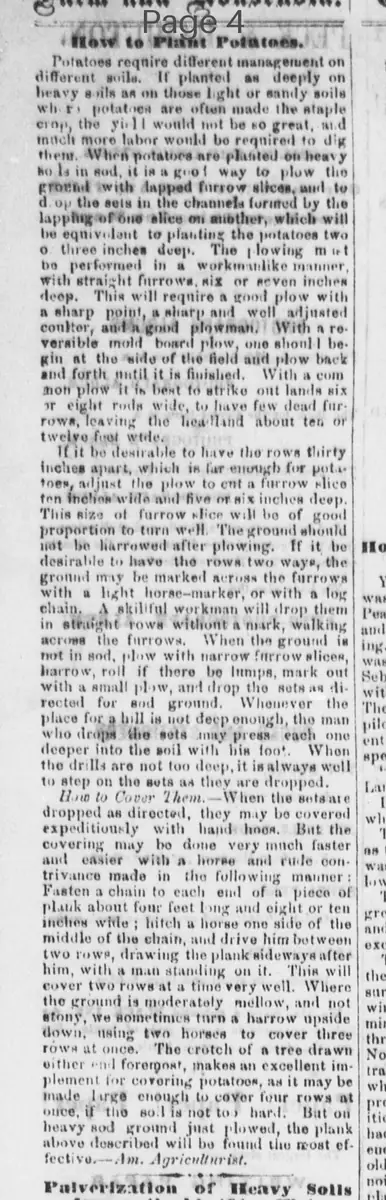
How to Plant Potatoes.
Potatoes require different management on different soils. If planted as deeply on heavy soils as on those light or sandy soils where potatoes are often made the staple crop, the yield would not be so great, and much more labor would be required to dig them. When potatoes are planted on heavy soils in sod, it is a good way to plow the ground with lapped furrow slices, and to drop the sets in the channels formed by the lapping of one slice on another, which will be equivalent to planting the potatoes two or three inches deep. The plowing must be performed in a workmanlike manner, with straight furrows, six or seven inches deep. This will require a good plow with a sharp point, a sharp and well adjusted coulter, and a good plowman. With a reversible mold board plow, one should begin at the side of the field and plow back and forth until it is finished. With a common plow it is best to strike out lands six or eight rods wide, to have few dead furrows, leaving the headland about ten or twelve feet wide.
If it be desirable to have the rows thirty inches apart, which is far enough for potatoes, adjust the plow to cut a furrow slice ten inches wide and five or six inches deep. This size of furrow slice will be of good proportion to turn well. The ground should not be harrowed after plowing. If it be desirable to have the rows two ways, the ground may be marked across the furrows with a light horse-marker, or with a log chain. A skillful workman will drop them in straight rows without a mark, walking across the furrows. When the ground is not in sod, plow with narrow furrow slices, harrow, roll if there be lumps, mark out with a small plow, and drop the sets as directed for sod ground. Whenever the place for a hill is not deep enough, the man who drops the sets may press each one deeper into the soil with his foot. When the drills are not too deep, it is always well to step on the sets as they are dropped.
How to Cover Them.—When the sets are dropped as directed, they may be covered expeditiously with hand hoes. But the covering may be done very much faster and easier with a horse and rude contrivance made in the following manner: Fasten a chain to each end of a piece of plank about four feet long and eight or ten inches wide; hitch a horse one side of the middle of the chain, and drive him between two rows, drawing the plank sideways after him, with a man standing on it. This will cover two rows at a time very well. Where the ground is moderately mellow, and not stony, we sometimes turn a harrow upside down, using two horses to cover three rows at once. The crotch of a tree drawn either end forerpost, makes an excellent implement for covering potatoes, as it may be made large enough to cover four rows at once, if the soil is not too hard. But on heavy sod ground just plowed, the plank above described will be found the most effective.—Am. Agriculturist.
Potatoes require different management on different soils. If planted as deeply on heavy soils as on those light or sandy soils where potatoes are often made the staple crop, the yield would not be so great, and much more labor would be required to dig them. When potatoes are planted on heavy soils in sod, it is a good way to plow the ground with lapped furrow slices, and to drop the sets in the channels formed by the lapping of one slice on another, which will be equivalent to planting the potatoes two or three inches deep. The plowing must be performed in a workmanlike manner, with straight furrows, six or seven inches deep. This will require a good plow with a sharp point, a sharp and well adjusted coulter, and a good plowman. With a reversible mold board plow, one should begin at the side of the field and plow back and forth until it is finished. With a common plow it is best to strike out lands six or eight rods wide, to have few dead furrows, leaving the headland about ten or twelve feet wide.
If it be desirable to have the rows thirty inches apart, which is far enough for potatoes, adjust the plow to cut a furrow slice ten inches wide and five or six inches deep. This size of furrow slice will be of good proportion to turn well. The ground should not be harrowed after plowing. If it be desirable to have the rows two ways, the ground may be marked across the furrows with a light horse-marker, or with a log chain. A skillful workman will drop them in straight rows without a mark, walking across the furrows. When the ground is not in sod, plow with narrow furrow slices, harrow, roll if there be lumps, mark out with a small plow, and drop the sets as directed for sod ground. Whenever the place for a hill is not deep enough, the man who drops the sets may press each one deeper into the soil with his foot. When the drills are not too deep, it is always well to step on the sets as they are dropped.
How to Cover Them.—When the sets are dropped as directed, they may be covered expeditiously with hand hoes. But the covering may be done very much faster and easier with a horse and rude contrivance made in the following manner: Fasten a chain to each end of a piece of plank about four feet long and eight or ten inches wide; hitch a horse one side of the middle of the chain, and drive him between two rows, drawing the plank sideways after him, with a man standing on it. This will cover two rows at a time very well. Where the ground is moderately mellow, and not stony, we sometimes turn a harrow upside down, using two horses to cover three rows at once. The crotch of a tree drawn either end forerpost, makes an excellent implement for covering potatoes, as it may be made large enough to cover four rows at once, if the soil is not too hard. But on heavy sod ground just plowed, the plank above described will be found the most effective.—Am. Agriculturist.
What sub-type of article is it?
Instructional Guide
Agricultural Advice
What keywords are associated?
Potato Planting
Soil Management
Plowing Techniques
Covering Methods
Agricultural Tools
Story Details
Story Details
Detailed guide on planting potatoes adapted to soil types, including plowing methods for sod and non-sod ground, dropping sets in rows, and covering with hoes or horse-drawn tools like planks or harrows.