Thank you for visiting SNEWPapers!
Sign up free
Washington Statesman
Walla Walla, Walla Walla County, Washington
What is this article about?
The remains of Christopher Columbus, who died in 1506, were relocated multiple times: from Valladolid to Seville in 1518, to San Domingo in 1536, and to Havana, Cuba in 1796 after Spain ceded Hispaniola to France. They are now to be moved to a new Havana cemetery.
Clipping
OCR Quality
Full Text
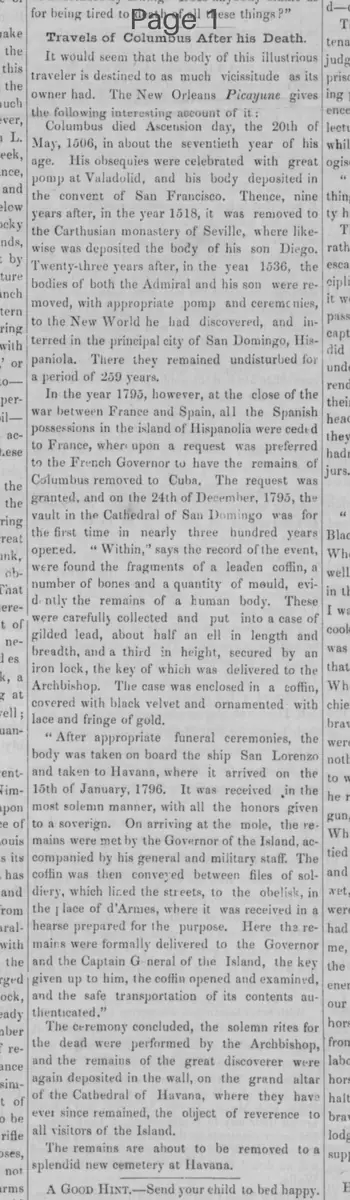
It would seem that the body of this illustrious traveler is destined to as much vicissitude as its owner had. The New Orleans Picayune gives the following interesting account of it :
Columbus died Ascension day, the 20th of May, 1506, in about the seventieth year of his age. His obsequies were celebrated with great pomp at Valladolid, and his body deposited in the convent of San Francisco. Thence, nine years after. in the year 1518. it was removed to the Carthusian monastery of Seville, where likewise was deposited the body of his son Diego.
Twenty-three years after, in the year 1536, the bodies of both the Admiral and his son were removed, with appropriate pomp and ceremonies, to the New World he had discovered. and interred in the principal city of San Domingo, Hispaniola. There they remained undisturbed for a period of 259 years.
In the year 1795. however, at the close of the war between France and Spain, all the Spanish possessions in the island of Hispaniola were ceded to France, where upon a request was preferred to the French Governor to have the remains of Columbus removed to Cuba. The request was granted, and on the 24th of December, 1795, the vault in the Cathedral of San Domingo was for the first time in nearly three hundred years opened. " Within," says the record of the event, were found the fragments of a leaden coffin, a number of bones and a quantity of mould, evidently the remains of a human body. These were carefully collected and put into a case of gilded lead, about half an ell in length and breadth, and a third in height, secured by an iron lock, the key of which was delivered to the Archbishop. The case was enclosed in a coffin, covered with black velvet and ornamented with lace and fringe of gold.
" After appropriate funeral ceremonies, the body was taken on board the ship San Lorenzo and taken to Havana, where it arrived on the 15th of January, 1796. It was received in the most solemn manner, with all the honors given to a sovereign. On arriving at the mole, the remains were met by the Governor of the Island, accompanied by his general and military staff. The coffin was then conveyed between files of soldiery, which lined the streets, to the obelisk, in the Place d'Armes, where it was received in a hearse prepared for the purpose. Here the remains were formally delivered to the Governor and the Captain General of the Island, the key given up to him, the coffin opened and examined, and the safe transportation of its contents authenticated."
The ceremony concluded, the solemn rites for the dead were performed by the Archbishop, and the remains of the great discoverer were again deposited in the wall, on the grand altar of the Cathedral of Havana, where they have ever since remained, the object of reverence to all visitors of the Island.
The remains are about to be removed to a splendid new cemetery at Havana.
What sub-type of article is it?
What themes does it cover?
What keywords are associated?
What entities or persons were involved?
Where did it happen?
Story Details
Key Persons
Location
Valladolid, Seville, San Domingo, Hispaniola, Havana, Cuba
Event Date
1506 05 20 To 1796 01 15, And Recent
Story Details
Columbus died in 1506 and his body was buried in Valladolid, then moved to Seville in 1518 with his son Diego, to San Domingo in 1536, and to Havana in 1796 after the cession of Hispaniola to France, with elaborate ceremonies; now to be removed to a new cemetery.