Thank you for visiting SNEWPapers!
Sign up free
Edgefield Advertiser
Edgefield, Edgefield County, South Carolina
What is this article about?
George Creel advocates for industrial courts like those created in France in 1806 and adopted by other European countries, praising their simple, efficient dispute resolution without lawyers, contrasting it with the costly American legal system that disadvantages the poor.
Clipping
OCR Quality
Full Text
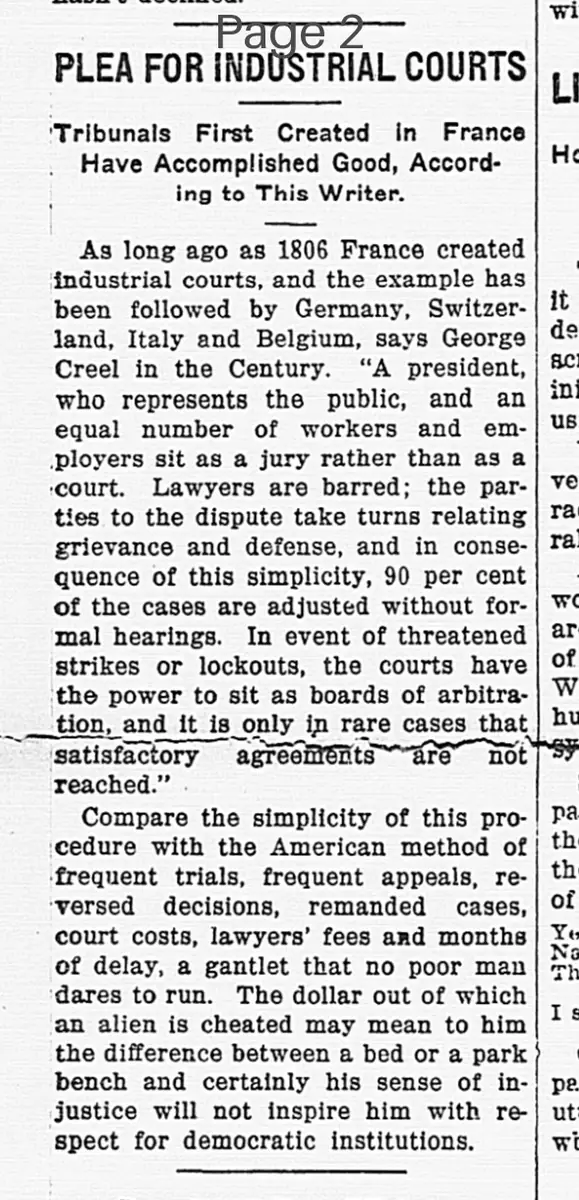
Tribunals First Created in France Have Accomplished Good, According to This Writer.
As long ago as 1806 France created industrial courts, and the example has been followed by Germany, Switzerland, Italy and Belgium, says George Creel in the Century. "A president, who represents the public, and an equal number of workers and employers sit as a jury rather than as a court. Lawyers are barred; the parties to the dispute take turns relating grievance and defense, and in consequence of this simplicity, 90 per cent of the cases are adjusted without formal hearings. In event of threatened strikes or lockouts, the courts have the power to sit as boards of arbitration, and it is only in rare cases that satisfactory agreements are not reached."
Compare the simplicity of this procedure with the American method of frequent trials, frequent appeals, reversed decisions, remanded cases, court costs, lawyers' fees and months of delay, a gantlet that no poor man dares to run. The dollar out of which an alien is cheated may mean to him the difference between a bed or a park bench and certainly his sense of injustice will not inspire him with respect for democratic institutions.
What sub-type of article is it?
What themes does it cover?
What keywords are associated?
What entities or persons were involved?
Where did it happen?
Story Details
Key Persons
Location
France, Germany, Switzerland, Italy, Belgium
Event Date
1806
Story Details
France created industrial courts in 1806, followed by other European nations; these courts feature a public president and equal workers and employers as jury, bar lawyers, allow simple grievance presentations, resolve 90% of cases without hearings, and arbitrate strikes or lockouts effectively; contrasted with complex, costly American legal delays that disadvantage the poor and immigrants.