Thank you for visiting SNEWPapers!
Sign up free
The New England Weekly Review
Hartford, Hartford County, Connecticut
What is this article about?
Students at Yale College protested poor food quality in the commons during the summer, leading to four expulsions and 134 voluntarily leaving the institution. The faculty's firm stance is praised, and a wealthy donor pledged annual support equivalent to 100 students' expenses.
Clipping
OCR Quality
Full Text
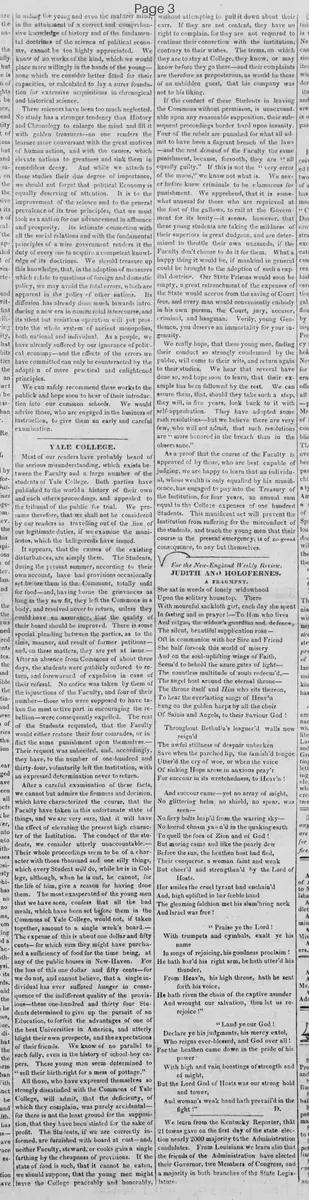
Most of our readers have probably heard of the serious misunderstanding, which exists between the Faculty and a large number of the students of Yale College. Both parties have published to the world a history of their own and each others proceedings, and appealed to the tribunal of the public for trial. We presume therefore, that we shall not be considered by our readers as travelling out of the line of our legitimate duties, if we examine the manifestos, which the belligerents have issued.
It appears, that the causes of the existing disturbances, are simply these. The Students, during the present summer, according to their own account, have had provisions occasionally set before them in the Commons, totally unfit for food—and, having borne the grievances as long as they saw fit, they left the Commons in a body, and resolved never to return, unless they could have an assurance, that the quality of their board should be improved. There is some special pleading between the parties, as to the time, manner, and result of former petitions—and, on these matters, they are yet at issue.—After an absence from Commons of about three days, the students were publicly ordered to return, and forewarned of expulsion in case of their refusal. No notice was taken by them of the injunctions of the Faculty, and four of their number—those who were supposed to have taken the most active part in encouraging the rebellion—were consequently expelled. The rest of the Students requested, that the Faculty would either restore their four comrades, or inflict the same punishment upon themselves.—Their request was unheeded, and, accordingly, they have, to the number of one-hundred and thirty-four, voluntarily left the Institution, with an expressed determination never to return.
After a careful examination of these facts, we cannot but admire the firmness and decision which have characterized the course, that the Faculty have taken in this unfortunate state of things, and we are very sure, that it will have the effect of elevating the present high character of the Institution. The conduct of the students, we consider utterly unaccountable.—Their whole proceedings seem to be of a character with those thousand and one silly things, which every Student will do, while he is in College, although, when he is out, he cannot, for the life of him, give a reason for having done them. The most exasperated of the young men that we have seen, confess that all the bad meals, which have been set before them in the Commons of Yale College, would not, if taken together, amount to a single week's board.—The expense of this is about one dollar and fifty cents—for which sum they might have purchased a sufficiency of food for the time being, at any of the public houses in New-Haven. For the loss of this one dollar and fifty cents—for we do not, and cannot believe, that a single individual has ever suffered hunger in consequence of the indifferent quality of the provisions—these one-hundred and thirty four Students determined to give up the pursuit of an Education, to forfeit the advantages of one of the best Universities in America, and utterly blight their own prospects, and the expectations of their friends. We know of no parallel to such folly, even in the history of school-boy capers. These young men seem determined to "sell their birth-right for a mess of pottage."
All those, who have expressed themselves so strongly dissatisfied with the Commons of Yale College, will admit, that the deficiency, of which they complain, was purely accidental—for there is not the least ground for the supposition, that they have been stinted for the sake of profit. The Students, if we are correctly informed, are furnished with board at cost—and, neither Faculty, steward, or cooks gain a single farthing by the cheapness of provisions. If the state of food is such, that it cannot be eaten, we should suppose, that the young men might leave the College peaceably and honorably, without attempting to pull it down about their ears. If they are not content, they have no right to complain, for they are not required to continue their connection with the institution, contrary to their wishes. The terms, on which they are to stay at College, they know, or may know before they go there—and their complaints are therefore as preposterous, as would be those of an unbidden guest, that his company was not to his liking.
If the conduct of these Students in leaving the Commons without permission, is unaccountable upon any reasonable supposition, their subsequent proceedings border hard upon insanity. Four of the rebels are punished for what all admit to have been a flagrant breach of the laws—and the rest demand of the Faculty the same punishment, because, forsooth, they are "all equally guilty." If this is not the "very error of the moon," we know not what is. We never before knew criminals to be clamorous for punishment. We apprehend, that it is somewhat unusual for those who are reprieved at the foot of the gallows, to rail at the Government for its lenity—it seems, however, that these young students are taking the mildness of their superiors in great dudgeon, and are determined to throttle their own weasands, if the Faculty don't choose to do it for them. What a happy thing it would be, if mankind in general could be brought to the adoption of such a capital doctrine. Our State Prisons would soon be empty, a great retrenchment of the expenses of the State would accrue from the saving of Court fees, and every man would conveniently embody in his own person, the Court, jury, accuser, criminal, and hangman. Verily, young Gentlemen, you deserve an immortality for your ingenuity.
We really hope, that these young men, finding their conduct so strongly condemned by the public, will come to their wits, and return again to their studies. We hear that several have done so, and hope soon to learn, that their example has been followed by the rest. We can assure them, that, should they take such a step, they will, in five years, look back to it with self-approbation. They have adopted some rash resolutions—but we believe there are very few, who will not admit, that such resolutions are "more honored in the breach than in the observance."
As a proof that the course of the Faculty is approved of by those, who are best capable of judging, we are happy to learn that an individual, whose wealth is only equalled by his munificence, has engaged to pay into the Treasury of the Institution, for four years, an annual sum equal to the College expenses of one hundred Students. This munificent act will prevent the Institution from suffering for the misconduct of the students, and teach the young men that their course in the present emergency, is of no great consequence, to any but themselves.
What sub-type of article is it?
What keywords are associated?
Where did it happen?
Domestic News Details
Primary Location
Yale College, New Haven
Event Date
Present Summer
Outcome
four students expelled; 134 students voluntarily left the institution; several have returned; anonymous donor pledged annual support equal to expenses for 100 students for four years.
Event Details
Students protested unfit provisions in the college commons, left en masse, ignored faculty orders to return, leading to expulsion of four leaders and voluntary departure of the rest demanding equal punishment. The article criticizes the students' actions as foolish and praises the faculty's firmness.