Thank you for visiting SNEWPapers!
Sign up free
The Tribune
Roanoke, Virginia
What is this article about?
Howard Whitman's article investigates racial segregation in U.S. churches, citing examples of discrimination against African Americans, low integration statistics from 1948-1950s surveys, church leaders' calls for reform, and the need for youth-led change to align with Christian principles and bolster global democracy.
Merged-components note: Merged image into the 'Shame of Sunday Morning' story as it is spatially adjacent and likely an illustrative photo.
Clipping
OCR Quality
Full Text
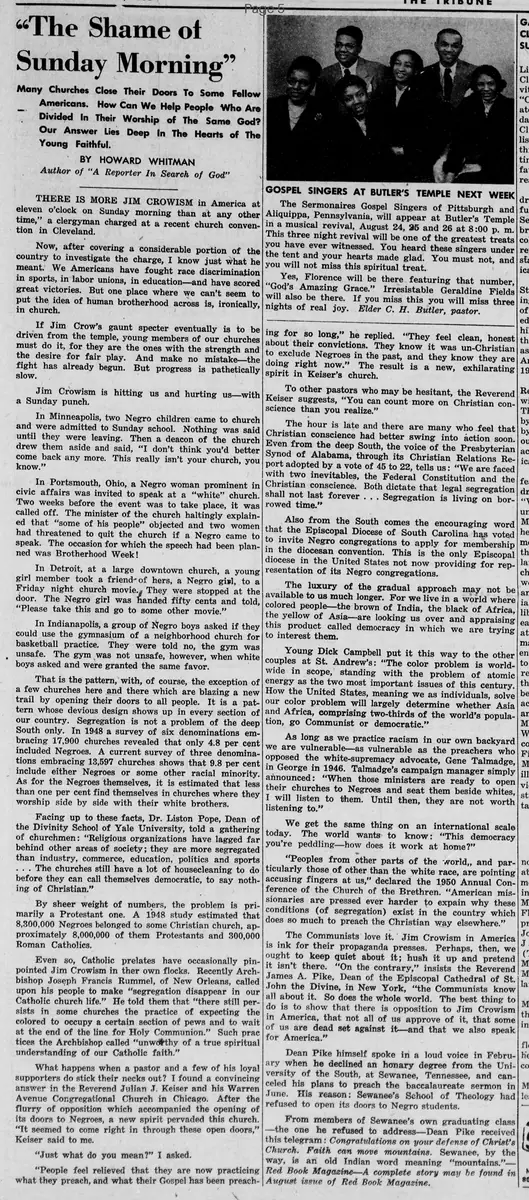
Many Churches Close Their Doors To Some Fellow Americans. How Can We Help People Who Are Divided In Their Worship of The Same God?
Our Answer Lies Deep In The Hearts of The Young Faithful.
BY HOWARD WHITMAN
Author of "A Reporter In Search of God"
THERE IS MORE JIM CROWISM in America at eleven o'clock on Sunday morning than at any other time," a clergyman charged at a recent church convention in Cleveland.
Now, after covering a considerable portion of the country to investigate the charge, I know just what he meant. We Americans have fought race discrimination in sports, in labor unions, in education-and have scored great victories. But one place where we can't seem to put the idea of human brotherhood across is, ironically, in church.
If Jim Crow's gaunt specter eventually is to be driven from the temple, young members of our churches must do it, for they are the ones with the strength and the desire for fair play. And make no mistake the fight has already begun. But progress is pathetically slow.
Jim Crowism is hitting us and hurting us -with a Sunday punch.
In Minneapolis, two Negro children came to church and were admitted to Sunday school. Nothing was said until they were leaving. Then a deacon of the church drew them aside and said. "I don't think you'd better come back any more. This really isn't your church, you know."
In Portsmouth, Ohio, a Negro woman prominent in civic affairs was invited to speak at a "white" church. Two weeks before the event was to take place, it was called off. The minister of the church haltingly explained that "some of his people" objected and two women had threatened to quit the church if a Negro came to speak. The occasion for which the speech had been planned was Brotherhood Week!
In Detroit, at a large downtown church, a young girl member took a friend-of hers, a Negro girl, to a Friday night church movie. They were stopped at the door. The Negro girl was handed fifty cents and told, "Please take this and go to some other movie."
In Indianapolis, a group of Negro boys asked if they could use the gymnasium of a neighborhood church for basketball practice. They were told no, the gym was unsafe. The gym was not unsafe, however, when white boys asked and were granted the same favor.
That is the pattern, with, of course, the exception of a few churches here and there which are blazing a new trail by opening their doors to all people. It is a pattern whose devious design shows up in every section of our country. Segregation is not a problem of the deep South only. In 1948 a survey of six denominations embracing 17,900 churches revealed that only 4.8 per cent included Negroes. A current survey of three denominations embracing 13,597 churches shows that 9.8 per cent include either Negroes or some other racial minority.
As for the Negroes themselves, it is estimated that less than one per cent find themselves in churches where they worship side by side with their white brothers.
Facing up to these facts, Dr. Liston Pope, Dean of the Divinity School of Yale University, told a gathering of churchmen: "Religious organizations have lagged far behind other areas of society; they are more segregated than industry, commerce, education, politics and sports . . . The churches still have a lot of housecleaning to do before they can call themselves democratic, to say nothing of Christian."
By sheer weight of numbers, the problem is primarily a Protestant one. A 1948 study estimated that 8,300,000 Negroes belonged to some Christian church, approximately 8,000,000 of them Protestants and 300,000 Roman Catholics.
Even so, Catholic prelates have occasionally pinpointed Jim Crowism in their own flocks. Recently Archbishop Joseph Francis Rummel, of New Orleans, called upon his people to make "segregation disappear in our Catholic church life." He told them that "there still persists in some churches the practice of expecting the colored to occupy a certain section of pews and to wait at the end of the line for Holy Communion." Such practices the Archbishop called "unworthy of a true spiritual understanding of our Catholic faith."
What happens when a pastor and a few of his loyal supporters do stick their necks out? I found a convincing answer in the Reverend Julian J. Keiser and his Warren Avenue Congregational Church in Chicago. After the flurry of opposition which accompanied the opening of its doors to Negroes, a new spirit pervaded this church.
"It seemed to come right in through these open doors," Keiser said to me.
"Just what do you mean?" I asked.
"People feel relieved that they are now practicing what they preach, and what their Gospel has been preaching for so long," he replied. "They feel clean, honest about their convictions. They know it was un-Christian to exclude Negroes in the past, and they know they are doing right now." The result is a new, exhilarating spirit in Keiser's church.
To other pastors who may be hesitant, the Reverend Keiser suggests, "You can count more on Christian conscience than you realize."
The hour is late and there are many who feel that Christian conscience had better swing into action soon.
Even from the deep South, the voice of the Presbyterian Synod of Alabama, through its Christian Relations Report adopted by a vote of 45 to 22, tells us: "We are faced with two inevitables, the Federal Constitution and the Christian conscience. Both dictate that legal segregation shall not last forever . . . Segregation is living on borrowed time."
Also from the South comes the encouraging word that the Episcopal Diocese of South Carolina has voted to invite Negro congregations to apply for membership in the diocesan convention. This is the only Episcopal diocese in the United States not now providing for representation of its Negro congregations.
The luxury of the gradual approach may not be available to us much longer. For we live in a world where colored people--the brown of India, the black of Africa, the yellow of Asia-are looking us over and appraising this product called democracy in which we are trying to interest them.
Young Dick Campbell put it this way to the other couples at St. Andrew's: "The color problem is world-wide in scope, standing with the problem of atomic energy as the two most important issues of this century.
How the United States, meaning we as individuals, solve our color problem will largely determine whether Asia and Africa, comprising two-thirds of the world's population, go Communist or democratic."
As long as we practice racism in our own backyard we are vulnerable as vulnerable as the preachers who opposed the white-supremacy advocate, Gene Talmadge, in Georgia in 1946. Talmadge's campaign manager simply announced: "When those ministers are ready to open their churches to Negroes and seat them beside whites, I will listen to them. Until then, they are not worth listening to."
We get the same thing on an international scale today. The world wants to know: "This democracy you're peddling--how does it work at home?"
"Peoples from other parts of the world, and particularly those of other than the white race, are pointing accusing fingers at us." declared the 1950 Annual Conference of the Church of the Brethren. "American missionaries are pressed ever harder to explain why these conditions (of segregation) exist in the country which does so much to preach the Christian way elsewhere."
The Communists love it. Jim Crowism in America is ink for their propaganda presses. Perhaps, then, we ought to keep quiet about it; hush it up and pretend it isn't there. "On the contrary," insists the Reverend James A. Pike, Dean of the Episcopal Cathedral of St. John the Divine, in New York. "the Communists know all about it. So does the whole world. The best thing to do is to show that there is opposition to Jim Crowism in America, that not all of us approve of it, that some of us are dead set against it-and that we also speak for America."
Dean Pike himself spoke in a loud voice in February when he declined an honorary degree from the University of the South, at Sewanee, Tennessee, and canceled his plans to preach the baccalaureate sermon in June. His reason: Sewanee's School of Theology had refused to open its doors to Negro students.
From members of Sewanee's own graduating class -the one he refused to address-Dean Pike received this telegram: Congratulations on your defense of Christ's Church. Faith can move mountains. Sewanee, by the way, is an old Indian word meaning "mountains."
Red Book Magazine—A complete story may be found in August issue of Red Book Magazine.
What sub-type of article is it?
What themes does it cover?
What keywords are associated?
What entities or persons were involved?
Where did it happen?
Story Details
Key Persons
Location
United States (Various Cities Including Minneapolis, Portsmouth Ohio, Detroit, Indianapolis, Chicago, New Orleans, South Carolina)
Event Date
1948 1950s
Story Details
Investigative report on racial segregation in American churches, with anecdotes of discrimination against African Americans in Protestant and Catholic congregations, surveys showing low integration rates, calls for change by church leaders, and examples of progress in some churches emphasizing Christian conscience and global implications for democracy.