Thank you for visiting SNEWPapers!
Sign up free
Story
February 28, 1820
Daily National Intelligencer
Washington, District Of Columbia
What is this article about?
In a congressional speech, Mr. Cooke urges adoption of a resolution offering unpaid soldiers certificates for lands near settlements rather than remote bounties, to counter speculator exploitation and ensure fair reward for their service, saving government land while aiding veterans.
Clipping
OCR Quality
98%
Excellent
Full Text
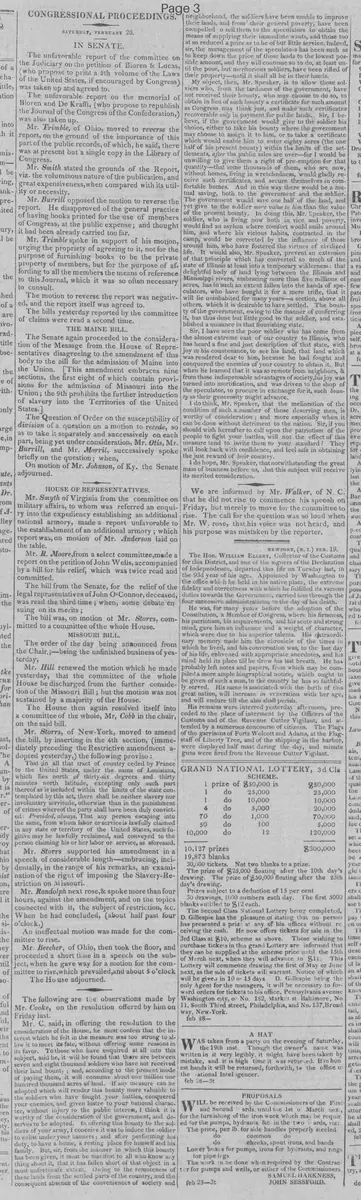
The following are the observations made by Mr. Cooke, on the resolution offered by him on Friday last.
Mr. C. said, in offering the resolution to the consideration of the House, he must confess that the interest which he felt in the measure was too strong to allow it to meet its fate, without offering some reasons in its favor. To those who have enquired at all into this subject, said he, it will be found that there are between seven and eight thousand soldiers who have not received their land bounty; and, according to the present mode of paying them, it will consume about one million one hundred thousand acres of land. If any measure can be adopted which will render this bounty more valuable to the soldiers who have fought your battles, conquered your enemies, and given lustre to your national character, without injury to the public interest, I think it is worthy of the consideration of the government, and deserves to be adopted. In offering this bounty to the soldiers of your army, I conceive it was to induce the soldier to enlist under your banners; and after performing his duty, to have a home, a resting place for himself and his family. But, sir, from the manner in which this bounty has been given, it must be manifest to all who know any thing about it, that it has fallen short of that object in a most unfortunate extent. Owing to the remoteness of these lands from the settled parts of the country, and the consequent absence of the conveniences of society and neighborhood, the soldiers have been unable to improve their lands, and from their general poverty, have been compelled to sell them to the speculators to obtain the means of supplying their immediate wants, and those too at so reduced a price as to be of but little service. Indeed, sir, the management of the speculators has been such as to keep down the price of those lands to the lowest possible amount, and they will continue so to do, at least until the poor, but meritorious soldiers, have been rifled of their property—until it shall all be in their hands.
My object, then, Mr. Speaker, is to allow those soldiers who, from the tardiness of the government, have not received their bounty, who may choose to do so, to obtain in lieu of such bounty a certificate for such amount as Congress may think just, and make such certificates recoverable only in payment for public lands. Sir, I believe, if the government would give to the soldier his choice, either to take his bounty where the government may choose to assign it to him, or to take a certificate which would enable him to enter eighty acres (the one half of his present bounty) within the limits of the settlements, after the public sales are over—for I would be unwilling to give them a right of pre-emption for that quantity—that some thousands of them, who are now, without homes, living in wretchedness, would gladly receive such certificates, and secure themselves in comfortable homes. And in this way there would be a mutual saving, both to the government and the soldier The government would save one half of the land, and yet give to the soldier more value to him than the value of the present bounty. In doing this, Mr. Speaker, the soldier, who is living now both in vice and poverty, would find an asylum where comfort would smile around him, and where his vicious habits, contracted in the camp, would be corrected by the influence of those around him, who have fostered the virtues of civilized life. It would also, Mr. Speaker, prevent an extension of that principle which has converted so much of the state of Illinois at least into a temporary wilderness: that delightful body of land lying between the Illinois and Mississippi rivers, embracing more than five millions of acres, has to such an extent fallen into the hands of speculators, who have bought it for a mere trifle, that it will lie uninhabited for many years—a section, above all others, which it is desirable to have settled. The bounty of the government, owing to the manner of conferring it, has thus done but little good to the soldier, and established a nuisance in that flourishing state.
Sir, I have seen the poor soldier who has come from the almost extreme east of our country to Illinois, who has heard a fine and just description of that state, with joy in his countenance, to see his land, that land which was rendered dear to him, because he had fought and conquered the enemies of your country to obtain it. But when he learned that it was so remote from neighbors, & from those indispensable advantages of society, his joy was turned into mortification, and was driven to the shop of the speculator, to procure in exchange for it, such bounty as their generosity might advance.
I do think, Mr. Speaker, that the melioration of the condition of such a number of those deserving men, is worthy of consideration; and more especially when it can be done without detriment to the nation. Sir, if you should wish hereafter to call upon the patriotism of the people to fight your battles, will not the effect of this measure tend to invite them to your standard? They will look back with confidence, and feel safe in obtaining the just reward of their country.
I do hope, Mr. Speaker, that notwithstanding the great mass of business before us, that this subject will receive its merited consideration.
Mr. C. said, in offering the resolution to the consideration of the House, he must confess that the interest which he felt in the measure was too strong to allow it to meet its fate, without offering some reasons in its favor. To those who have enquired at all into this subject, said he, it will be found that there are between seven and eight thousand soldiers who have not received their land bounty; and, according to the present mode of paying them, it will consume about one million one hundred thousand acres of land. If any measure can be adopted which will render this bounty more valuable to the soldiers who have fought your battles, conquered your enemies, and given lustre to your national character, without injury to the public interest, I think it is worthy of the consideration of the government, and deserves to be adopted. In offering this bounty to the soldiers of your army, I conceive it was to induce the soldier to enlist under your banners; and after performing his duty, to have a home, a resting place for himself and his family. But, sir, from the manner in which this bounty has been given, it must be manifest to all who know any thing about it, that it has fallen short of that object in a most unfortunate extent. Owing to the remoteness of these lands from the settled parts of the country, and the consequent absence of the conveniences of society and neighborhood, the soldiers have been unable to improve their lands, and from their general poverty, have been compelled to sell them to the speculators to obtain the means of supplying their immediate wants, and those too at so reduced a price as to be of but little service. Indeed, sir, the management of the speculators has been such as to keep down the price of those lands to the lowest possible amount, and they will continue so to do, at least until the poor, but meritorious soldiers, have been rifled of their property—until it shall all be in their hands.
My object, then, Mr. Speaker, is to allow those soldiers who, from the tardiness of the government, have not received their bounty, who may choose to do so, to obtain in lieu of such bounty a certificate for such amount as Congress may think just, and make such certificates recoverable only in payment for public lands. Sir, I believe, if the government would give to the soldier his choice, either to take his bounty where the government may choose to assign it to him, or to take a certificate which would enable him to enter eighty acres (the one half of his present bounty) within the limits of the settlements, after the public sales are over—for I would be unwilling to give them a right of pre-emption for that quantity—that some thousands of them, who are now, without homes, living in wretchedness, would gladly receive such certificates, and secure themselves in comfortable homes. And in this way there would be a mutual saving, both to the government and the soldier The government would save one half of the land, and yet give to the soldier more value to him than the value of the present bounty. In doing this, Mr. Speaker, the soldier, who is living now both in vice and poverty, would find an asylum where comfort would smile around him, and where his vicious habits, contracted in the camp, would be corrected by the influence of those around him, who have fostered the virtues of civilized life. It would also, Mr. Speaker, prevent an extension of that principle which has converted so much of the state of Illinois at least into a temporary wilderness: that delightful body of land lying between the Illinois and Mississippi rivers, embracing more than five millions of acres, has to such an extent fallen into the hands of speculators, who have bought it for a mere trifle, that it will lie uninhabited for many years—a section, above all others, which it is desirable to have settled. The bounty of the government, owing to the manner of conferring it, has thus done but little good to the soldier, and established a nuisance in that flourishing state.
Sir, I have seen the poor soldier who has come from the almost extreme east of our country to Illinois, who has heard a fine and just description of that state, with joy in his countenance, to see his land, that land which was rendered dear to him, because he had fought and conquered the enemies of your country to obtain it. But when he learned that it was so remote from neighbors, & from those indispensable advantages of society, his joy was turned into mortification, and was driven to the shop of the speculator, to procure in exchange for it, such bounty as their generosity might advance.
I do think, Mr. Speaker, that the melioration of the condition of such a number of those deserving men, is worthy of consideration; and more especially when it can be done without detriment to the nation. Sir, if you should wish hereafter to call upon the patriotism of the people to fight your battles, will not the effect of this measure tend to invite them to your standard? They will look back with confidence, and feel safe in obtaining the just reward of their country.
I do hope, Mr. Speaker, that notwithstanding the great mass of business before us, that this subject will receive its merited consideration.
What sub-type of article is it?
Historical Event
What themes does it cover?
Justice
Misfortune
Bravery Heroism
What keywords are associated?
Soldiers Bounty
Land Speculators
Public Lands
Veterans Welfare
Congressional Resolution
What entities or persons were involved?
Mr. Cooke
Where did it happen?
Illinois
Story Details
Key Persons
Mr. Cooke
Location
Illinois
Story Details
Mr. Cooke defends a resolution to allow unpaid soldiers to receive certificates redeemable for public lands near settlements instead of remote bounties, arguing it would provide greater value, prevent exploitation by speculators, and benefit both soldiers and the government.