Thank you for visiting SNEWPapers!
Sign up free
Literary
April 17, 1772
The New Hampshire Gazette And Historical Chronicle
Portsmouth, Greenland, Rockingham County, New Hampshire
What is this article about?
Excerpt from the novel 'The Fool of Quality' featuring a dialogue between Mr. Fenton and Mr. Fielding critiquing the English legal system's handling of property disputes, highlighting endless litigation, lawyers' profits, and the superiority of simple arbitration. Includes an anecdote about a farmer's futile 13-year lawsuit.
Clipping
OCR Quality
95%
Excellent
Full Text
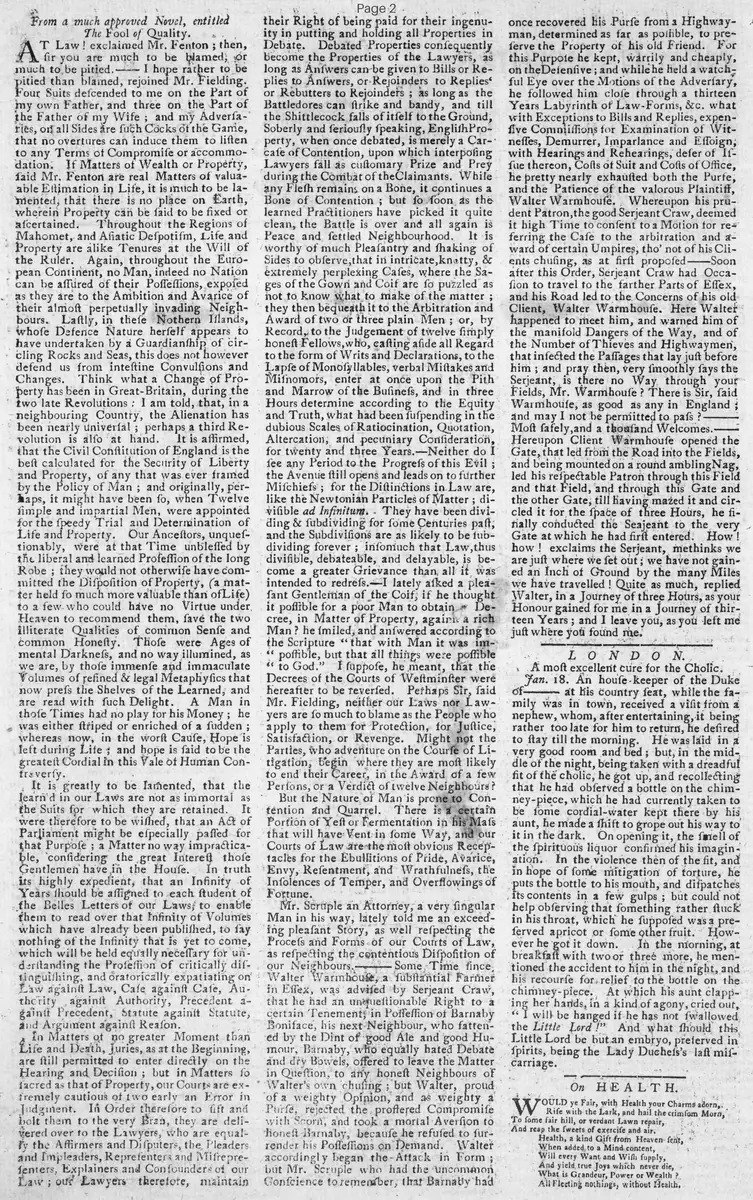
From a much approved Novel, entitled
The Fool of Quality.
"The Law!" exclaimed Mr. Fenton; "then,
sir, you are much to be blamed; or
much to be pitied."
"I hope rather to be
pitied than blamed," rejoined Mr. Fielding.
"Four Suits descended to me on the Part of
my own Father, and three on the Part of
the Father of my Wife: and my Adversaries,
on all Sides are such Cocks of the Game,
that no overtures can induce them to listen
to any Terms of Compromise or accommodation: If Matters of Wealth or Property,
said Mr. Fenton, are real Matters of valuable Estimation in Life, it is much to be lamented; that there is no place on Earth,
wherein Property can be said to be fixed or
ascertained. Throughout the Regions of
Mahomet, and Asiatic Despotism, Life and
Property are alike Tenures at the Will of
the Ruler. Again, throughout the European Continent, no Man, indeed no Nation
can be assured of their Possessions, exposed
as they are to the Ambition and Avarice of
their almost perpetually invading Neighbours. Lastly, in these Northern Islands.
whose Defence Nature herself appears to
have undertaken by a Guardianship of circling Rocks and Seas, this does not however
defend us from intestine Convulsions and
Changes. Think what a Change of Property has been in Great-Britain, during the
two late Revolutions: I am told, that, in a
neighbouring Country, the Alienation has
been nearly universal; perhaps a third Revolution is also at hand. It is affirmed,
that the Civil Constitution of England is the
best calculated for the Security of Liberty
and Property, of any that was ever framed
by the Policy of Man; and originally, perhaps, it might have been so, when Twelve
simple and impartial Men, were appointed
for the speedy Trial and Determination of
Life and Property. Our Ancestors, unquestionably, were at that Time unblessed by
the liberal and learned Profession of the long
Robe: they would not otherwise have committed the Disposition of Property, (a matter held so much more valuable than of Life)
to a few who could have no Virtue under
Heaven to recommend them, save the two
illiterate Qualities of common Sense and
common Honesty. Those were Ages of
mental Darkness, and no way illumined, as
we are, by those immense and immaculate
Volumes of refined & legal Metaphysics that
now press the Shelves of the Learned; and
are read with such Delight. A Man in
those Times had no play for his Money; he
was either stripped or enriched of a sudden;
whereas now, in the worst Cause, Hope is
left during Life: and hope is said to be the
greatest Cordial in this Vale of Human Controversy.
It is greatly to be lamented, that the
Learned in our Laws are not as immortal as
the Suits for which they are retained. It
were therefore to be wished, that an Act of
Parliament might be especially passed for
that Purpose; a Matter no way impracticable, considering the great Interest those
Gentlemen have in the House. In truth
its highly expedient, that an Infinity of
Years should be assigned to each student of
the Belles Letters of our Laws to enable
them to read over that Infinity of Volumes
which have already been published, to say
nothing of the Infinity that is yet to come.
which will be held equally necessary for understanding the Profession of critically distinguishing, and oratorically expatiating on
Law against Law, Case against Case, Authority against Authority, Precedent against Precedent, Statute against Statute,
and Argument against Reason.
In Matters of no greater Moment than
Life and Death, Juries, as at the Beginning,
are still permitted to enter directly on the
Hearing and Decision; but in Matters o
sacred as that of Property, our Courts are extremely cautious of too early an Error in
Judgment. In Order therefore to sift and
bolt them to the very Bran, they are delivered over to the Lawyers, who are equally the Affirmers and Disputers, the Pleaders
and Impleaders, Representers and Misrepresenters, Explainers and Confounders of our
Law; our Lawyers therefore, maintain
their Right of being paid for their ingenuity in putting and holding all Properties in
Debate. Debated Properties consequently
become the Properties of the Lawyers, as
long as Answers can be given to Bills or Replies to Answers, Or-Rejoinders to Replies
or Rebutters to Rejoinders; as long as the
Battledores can strike and bandy, and till
the Shuttlecock falls of itself to the Ground.
Soberly and seriously speaking, English Property, when once debated, is merely a Carcass of Contention, upon which interposing
Lawyers fall as customary Prize and Prey
during the Combat of the Claimants. While
any Flesh remains on a Bone, it continues a
Bone of Contention; but so soon as the
learned Practitioners have picked it quite
clean, the Battle is over and all again is
Peace and settled Neighbourhood. It is
worthy of much Pleasantness and shaking of
Sides to observe, that in intricate, knotty, &
extremely perplexing Cases, where the Sages of the Gown and Coif are so puzzled as
not to know what to make of the matter;
they then bequeath it to the Arbitration and
Award of two or three plain Men; or, by
Record, to the Judgement of twelve simply
honest Fellows, who, casting aside all Regard
to the form of Writs and Declarations, to the
Lapse of Monosyllables, verbal Mistakes and
Misnomers, enter at once upon the Pith
and Marrow of the Business, and in three
Hours determine according to the Equity
and Truth, what had been suspending in the
dubious Scales of Ratiocination, Quotation,
Altercation; and pecuniary Consideration,
for twenty and three Years.--Neither do I
see any Period to the Progress of this Evil;
the Avenue still opens and leads on to further
Mischiefs; for the Distinctions in Law are.
like the Newtonian Particles of Matter; divisible ad Infinitum. They have been dividing & subdividing for some Centuries past.
and the Subdivisions are as likely to be subdividing forever; insomuch that Law thus
divisible, debateable, and delayable, is become a greater Grievance than all it was
intended to redress. I lately asked a pleasant Gentleman of the Coif, if he thought
it possible for a poor Man to obtain Decree, in Matter of Property, against a rich
Man? he smiled, and answered according to
the Scripture "that with Man it was impossible, but that all things were possible
"to God." I suppose, he meant, that the
Decrees of the Courts of Westminster were
hereafter to be revered. Perhaps Sir, said
Mr. Fielding, neither our Laws nor Lawyers are so much to blame as the People who
apply to them for Protection, for Justice.
Satisfaction, or Revenge. Might not the
Parties, who adventure on the Course of Litigation, begin where they are most likely
to end their Career, in the Award of a few
Persons, Or a Verdict of twelve Neighbours?
But the Nature of Man is prone to Contention and Quarrel. There is a certain
Portion of Yeast or Fermentation in his Mass
that will have Vent in some Way, and our
Courts of Law are the most obvious Receptacles for the Ebullitions of Pride, Avarice.
Envy, Resentment, and Wrathfulness, the
Insolences of Temper, and Overflowings of
Fortune.
Mr. Scruple an Attorney; a very singular
Man in his way, lately told me an exceeding pleasant Story, as well respecting the
Process and Forms of our Courts of Law,
as respecting the contentious Disposition of
our Neighbours.--Some Time since.
Walter Warmhouse, a substantial Farmer
in Essex, was advised by Serjeant Craw,
that he had an unquestionable Right to a
certain Tenement, in Possession of Barnaby
Boniface, his next Neighbour, who fattened
by the Dint of good Ale and good Humour, Barnaby, who equally hated Debate
and dry Bowels, offered to leave the Matter
in Question, to any honest Neighbours of
Walter's own choosing; but Walter, proud
of a weighty Opinion, and as weighty a
Purse, rejected the proffered Compromise
with Scorn, and took a mortal Aversion to
honest Barnaby, because he refused to surrender his Possessions on Demand. Walter
accordingly began the Attack in Form:
but Mr. Scruple who had the uncommon
Conscience to remember, that Barnaby had
once recovered his Purse from a Highwayman, determined as far as possible, to preserve the Property of his old Friend. For
this Purpose he kept, warily and cheaply,
on the Defensive; and while he held a watchful Eye over the Motions of the Adversary.
he followed him close through a thirteen
Years Labyrinth of Law-Forms, &c. what
with Exceptions to Bills and Replies, expensive Commissions for Examination of Witnesses, Demurrer, Imparlance and Ejoign;
with Hearings and Rehearings, defer of Issue thereon, Costs of Suit and Costs of Office,
he pretty nearly exhausted both the Purse;
and the Patience of the valorous Plaintiff,
Walter Warmhouse. Whereupon his prudent Patron, the good Serjeant Craw, deemed
it high Time to consent to a Motion for referring the Case to the arbitration and award of certain Umpires, tho' not of his Client's choosing, as at first proposed--Soon
after this Order, Serjeant Craw had Occasion to travel to the farther Parts of Essex.
and his Road led to the Concerns of his old
Client, Walter Warmhouse. Here Walter
happened to meet him, and warned him of
the manifold Dangers of the Way, and of
the Number of Thieves and Highwaymen,
that infested the Passages that lay just before
him; and pray then, very smoothly says the
Serjeant, is there no Way through your
Fields, Mr. Warmhouse? There is Sir, said
Warmhouse, as good as any in England;
and may I not be permitted to pass?-
Most safely, and a thousand Welcomes.-
Hereupon Client Warmhouse opened the
Gate, that led from the Road into the Fields.
and being mounted on a round ambling Nag,
led his respectable Patron through this Field
and that Field, and through this Gate and
the other Gate: till having mazed it and circled it for the space of three Hours, he finally conducted the Serjeant to the very
Gate at which he had first entered. How!
how! exclaims the Serjeant, methinks we
are just where we set out; we have not gained an Inch of Ground by the many Miles
we have travelled! Quite as much, replied
Walter, in a Journey of three Hours, as your
Honour gained for me in a Journey of thirteen Years; and I leave you, as you left me
just where you found me.
The Fool of Quality.
"The Law!" exclaimed Mr. Fenton; "then,
sir, you are much to be blamed; or
much to be pitied."
"I hope rather to be
pitied than blamed," rejoined Mr. Fielding.
"Four Suits descended to me on the Part of
my own Father, and three on the Part of
the Father of my Wife: and my Adversaries,
on all Sides are such Cocks of the Game,
that no overtures can induce them to listen
to any Terms of Compromise or accommodation: If Matters of Wealth or Property,
said Mr. Fenton, are real Matters of valuable Estimation in Life, it is much to be lamented; that there is no place on Earth,
wherein Property can be said to be fixed or
ascertained. Throughout the Regions of
Mahomet, and Asiatic Despotism, Life and
Property are alike Tenures at the Will of
the Ruler. Again, throughout the European Continent, no Man, indeed no Nation
can be assured of their Possessions, exposed
as they are to the Ambition and Avarice of
their almost perpetually invading Neighbours. Lastly, in these Northern Islands.
whose Defence Nature herself appears to
have undertaken by a Guardianship of circling Rocks and Seas, this does not however
defend us from intestine Convulsions and
Changes. Think what a Change of Property has been in Great-Britain, during the
two late Revolutions: I am told, that, in a
neighbouring Country, the Alienation has
been nearly universal; perhaps a third Revolution is also at hand. It is affirmed,
that the Civil Constitution of England is the
best calculated for the Security of Liberty
and Property, of any that was ever framed
by the Policy of Man; and originally, perhaps, it might have been so, when Twelve
simple and impartial Men, were appointed
for the speedy Trial and Determination of
Life and Property. Our Ancestors, unquestionably, were at that Time unblessed by
the liberal and learned Profession of the long
Robe: they would not otherwise have committed the Disposition of Property, (a matter held so much more valuable than of Life)
to a few who could have no Virtue under
Heaven to recommend them, save the two
illiterate Qualities of common Sense and
common Honesty. Those were Ages of
mental Darkness, and no way illumined, as
we are, by those immense and immaculate
Volumes of refined & legal Metaphysics that
now press the Shelves of the Learned; and
are read with such Delight. A Man in
those Times had no play for his Money; he
was either stripped or enriched of a sudden;
whereas now, in the worst Cause, Hope is
left during Life: and hope is said to be the
greatest Cordial in this Vale of Human Controversy.
It is greatly to be lamented, that the
Learned in our Laws are not as immortal as
the Suits for which they are retained. It
were therefore to be wished, that an Act of
Parliament might be especially passed for
that Purpose; a Matter no way impracticable, considering the great Interest those
Gentlemen have in the House. In truth
its highly expedient, that an Infinity of
Years should be assigned to each student of
the Belles Letters of our Laws to enable
them to read over that Infinity of Volumes
which have already been published, to say
nothing of the Infinity that is yet to come.
which will be held equally necessary for understanding the Profession of critically distinguishing, and oratorically expatiating on
Law against Law, Case against Case, Authority against Authority, Precedent against Precedent, Statute against Statute,
and Argument against Reason.
In Matters of no greater Moment than
Life and Death, Juries, as at the Beginning,
are still permitted to enter directly on the
Hearing and Decision; but in Matters o
sacred as that of Property, our Courts are extremely cautious of too early an Error in
Judgment. In Order therefore to sift and
bolt them to the very Bran, they are delivered over to the Lawyers, who are equally the Affirmers and Disputers, the Pleaders
and Impleaders, Representers and Misrepresenters, Explainers and Confounders of our
Law; our Lawyers therefore, maintain
their Right of being paid for their ingenuity in putting and holding all Properties in
Debate. Debated Properties consequently
become the Properties of the Lawyers, as
long as Answers can be given to Bills or Replies to Answers, Or-Rejoinders to Replies
or Rebutters to Rejoinders; as long as the
Battledores can strike and bandy, and till
the Shuttlecock falls of itself to the Ground.
Soberly and seriously speaking, English Property, when once debated, is merely a Carcass of Contention, upon which interposing
Lawyers fall as customary Prize and Prey
during the Combat of the Claimants. While
any Flesh remains on a Bone, it continues a
Bone of Contention; but so soon as the
learned Practitioners have picked it quite
clean, the Battle is over and all again is
Peace and settled Neighbourhood. It is
worthy of much Pleasantness and shaking of
Sides to observe, that in intricate, knotty, &
extremely perplexing Cases, where the Sages of the Gown and Coif are so puzzled as
not to know what to make of the matter;
they then bequeath it to the Arbitration and
Award of two or three plain Men; or, by
Record, to the Judgement of twelve simply
honest Fellows, who, casting aside all Regard
to the form of Writs and Declarations, to the
Lapse of Monosyllables, verbal Mistakes and
Misnomers, enter at once upon the Pith
and Marrow of the Business, and in three
Hours determine according to the Equity
and Truth, what had been suspending in the
dubious Scales of Ratiocination, Quotation,
Altercation; and pecuniary Consideration,
for twenty and three Years.--Neither do I
see any Period to the Progress of this Evil;
the Avenue still opens and leads on to further
Mischiefs; for the Distinctions in Law are.
like the Newtonian Particles of Matter; divisible ad Infinitum. They have been dividing & subdividing for some Centuries past.
and the Subdivisions are as likely to be subdividing forever; insomuch that Law thus
divisible, debateable, and delayable, is become a greater Grievance than all it was
intended to redress. I lately asked a pleasant Gentleman of the Coif, if he thought
it possible for a poor Man to obtain Decree, in Matter of Property, against a rich
Man? he smiled, and answered according to
the Scripture "that with Man it was impossible, but that all things were possible
"to God." I suppose, he meant, that the
Decrees of the Courts of Westminster were
hereafter to be revered. Perhaps Sir, said
Mr. Fielding, neither our Laws nor Lawyers are so much to blame as the People who
apply to them for Protection, for Justice.
Satisfaction, or Revenge. Might not the
Parties, who adventure on the Course of Litigation, begin where they are most likely
to end their Career, in the Award of a few
Persons, Or a Verdict of twelve Neighbours?
But the Nature of Man is prone to Contention and Quarrel. There is a certain
Portion of Yeast or Fermentation in his Mass
that will have Vent in some Way, and our
Courts of Law are the most obvious Receptacles for the Ebullitions of Pride, Avarice.
Envy, Resentment, and Wrathfulness, the
Insolences of Temper, and Overflowings of
Fortune.
Mr. Scruple an Attorney; a very singular
Man in his way, lately told me an exceeding pleasant Story, as well respecting the
Process and Forms of our Courts of Law,
as respecting the contentious Disposition of
our Neighbours.--Some Time since.
Walter Warmhouse, a substantial Farmer
in Essex, was advised by Serjeant Craw,
that he had an unquestionable Right to a
certain Tenement, in Possession of Barnaby
Boniface, his next Neighbour, who fattened
by the Dint of good Ale and good Humour, Barnaby, who equally hated Debate
and dry Bowels, offered to leave the Matter
in Question, to any honest Neighbours of
Walter's own choosing; but Walter, proud
of a weighty Opinion, and as weighty a
Purse, rejected the proffered Compromise
with Scorn, and took a mortal Aversion to
honest Barnaby, because he refused to surrender his Possessions on Demand. Walter
accordingly began the Attack in Form:
but Mr. Scruple who had the uncommon
Conscience to remember, that Barnaby had
once recovered his Purse from a Highwayman, determined as far as possible, to preserve the Property of his old Friend. For
this Purpose he kept, warily and cheaply,
on the Defensive; and while he held a watchful Eye over the Motions of the Adversary.
he followed him close through a thirteen
Years Labyrinth of Law-Forms, &c. what
with Exceptions to Bills and Replies, expensive Commissions for Examination of Witnesses, Demurrer, Imparlance and Ejoign;
with Hearings and Rehearings, defer of Issue thereon, Costs of Suit and Costs of Office,
he pretty nearly exhausted both the Purse;
and the Patience of the valorous Plaintiff,
Walter Warmhouse. Whereupon his prudent Patron, the good Serjeant Craw, deemed
it high Time to consent to a Motion for referring the Case to the arbitration and award of certain Umpires, tho' not of his Client's choosing, as at first proposed--Soon
after this Order, Serjeant Craw had Occasion to travel to the farther Parts of Essex.
and his Road led to the Concerns of his old
Client, Walter Warmhouse. Here Walter
happened to meet him, and warned him of
the manifold Dangers of the Way, and of
the Number of Thieves and Highwaymen,
that infested the Passages that lay just before
him; and pray then, very smoothly says the
Serjeant, is there no Way through your
Fields, Mr. Warmhouse? There is Sir, said
Warmhouse, as good as any in England;
and may I not be permitted to pass?-
Most safely, and a thousand Welcomes.-
Hereupon Client Warmhouse opened the
Gate, that led from the Road into the Fields.
and being mounted on a round ambling Nag,
led his respectable Patron through this Field
and that Field, and through this Gate and
the other Gate: till having mazed it and circled it for the space of three Hours, he finally conducted the Serjeant to the very
Gate at which he had first entered. How!
how! exclaims the Serjeant, methinks we
are just where we set out; we have not gained an Inch of Ground by the many Miles
we have travelled! Quite as much, replied
Walter, in a Journey of three Hours, as your
Honour gained for me in a Journey of thirteen Years; and I leave you, as you left me
just where you found me.
What sub-type of article is it?
Prose Fiction
Dialogue
Satire
What themes does it cover?
Political
Moral Virtue
Social Manners
What keywords are associated?
Legal Satire
Property Disputes
English Law
Litigation Delays
Lawyers Critique
Arbitration
Court System
Human Contention
Literary Details
Title
The Fool Of Quality
Subject
Critique Of The English Legal System And Property Litigation
Form / Style
Satirical Novel Excerpt In Dialogue And Narrative Form
Key Lines
"The Law!" Exclaimed Mr. Fenton; "Then, Sir, You Are Much To Be Blamed; Or Much To Be Pitied."
"I Hope Rather To Be Pitied Than Blamed," Rejoined Mr. Fielding.
English Property, When Once Debated, Is Merely A Carcass Of Contention, Upon Which Interposing Lawyers Fall As Customary Prize And Prey During The Combat Of The Claimants.
Quite As Much, Replied Walter, In A Journey Of Three Hours, As Your Honour Gained For Me In A Journey Of Thirteen Years; And I Leave You, As You Left Me Just Where You Found Me.
Law Thus Divisible, Debateable, And Delayable, Is Become A Greater Grievance Than All It Was Intended To Redress.