Thank you for visiting SNEWPapers!
Sign up free
The New Hampshire Gazette
Portsmouth, Rockingham County, New Hampshire
What is this article about?
Extract from a 1795 pamphlet by M. Theremin, received in Paris, critiques the coalition against France as harming Continental interests by bolstering England's commercial dominance. Discusses England's monopolistic trade practices, support for tyranny, and the recent Jay Treaty with the US, which favors Britain and undermines American independence.
Merged-components note: Continuation of the extract from the Aurora pamphlet on British commercial influence and politics, spanning pages 1 and 2 with sequential reading order.
Clippings
1 of 2
OCR Quality
Full Text
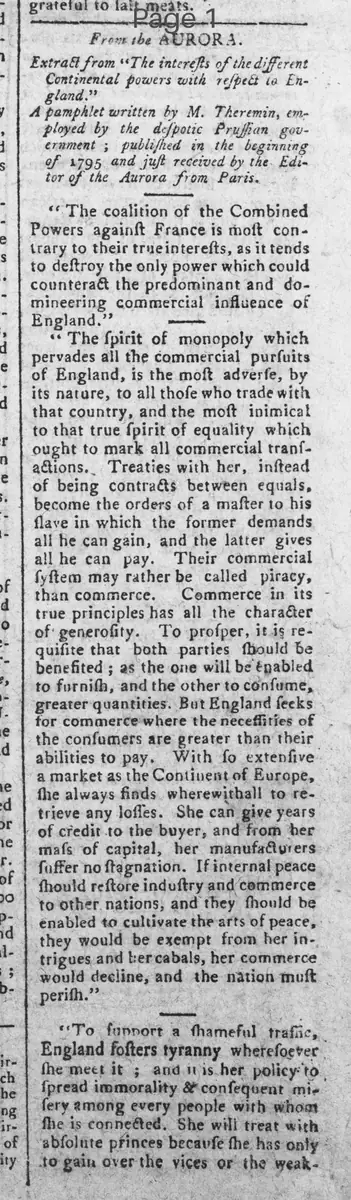
Extract from "The interests of the different Continental powers with respect to England."
A pamphlet written by M. Theremin, employed by the despotic Prussian government; published in the beginning of 1795 and just received by the Editor of the Aurora from Paris.
"The coalition of the Combined Powers against France is most contrary to their true interests, as it tends to destroy the only power which could counteract the predominant and domineering commercial influence of England."
"The spirit of monopoly which pervades all the commercial pursuits of England, is the most adverse, by its nature, to all those who trade with that country, and the most inimical to that true spirit of equality which ought to mark all commercial transactions. Treaties with her, instead of being contracts between equals, become the orders of a master to his slave in which the former demands all he can gain, and the latter gives all he can pay. Their commercial system may rather be called piracy, than commerce. Commerce in its true principles has all the character of generosity. To prosper, it is requisite that both parties should be benefited; as the one will be enabled to furnish, and the other to consume, greater quantities. But England seeks for commerce where the necessities of the consumers are greater than their abilities to pay. With so extensive a market as the Continent of Europe, she always finds wherewithal to retrieve any loss. She can give years of credit to the buyer. and from her mass of capital, her manufacturers suffer no stagnation. If internal peace should restore industry and commerce to other nations, and they should be enabled to cultivate the arts of peace, they would be exempt from her intrigues and her exactions, her commerce would decline, and the nation must perish."
"To support a shameful traffic, England fosters tyranny wherever she meets it; and it is her policy to spread immorality & consequent misery among every people with whom she is connected. She will treat with absolute princes because she has only to gain over the vices or the weakness--channels of an individual : But he avoids all free nations, because the Representatives of a free people are more difficult of purchase than a King. The Monarchs who are thus in English trammels, neglect the property of their respective nations ; and whether from imbecility, indolence or connivance, that nation is permitted to create a monopoly, there she attacks in arms and seizes on its territory and productions. No better account can be given of their politics than that of Dr. Franklin in his letter to Lord Howe, "As a warlike nation she is greedy of conquest, as an ambitious nation she seeks her dominion as a commercial one she attempts universal monopoly."
" It is an egregious error to think that England is omnipotent. She reigns over neutral nations by a fictitious ascendency which she has acquired over their minds. These are arms which cost them nothing ; but in her turn, did she meet with opposition, the very anxiety to preserve this influence would render her timid. The charm would vanish the moment it was examined. Endure her insults and she will aggravate them ; but in proportion as she meets a firm and decided tone, she retracts from her decision. It was thus that the orders were extorted which put in surety the Danish, Swedish and American vessels which were loaded with grain. These counter orders were in consequence of a dread of the junction of the Northern powers with America. But if her measures and her conduct was insolent : if the rights which she had engrossed to herself were contrary to all the known laws of nations, her moderation was a snare and the satisfaction which she offered was delusive. While She appeared thus moderate she was negotiating with Mr. Jay, and has now signed a treaty which, when carried into effect, will relieve them from the danger of an armed league, and will permit her to lean the heavier on the other two powers. This treaty not only assists England against that coalition which she dreaded might attack her Islands, but even makes the neutrality which Congress may think for the interest of America, lean in favor of Britain. The United States may in truth be said to have restored themselves to Britain, and France at the best can only have a nominal friend in that nation, whose independence grew out of the blood of Frenchmen. The halcyon days of Washington are at an end ! Why does virtue become thus decried ? Why has he survived his glory? The rebel WASHINGTON, on whose head a price had been set, has returned to his allegiance and received his pardon. But why speak of a man, when there is a nation ? It is easy to perceive that this treaty which was prepared to figure at the opening of the British Parliament, will excite murmurs among the American people, and in their House of Representatives, in spite of the support which the President and Senate will give to the infant of their creation. The insult offered to the Americans by the assistance given to the savages, is not repaired. American navigation is by no means assured by the truce with Algiers. The examination of the principle that neutral bottoms make neutral cargoes has been evaded has been postponed indefinitely. Such pains does the Court of London take to ward off the discussion of an axiom which might become the basis of an armed neutrality. We shall see in the debates of Congress upon this treaty the principle of each party, and I trust that the honor and gratitude of the nation with the vigour of the people will bear down the guilty pusillanimity of their leaders."
What sub-type of article is it?
What keywords are associated?
What entities or persons were involved?
Where did it happen?
Foreign News Details
Primary Location
Continent Of Europe
Event Date
Beginning Of 1795
Key Persons
Outcome
the jay treaty assists england against coalitions, favors britain in american neutrality, excites murmurs in american congress, evades neutral rights discussion.
Event Details
Pamphlet by M. Theremin argues that the coalition against France harms Continental interests by strengthening England's commercial monopoly. Criticizes England's trade as piracy, support for tyranny, and the Jay Treaty as restoring US allegiance to Britain, undermining French alliance and American independence.