Thank you for visiting SNEWPapers!
Sign up free
The Independent Press
Abbeville, Abbeville County, South Carolina
What is this article about?
Report on the Battle of Solferino (June 24, 1859), where French and Sardinian forces under Napoleon III defeated the Austrian army led by Emperor Francis Joseph, resulting in heavy Austrian losses and retreat across the Mincio River.
Clipping
OCR Quality
Full Text
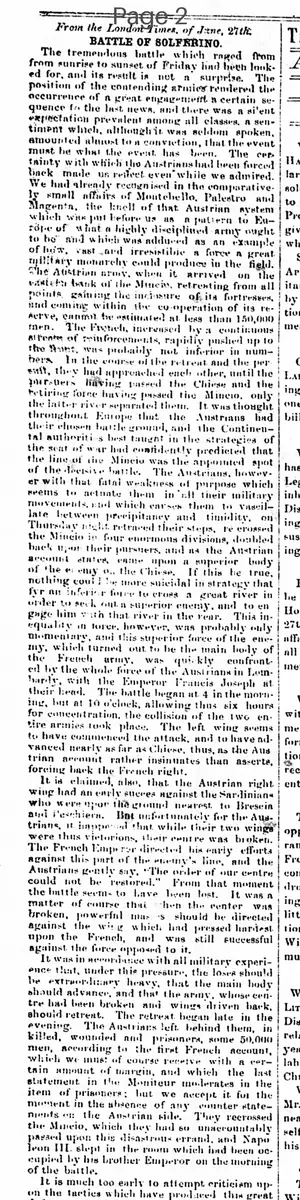
BATTLE OF SOLFERINO.
The tremendous battle which raged from sunrise to sunset of Friday last had been looked for, and its result is not a surprise. The position of the contending armies rendered the occurrence of a great engagement a certain sequence to the last news, and there was a silent expectation prevalent among all classes, a sentiment which, although it was seldom spoken, amounted almost to a conviction, that the event must be what the event has been. The certainty with which the Austrians had been forced back made us regret even while we admired. We had already recognised in the comparatively small affairs of Montebello, Palestro and Magenta, the knell of that Austrian system which was put before us as a pattern to Europe of what a highly disciplined army ought to be, and which was adduced as an example of how vast and irresistible a force a great military monarchy could produce in the field. The Austrian army, when it arrived on the Venetian bank of the Mincio, retreating from all points, gaining the succour of its fortresses, and coming within the co-operation of its reserve, cannot be estimated at less than 150,000 men. The French, increased by a continuous stream of reinforcements, rapidly pushed up to the front, was probably not inferior in numbers. In the course of the retreat and the pursuit, they had approached each other, until the pioneers having passed the Chiese and the retiring force having passed the Mincio, only the latter river separated them. It was thought throughout Europe that the Austrians had their chosen battle ground, and the Continental authorities best taught in the strategies of the seat of war had confidently predicted that the line of the Mincio was the appointed spot of the decisive battle. The Austrians, however, with that fatal weakness of purpose which seems to actuate them in all their military movements, and which causes them to oscillate between precipitancy and timidity, on Thursday night retraced their steps, re-crossed the Mincio in four enormous divisions, doubled back on their pursuers, and as the Austrian account states, came upon a superior body of the enemy on the Chiese. If this be true, nothing could be more suicidal in strategy than for an inferior force to cross a great river in order to seek out a superior enemy, and to engage him with that river in the rear. This inequality in force, however, was probably only momentary, and this superior force of the enemy, which turned out to be the main body of the French army, was quickly confronted by the whole force of the Austrians in Lombardy, with the Emperor Francis Joseph at their head. The battle began at 4 in the morning, but at 10 o'clock, allowing thus six hours for concentration, the collision of the two entire armies took place. The left wing seems to have commenced the attack, and to have advanced nearly as far as Chiese, thus, as the Austrian account rather insinuates than asserts, forcing back the French right. It is claimed, also, that the Austrian right wing had an early success against the Sardinians, who were near the ground nearest to Brescia and the Isonzo. But unfortunately for the Austrians, it appears that while their two wings were thus victorious, their centre was broken. The French Emperor directed his early efforts against this part of the enemy's line, and the Austrians gently say, 'The order of our centre could not be restored.' From that moment the battle seems to have been lost. It was a matter of course that when the center was broken, powerful masses should be directed against the wing which had pressed hardest upon the French, and was still successful against the force opposed to it. It was in accordance with all military experience that, under this pressure, the losses should be extraordinarily heavy, that the main body should advance, and that the army, whose centre had been broken and wings driven back, should retreat. The retreat began late in the evening. The Austrians left behind them, in killed, wounded and prisoners, some 50,000 men, according to the first French account, which we must of course receive with a certain amount of margin, and which the last statement in the Moniteur moderates in the item of prisoners; but we accept it for the moment in the absence of any counter statements on the Austrian side. They re-crossed the Mincio, which they had so unaccountably passed upon this disastrous errand, and Napoleon III slept in the room which had been occupied by his brother Emperor on the morning of the battle. It is much too early to attempt criticism upon the tactics which have produced this great defeat, or to speculate upon the consequences it must produce. Some great facts, however, there are, which lie upon the surface, and are seen even in the medium of those telegraphic dispatches. The Austrians have most candidly admitted their defeat. History scarcely records a bulletin in which a disaster was more explicitly avowed. It is said that they are prepared to resume the contest on the other side of the Mincio and to be again defeated with the same stolid bravery and unteachable awkwardness which they have manifested in all their previous operations. Among the many pieces of good fortune which fall to the French Emperor, it is not the least to have to deal with such an enemy as this—brave, disciplined and creditable to beat, but so slow of counsel and changeable of purpose that a single intelligent mind, commanding an army of even only equal courage and discipline, can count every battle a victory, and every campaign a conquest.
What sub-type of article is it?
What keywords are associated?
What entities or persons were involved?
Where did it happen?
Foreign News Details
Primary Location
Solferino
Event Date
Friday Last
Key Persons
Outcome
austrians suffered approximately 50,000 killed, wounded, and prisoners; admitted defeat and retreated across the mincio river.
Event Details
The Battle of Solferino involved Austrian forces under Emperor Francis Joseph crossing the Mincio to engage French and Sardinian troops led by Napoleon III. The battle raged from 4 a.m. to evening, with Austrians initially successful on the wings but their center broken by French attacks, leading to heavy losses and retreat.