Thank you for visiting SNEWPapers!
Sign up free
Alexandria Gazette, Commercial And Political
Alexandria, Virginia
What is this article about?
Reports from London detail a proposed peace treaty between Napoleon Bonaparte and captive Spanish King Ferdinand VII, including letters to Spain's temporary government not shared with British envoy Sir H. Wellesley. Allied diplomatic movements involve Lord Castlereagh, the Crown Prince, and French royal exiles heading to key locations amid war updates.
Clipping
OCR Quality
Full Text
London, Jan. 31.
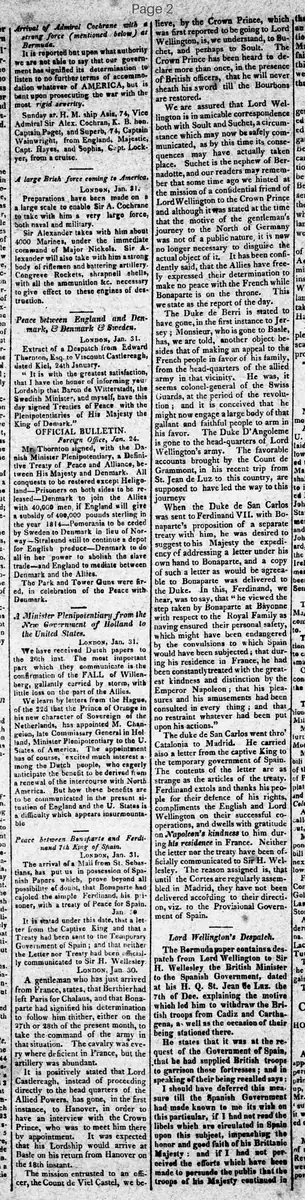
The arrival of a Mail from St. Sebastian's, has put us in possession of Spanish Papers which, prove beyond all possibility of doubt, that Bonaparte had cajoled the simple Ferdinand, his prisoner, with a treaty of Peace for Spain.
Jan. 9.
It is stated under this date, that a letter from the Captive King and that a Treaty had been sent to the Temporary Government of Spain; and that neither the Letter nor Treaty had been officially communicated to Sir H. Wellesley.
London, Jan. 30.
A gentleman who has just arrived from France, states, that Berthier had left Paris for Chalons, and that Bonaparte had signified his determination to follow him thither, either on the 27th or 28th of the present month, to take the command of the army in that situation. The cavalry was every where deficient in France, but the artillery was abundant.
It is positively stated that Lord Castlereagh, instead of proceeding directly to the head quarters of the Allied Powers, has gone, in the first instance, to Hanover, in order to have an interview with the Crown Prince, who was to meet him there by appointment. It was expected that his Lordship would arrive at Basle on his return from Hanover on the 18th instant.
The mission entrusted to an officer, the Count de Viel Castel, we believe, by the Crown Prince, which was first reported to be going to Lord Wellington, is, we understand, to Suchet, and perhaps to Soult. The Crown Prince has been heard to declare more than once, in the presence of British officers, that he will never sheath his sword till the Bourbons are restored.
We are assured that Lord Wellington is in amicable correspondence both with Soult and Suchet, a circumstance which may now be safely communicated, as by this time its consequences may have actually taken place. Suchet is the nephew of Bernadotte, and our readers may remember that some time ago we hinted at the mission of a confidential friend of Lord Wellington to the Crown Prince and although it was stated at the time that the motive of the gentleman's journey to the North of Germany was not of a public nature, it is now no longer necessary to disguise the actual object of it. It has been confidently said, that the Allies have freely expressed their determination to make no peace with the French while Bonaparte is on the throne. This we state as the report of the day.
The Duke de Berri is stated to have gone, in the first instance to Jersey; Monsieur, who is gone to Basle, has, we are told, another object besides that of making an appeal to the French people in favor of his family, from the head-quarters of the allied army in that vicinity. He was, it seems colonel-general of the Swiss Guards, at the period of the revolution; and it is conceived that he might now engage a large body of that gallant and faithful people to arm in his favor. The Duke D'Angouleme is gone to the head-quarters of Lord Wellington's army. The favorable accounts brought by the Count de Grammont, in his recent trip from St. Jean de Luz to this country, are supposed to have led the way to this journey:
When the Duke de San Carlos was sent to Ferdinand VII. with Bonaparte's proposition of a separate treaty with him, he was desired to suggest to his Majesty the expediency of addressing a letter under his own hand to Bonaparte, and a copy of such a letter as would be agreeable to Bonaparte was delivered to the Duke. In this, Ferdinand, we hear, was to say, that "he viewed the step taken by Bonaparte at Bayonne with respect to the Royal Family as having ensured their personal safety, which might have been endangered by the convulsions to which Spain would have been subjected; that during his residence in France, he had been constantly treated with the greatest kindness and distinction by the Emperor Napoleon; that his pleasures and his amusements had been consulted in every thing; and that no restraint whatever had been put upon his actions."
The duke de San Carlos went thro' Catalonia to Madrid. He carried also a letter from the captive King to the temporary government of Spain. The contents of the letter are as strange as the articles of the treaty. Ferdinand extols and thanks his people for their defence of his rights, compliments the English and Lord Wellington on their successful co-operations, and dwells with gratitude on Napoleon's kindness to him during his residence in France. Neither the letter nor the treaty have been officially communicated to Sir H. Wellesley. The reason assigned is, that until the Cortes are regularly assembled in Madrid, they have not been delivered according to their direction, viz. to the Provisional Government of Spain.
What sub-type of article is it?
What keywords are associated?
What entities or persons were involved?
Where did it happen?
Foreign News Details
Primary Location
Spain
Event Date
Jan. 9 To Jan. 31
Key Persons
Outcome
proposed treaty and letter from ferdinand vii to spanish government not communicated to british envoy; allied diplomatic movements and correspondences ongoing; no peace with bonaparte on throne.
Event Details
Bonaparte proposed a peace treaty to captive King Ferdinand VII, who wrote a letter praising Napoleon's treatment; documents sent to Spain's temporary government via Duke de San Carlos but not shared with Sir H. Wellesley. Reports include Berthier and Bonaparte moving to command army; Lord Castlereagh meeting Crown Prince; missions to Suchet and Soult; Wellington's correspondences; French royals traveling to allied areas; allies refuse peace while Bonaparte rules.