Thank you for visiting SNEWPapers!
Sign up free
Editorial
April 6, 1827
Phenix Gazette
Alexandria, Virginia
What is this article about?
Editorial criticizes the opposition's factional tactics in the last Congress, defends the Administration, praises Secretary of State Henry Clay's merits, and warns of historical dangers of unbridled party opposition to the republic.
Clipping
OCR Quality
98%
Excellent
Full Text
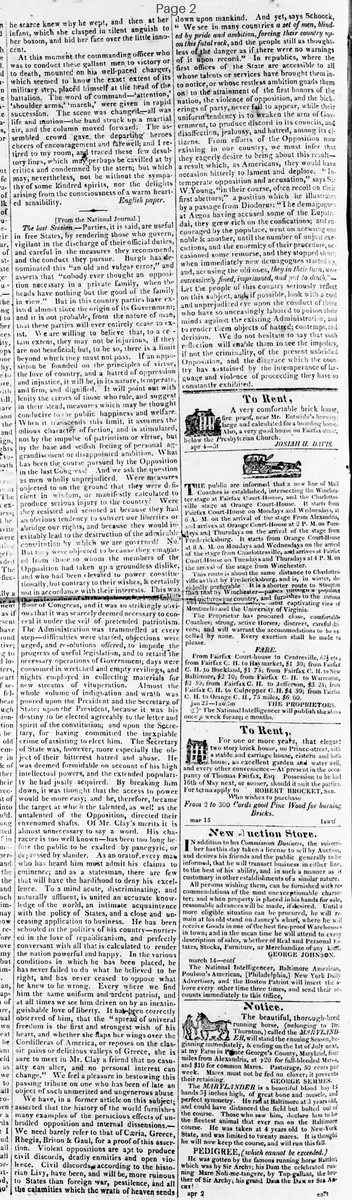
The last Session.-Parties, it is said, are useful in free States, by rendering those who govern, vigilant in the discharge of their official duties, and careful in the measures they recommend, and the conduct they pursue. Burgh has denominated this "an old and vulgar error," and asserts that "nobody ever thought an opposition necessary in a private family, when the heads have nothing but the good of the family in view." But in this country parties have existed almost since the origin of its Government; and it is not probable, from the nature of man, that these parties will ever entirely cease to exist. We are willing to believe that, to a certain extent, they may not be injurious, if they are not beneficial; but, to be so, there is a limit beyond which they must not pass. If an opposition be founded on the principles of virtue, the love of country, and a hatred of oppression and injustice, it will be, in its nature, temperate, and firm; and dignified. It will point out with lenity the errors of those who rule, and suggest in their stead, measures which may be thought conducive to the public happiness and welfare.
When it transcends this limit, it assumes the odious character of faction, and is stimulated, not by the impulse of patriotism or virtue, but by the base and selfish feeling of personal aggrandisement or disappointed ambition. What has been the course pursued by the Opposition in the last Congress? And we ask the question as men wholly unprejudiced. Were measures objected to on the ground that they were deficient in wisdom, or manifestly calculated to produce serious injury to the country? Were they resisted and scouted at because they had an obvious tendency to subvert our liberties or abridge our rights, and because they would inevitably lead to the destruction of the admirable constitution by which we are governed? No. But they were objected to because they emanated from those to whom the members of the Opposition had taken up a groundless dislike, and who had been elevated to power constitutionally, but contrary to their wishes, & certainly not in accordance with their interests. This was the avowed ation floor of Congress, and it was so strikingly obvious that it was scarcely deemed necessary to conceal it under the veil of pretended patriotism.
The Administration was trammelled at every step-difficulties were started, objections were urged, and resolutions offered, to impede the progress of useful legislation, and to retard the necessary operations of Government; days were consumed in wretched and empty revilings, and nights employed in collecting materials for new streams of vituperation. Almost the whole volume of indignation and wrath was poured upon the President and the Secretary of State: upon the President, because it was his destiny to be elected agreeably to the letter and spirit of the constitution; and upon the Secretary, for having committed the inexpiable crime of assisting to elect him. The Secretary of State was, however, more especially the object of their bitterest hatred and abuse. He was deemed formidable on account of his high intellectual powers, and the extended popularity he had justly acquired. By breaking him down, it was thought that the access to power would be more easy; and he, therefore, became the target at which the talented, as well as the untalented of the Opposition, directed their envenomed shafts. Of Mr. Clay's merits it is almost unnecessary to say a word. His character is too well known-has been too long before the public to be exalted by panegyric, or depressed by slander. As an orator, every man who has heard him must admit his claims to eminence; and as a statesman, there are few that will have the hardihood to deny his excellence. To a mind acute, discriminating, and naturally affluent, is united an accurate knowledge of the world, an intimate acquaintance with the policy of States, and a close and unceasing application to business. He has been schooled in the politics of his country--nurtured in the love of republicanism, and perfectly conversant with all that is calculated to render the nation powerful and happy. In the various conditions in which he has been placed, he has never failed to do what he believed to be right, and has never ceased to oppose what he knew to be wrong. Every where we find him the same uniform and ardent patriot, and at all times we see him driven on by an inextinguishable love of liberty. It has been correctly observed of him, that the "spread of universal freedom is the first and strongest wish of his heart, and whether she flaps her wings over the Cordilleras of America, or reposes on the classic plains or delicious valleys of Greece, she is sure to meet in Mr. Clay a friend that no casualty can alter, and no personal interest can change
We feel a pleasure in bestowing this passing tribute on one who has been of late an object of such unmerited and ungenerous abuse We have, in a former article on this subject; asserted that the history of the world furnishes many examples of the pernicious effects of unbridled opposition and internal dissensions.- We need barely refer to that of Caria, Greece, Rhegia, Briton & Gaul, for a proof of this assertion. Violent oppositions are apt to produce civil discords, deadly enmities and open violence. Civil discords according to the historian Livy, have been, and will be, more ruinous to States than foreign war, pestilence, and all down upon mankind. And yet, says Schoock, "We see in many countries a set of men, blinded by pride and ambition, forcing their country upon this fatal rock, and the people still as thoughtless of the danger as if there were no warnings of it upon record." , In republics, where the first offices of the State are accessible to all whose talents or services have brought them into notice, or whose restless ambition goads them on to the attainment of the first honors of the nation, the violence of opposition, and the bickerings of party, never fail to appear, while their uniform tendency is to weaken the arm of Government, to produce discord in its councils, and disaffection, jealousy, and hatred, among its citizens. From efforts of the Opposition now existing in our country, we must infer that they eagerly desire to bring about this result- a result which, as Americans, they would have occasion bitterly to lament and deplore. "Intemperate opposition and accusation," says Sir I. Young, "in their course, often recoil on their first abettors;" a position which he illustrates by a passage from Diodorus: "The demagogues at Argos having accused some of the Eupatridae, they grew rich on the confiscations; and encouraged by the populace, went on accusing one noble & another, until the number of unjust executions, and the enormity of their procedure, occasioned some remorse, and they stopped short, when immediately new demagogues started up, and, accusing the old ones, they in their turn, were successively fined, imprisoned, and put to death."
Let the people of this country seriously reflect on this subject, and, if possible, look with a cool and unprejudiced eye upon the conduct of those who have so unceasingly labored to poison their minds against the existing Administration, and to render them objects of hatred; contempt, and derision. We do not hesitate to say that such reflection will enable them to see the impolicy, if not the criminality, of the present unbridled Opposition, and the disgrace which the country has sustained by the intemperance of language and violence of proceeding they have so constantly exhibited.
When it transcends this limit, it assumes the odious character of faction, and is stimulated, not by the impulse of patriotism or virtue, but by the base and selfish feeling of personal aggrandisement or disappointed ambition. What has been the course pursued by the Opposition in the last Congress? And we ask the question as men wholly unprejudiced. Were measures objected to on the ground that they were deficient in wisdom, or manifestly calculated to produce serious injury to the country? Were they resisted and scouted at because they had an obvious tendency to subvert our liberties or abridge our rights, and because they would inevitably lead to the destruction of the admirable constitution by which we are governed? No. But they were objected to because they emanated from those to whom the members of the Opposition had taken up a groundless dislike, and who had been elevated to power constitutionally, but contrary to their wishes, & certainly not in accordance with their interests. This was the avowed ation floor of Congress, and it was so strikingly obvious that it was scarcely deemed necessary to conceal it under the veil of pretended patriotism.
The Administration was trammelled at every step-difficulties were started, objections were urged, and resolutions offered, to impede the progress of useful legislation, and to retard the necessary operations of Government; days were consumed in wretched and empty revilings, and nights employed in collecting materials for new streams of vituperation. Almost the whole volume of indignation and wrath was poured upon the President and the Secretary of State: upon the President, because it was his destiny to be elected agreeably to the letter and spirit of the constitution; and upon the Secretary, for having committed the inexpiable crime of assisting to elect him. The Secretary of State was, however, more especially the object of their bitterest hatred and abuse. He was deemed formidable on account of his high intellectual powers, and the extended popularity he had justly acquired. By breaking him down, it was thought that the access to power would be more easy; and he, therefore, became the target at which the talented, as well as the untalented of the Opposition, directed their envenomed shafts. Of Mr. Clay's merits it is almost unnecessary to say a word. His character is too well known-has been too long before the public to be exalted by panegyric, or depressed by slander. As an orator, every man who has heard him must admit his claims to eminence; and as a statesman, there are few that will have the hardihood to deny his excellence. To a mind acute, discriminating, and naturally affluent, is united an accurate knowledge of the world, an intimate acquaintance with the policy of States, and a close and unceasing application to business. He has been schooled in the politics of his country--nurtured in the love of republicanism, and perfectly conversant with all that is calculated to render the nation powerful and happy. In the various conditions in which he has been placed, he has never failed to do what he believed to be right, and has never ceased to oppose what he knew to be wrong. Every where we find him the same uniform and ardent patriot, and at all times we see him driven on by an inextinguishable love of liberty. It has been correctly observed of him, that the "spread of universal freedom is the first and strongest wish of his heart, and whether she flaps her wings over the Cordilleras of America, or reposes on the classic plains or delicious valleys of Greece, she is sure to meet in Mr. Clay a friend that no casualty can alter, and no personal interest can change
We feel a pleasure in bestowing this passing tribute on one who has been of late an object of such unmerited and ungenerous abuse We have, in a former article on this subject; asserted that the history of the world furnishes many examples of the pernicious effects of unbridled opposition and internal dissensions.- We need barely refer to that of Caria, Greece, Rhegia, Briton & Gaul, for a proof of this assertion. Violent oppositions are apt to produce civil discords, deadly enmities and open violence. Civil discords according to the historian Livy, have been, and will be, more ruinous to States than foreign war, pestilence, and all down upon mankind. And yet, says Schoock, "We see in many countries a set of men, blinded by pride and ambition, forcing their country upon this fatal rock, and the people still as thoughtless of the danger as if there were no warnings of it upon record." , In republics, where the first offices of the State are accessible to all whose talents or services have brought them into notice, or whose restless ambition goads them on to the attainment of the first honors of the nation, the violence of opposition, and the bickerings of party, never fail to appear, while their uniform tendency is to weaken the arm of Government, to produce discord in its councils, and disaffection, jealousy, and hatred, among its citizens. From efforts of the Opposition now existing in our country, we must infer that they eagerly desire to bring about this result- a result which, as Americans, they would have occasion bitterly to lament and deplore. "Intemperate opposition and accusation," says Sir I. Young, "in their course, often recoil on their first abettors;" a position which he illustrates by a passage from Diodorus: "The demagogues at Argos having accused some of the Eupatridae, they grew rich on the confiscations; and encouraged by the populace, went on accusing one noble & another, until the number of unjust executions, and the enormity of their procedure, occasioned some remorse, and they stopped short, when immediately new demagogues started up, and, accusing the old ones, they in their turn, were successively fined, imprisoned, and put to death."
Let the people of this country seriously reflect on this subject, and, if possible, look with a cool and unprejudiced eye upon the conduct of those who have so unceasingly labored to poison their minds against the existing Administration, and to render them objects of hatred; contempt, and derision. We do not hesitate to say that such reflection will enable them to see the impolicy, if not the criminality, of the present unbridled Opposition, and the disgrace which the country has sustained by the intemperance of language and violence of proceeding they have so constantly exhibited.
What sub-type of article is it?
Partisan Politics
What keywords are associated?
Partisan Opposition
Henry Clay
Congress
Administration
Factionalism
Civil Discord
Patriotism
What entities or persons were involved?
President
Secretary Of State
Mr. Clay
Opposition
Administration
Editorial Details
Primary Topic
Critique Of Opposition In The Last Congress
Stance / Tone
Supportive Of Administration And Critical Of Opposition Factionalism
Key Figures
President
Secretary Of State
Mr. Clay
Opposition
Administration
Key Arguments
Parties Useful In Free States But Must Not Exceed Limits Of Virtue And Patriotism
Opposition In Last Congress Objected To Measures Due To Groundless Dislike Of Administration Rather Than Principled Reasons
Administration Faced Constant Obstruction And Abuse
Secretary Of State Henry Clay Targeted For His Intellect And Popularity
Clay Praised For Oratory, Statesmanship, And Patriotism
Historical Examples Show Violent Oppositions Lead To Civil Discord And Ruin
Intemperate Opposition Recoils On Its Abettors
People Urged To Reflect On Opposition's Conduct And Its Impolicy