Thank you for visiting SNEWPapers!
Sign up free
Story
September 7, 1855
The Daily Dispatch
Richmond, Virginia
What is this article about?
An editorial critiques the New Jersey railroad monopoly following a deadly accident on the Camden and Amboy Railroad, blaming negligence, lack of double tracks, and corporate influence that hinders justice for victims.
Clipping
OCR Quality
98%
Excellent
Full Text
THE NEW JERSEY RAILROAD DISASTER
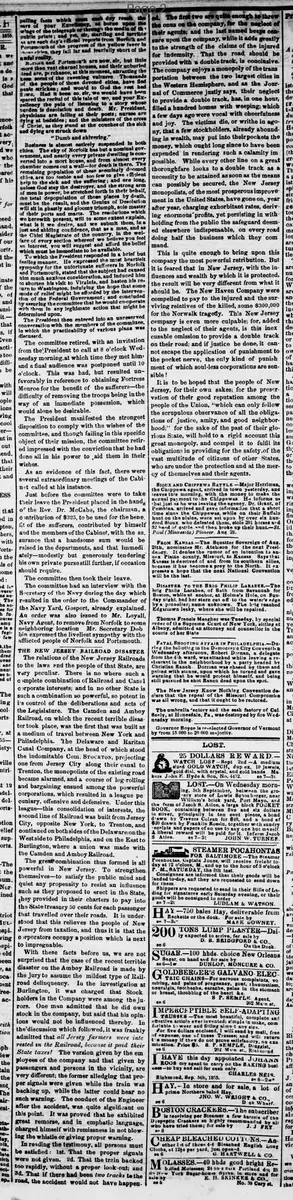
The relations of the New Jersey Railroads to the laws and the people of that State, are very peculiar. There is no where such a complete combination of Railroad and Canal corporate interests; and in no other State is such a combination so powerful, so potent in its control of the deliberations and acts of the Legislature. The Camden and Amboy Railroad, on which the recent terrible disaster took place, was the first that was built as a medium of travel between New York and Philadelphia. The Delaware and Raritan Canal Company, at the head of which stood the indomitable Com. Stockton, projecting one from Jersey City along their canal to Trenton, the monopolists of the existing road became alarmed, and a course of log-rolling and bargaining ensued among the powerful corporations, which resulted in a league pecuniary, offensive and defensive. Under this league-this consolidation of interests, the second line of Railroad was built from Jersey City, opposite New York, to Trenton, and continued on both sides of the Delaware: on the West side to Philadelphia, and on the East to Burlington, where a union was made with the Camden and Amboy Railroad.
The great combination thus formed is all powerful in New Jersey. To strengthen themselves-to satisfy the public mind and quiet any propensity to resist an influence such as they proposed to erect in the State, they provided in their charters to pay into the State treasury 50 cents for each passenger that travelled over their roads. It is understood that this relieves the people of New Jersey from taxation, and thus it is that the corporators occupy a position which is next to impregnable.
With these facts before us, we are not surprised that the case of the recent terrible disaster on the Amboy Railroad is made by the jury to assume the mildest type of Railroad delinquency. In the investigation at Burlington, it was charged that Stock holders in the Company were among the jurors. One man admitted that he did own stock in the company, but said that his opinions would not be influenced thereby. In the discussion which followed, it was frankly admitted that all Jersey farmers were interested in the Railroad, because it paid their State taxes! The version given by the employees of the company and that given by passengers and persons in the vicinity, are very different; the former alleging that proper signals were given while the train was backing up, while the latter could hear no such warning. The conduct of the Engineer after the accident, was quite significant on this point. It was proved that he exhibited great remorse, and in emphatic language, charged himself with remissness in not blowing the whistle or giving proper warning.
In reading the testimony, all persons must be satisfied: 1st. That the proper signals were not given. 2d. That the train backed too rapidly, without a proper look-out; and 3d. That if there had been two tracks to the road, the accident would not have happened.
The first two are quite enough to throw the onus on the company, for the neglect of their agents; and the last named heaps censure upon the company, while it adds greatly to the strength of the claims of the injured for indemnity. That the road should be provided with a double track, is conclusive. The company enjoys a monopoly of the transportation between the two largest cities in the Western Hemisphere, and as the Journal of Commerce justly says, their neglect to provide a double track, has, in one hour, filled a hundred homes with weeping; which a few days ago were vocal with cheerfulness and joy. The victims die, or writhe in agony, that a few stockholders, already abounding in wealth, may put into their pockets the money, which ought long since to have been expended in rendering such a calamity impossible. While every other line on a great thoroughfare looks to a double track as a necessity to be attained as soon as the means can possibly be secured, the New Jersey monopolists, of the most prosperous improvement in the United States, have gone on, year after year, charging exorbitant rates, deriving enormous profits, yet persisting in withholding from the public the safeguard deemed elsewhere indispensable, on every road doing half the business which they command.
This is quite enough to bring upon this company the most powerful retribution. But it is feared that in New Jersey, with the influences and wealth by which it is protected, the result will be very different from what it should be. The New Haven Company were compelled to pay to the injured and the surviving relatives of the killed, some $300,000 for the Norwalk tragedy. This New Jersey company is even more culpable: for, added to the neglect of their agents, is this inexcusable omission to provide a double track on their road; and if justice be done, it cannot escape the application of punishment to the pocket nerve, the only kind of punishment of which soul-less corporations are sensible!
It is to be hoped that the people of New Jersey, for their own sakes; for the preservation of their good reputation among the people of the Union, "which can only follow the scrupulous observance of all the obligations of justice, amity, and good neighborhood;" for the sake of the past of their glorious State, will hold to a rigid account this great monopoly, and compel it to fulfil its obligations in providing for the safety of the vast multitude of citizens of other States who are under the protection and at the mercy of themselves and their agents.
The relations of the New Jersey Railroads to the laws and the people of that State, are very peculiar. There is no where such a complete combination of Railroad and Canal corporate interests; and in no other State is such a combination so powerful, so potent in its control of the deliberations and acts of the Legislature. The Camden and Amboy Railroad, on which the recent terrible disaster took place, was the first that was built as a medium of travel between New York and Philadelphia. The Delaware and Raritan Canal Company, at the head of which stood the indomitable Com. Stockton, projecting one from Jersey City along their canal to Trenton, the monopolists of the existing road became alarmed, and a course of log-rolling and bargaining ensued among the powerful corporations, which resulted in a league pecuniary, offensive and defensive. Under this league-this consolidation of interests, the second line of Railroad was built from Jersey City, opposite New York, to Trenton, and continued on both sides of the Delaware: on the West side to Philadelphia, and on the East to Burlington, where a union was made with the Camden and Amboy Railroad.
The great combination thus formed is all powerful in New Jersey. To strengthen themselves-to satisfy the public mind and quiet any propensity to resist an influence such as they proposed to erect in the State, they provided in their charters to pay into the State treasury 50 cents for each passenger that travelled over their roads. It is understood that this relieves the people of New Jersey from taxation, and thus it is that the corporators occupy a position which is next to impregnable.
With these facts before us, we are not surprised that the case of the recent terrible disaster on the Amboy Railroad is made by the jury to assume the mildest type of Railroad delinquency. In the investigation at Burlington, it was charged that Stock holders in the Company were among the jurors. One man admitted that he did own stock in the company, but said that his opinions would not be influenced thereby. In the discussion which followed, it was frankly admitted that all Jersey farmers were interested in the Railroad, because it paid their State taxes! The version given by the employees of the company and that given by passengers and persons in the vicinity, are very different; the former alleging that proper signals were given while the train was backing up, while the latter could hear no such warning. The conduct of the Engineer after the accident, was quite significant on this point. It was proved that he exhibited great remorse, and in emphatic language, charged himself with remissness in not blowing the whistle or giving proper warning.
In reading the testimony, all persons must be satisfied: 1st. That the proper signals were not given. 2d. That the train backed too rapidly, without a proper look-out; and 3d. That if there had been two tracks to the road, the accident would not have happened.
The first two are quite enough to throw the onus on the company, for the neglect of their agents; and the last named heaps censure upon the company, while it adds greatly to the strength of the claims of the injured for indemnity. That the road should be provided with a double track, is conclusive. The company enjoys a monopoly of the transportation between the two largest cities in the Western Hemisphere, and as the Journal of Commerce justly says, their neglect to provide a double track, has, in one hour, filled a hundred homes with weeping; which a few days ago were vocal with cheerfulness and joy. The victims die, or writhe in agony, that a few stockholders, already abounding in wealth, may put into their pockets the money, which ought long since to have been expended in rendering such a calamity impossible. While every other line on a great thoroughfare looks to a double track as a necessity to be attained as soon as the means can possibly be secured, the New Jersey monopolists, of the most prosperous improvement in the United States, have gone on, year after year, charging exorbitant rates, deriving enormous profits, yet persisting in withholding from the public the safeguard deemed elsewhere indispensable, on every road doing half the business which they command.
This is quite enough to bring upon this company the most powerful retribution. But it is feared that in New Jersey, with the influences and wealth by which it is protected, the result will be very different from what it should be. The New Haven Company were compelled to pay to the injured and the surviving relatives of the killed, some $300,000 for the Norwalk tragedy. This New Jersey company is even more culpable: for, added to the neglect of their agents, is this inexcusable omission to provide a double track on their road; and if justice be done, it cannot escape the application of punishment to the pocket nerve, the only kind of punishment of which soul-less corporations are sensible!
It is to be hoped that the people of New Jersey, for their own sakes; for the preservation of their good reputation among the people of the Union, "which can only follow the scrupulous observance of all the obligations of justice, amity, and good neighborhood;" for the sake of the past of their glorious State, will hold to a rigid account this great monopoly, and compel it to fulfil its obligations in providing for the safety of the vast multitude of citizens of other States who are under the protection and at the mercy of themselves and their agents.
What sub-type of article is it?
Disaster
Historical Event
What themes does it cover?
Catastrophe
Justice
What keywords are associated?
Railroad Disaster
New Jersey Monopoly
Camden Amboy Railroad
Train Accident
Corporate Negligence
Double Track
Jury Investigation
What entities or persons were involved?
Com. Stockton
Engineer
Where did it happen?
New Jersey, Camden And Amboy Railroad, Burlington
Story Details
Key Persons
Com. Stockton
Engineer
Location
New Jersey, Camden And Amboy Railroad, Burlington
Event Date
Recent
Story Details
A train backs up without proper signals or lookout on the single-track Camden and Amboy Railroad, causing a deadly disaster; the article criticizes the company's monopoly, negligence, and failure to build a double track, calling for accountability and compensation.