Thank you for visiting SNEWPapers!
Sign up free
The Spirit Of Democracy
Woodsfield, Monroe County, Ohio
What is this article about?
Historical overview from Cincinnati Enquirer on the 'previous question' rule in U.S. Congress, its origins in 1811, rare early use, and frequent application since 1841 to stifle debate on key issues, contrasting with Senate practices and British Parliament; praises 1841 Democratic minority tactics against Whig measures.
Clipping
OCR Quality
Full Text
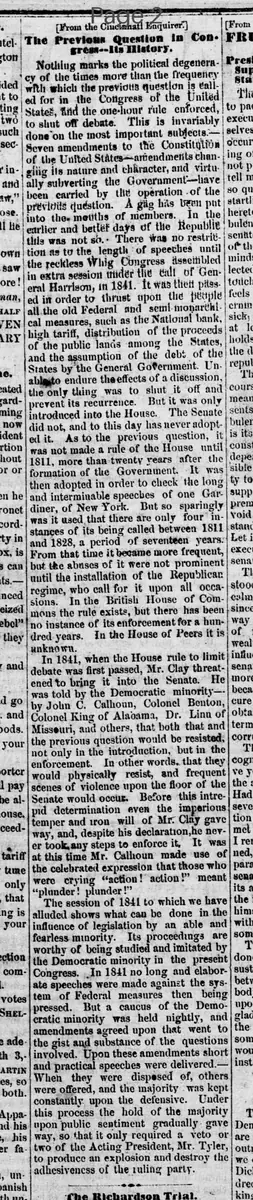
The Previous Question in Congress—Its History.
Nothing marks the political degeneracy of the times more than the frequency with which the previous question is called for in the Congress of the United States, and the one-hour rule enforced to shut off debate. This is invariably done on the most important subjects.
Seven amendments to the Constitution of the United States—amendments changing its nature and character, and virtually subverting the Government—have been carried by the operation of the previous question. A gag has been put into the mouths of members.
In the earlier and better days of the Republic this was not so. There was no restriction as to the length of speeches until the reckless Whig Congress assembled in extra session under the call of General Harrison, in 1841. It was then passed in order to thrust upon the people all the old Federal and semi-monarchical measures, such as the National bank, high tariff, distribution of the proceeds of the public lands among the States, and the assumption of the debt of the States by the General Government.
Unable to endure the effects of a discussion, the only thing was to shut it off and prevent its recurrence. But it was only introduced into the House. The Senate did not, and to this day has never adopted it.
As to the previous question, it was not made a rule of the House until 1811, more than twenty years after the formation of the Government. It was then adopted in order to check the long and interminable speeches of one Gardner, of New York. But so sparingly was it used that there are only four instances of its being called between 1811 and 1828, a period of seventeen years.
From that time it became more frequent, but the abuses of it were not prominent until the installation of the Republican regime, who call for it upon all occasions.
In the British House of Commons the rule exists, but there has been no instance of its enforcement for a hundred years. In the House of Peers it is unknown.
In 1841, when the House rule to limit debate was first passed, Mr. Clay threatened to bring it into the Senate. He was told by the Democratic minority—by John C. Calhoun, Colonel Benton, Colonel King of Alabama, Dr. Linn of Missouri, and others, that both that and the previous question would be resisted, not only in the introduction, but in the enforcement. In other words, that they would physically resist, and frequent scenes of violence upon the floor of the Senate would occur.
Before this intrepid determination even the imperious temper and iron will of Mr. Clay gave way, and, despite his declaration, he never took any steps to enforce it.
It was at this time Mr. Calhoun made use of the celebrated expression that those who were crying "action! action!" meant "plunder! plunder!"
The session of 1841 to which we have alluded shows what can be done in the influence of legislation by an able and fearless minority. Its proceedings are worthy of being studied and imitated by the Democratic minority in the present Congress.
In 1841 no long and elaborate speeches were made against the system of Federal measures then being pressed. But a caucus of the Democratic minority was held nightly, and amendments agreed upon that went to the gist and substance of the questions involved. Upon these amendments short and practical speeches were delivered. When they were disposed of, others were offered, and the majority was kept constantly upon the defensive.
Under this process the hold of the majority upon public sentiment gradually gave way, so that it only required a veto or two of the Acting President, Mr. Tyler, to produce an explosion and destroy the adhesiveness of the ruling party.
What sub-type of article is it?
What themes does it cover?
What keywords are associated?
What entities or persons were involved?
Where did it happen?
Story Details
Key Persons
Location
Congress Of The United States
Event Date
1841
Story Details
The article discusses the history and increasing use of the previous question rule in the U.S. House to limit debate, contrasting earlier republican practices with modern political degeneracy. It highlights its origins in 1811 and abuses under Republican regime, and the 1841 Whig Congress's tactics, resisted by Democratic minority led by Calhoun and others.