Thank you for visiting SNEWPapers!
Sign up free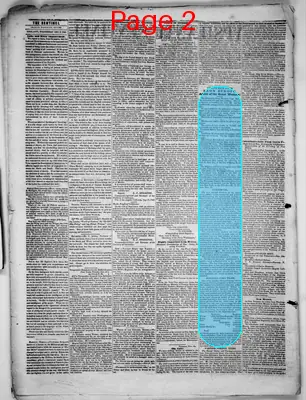
Ypsilanti Sentinel
Ypsilanti, Washtenaw County, Michigan
What is this article about?
European news from Liverpool via Great Western steamship arrival: advancing American cotton prices by 3d, rising provisions, severe famine causing starvation deaths in Ireland, commercial concerns over scarcity, dull manufacturing markets, and optimistic corn trade outlook due to ample supplies.
Clipping

OCR Quality
Full Text
Arrival of the Great Western!
The Steamship Great Western Capt. Matthews arrived at this port last evening. She left Liverpool on Saturday, the 31st ult. and has therefore the passage in little more than sixteen days.
We are indebted to the politeness of Captain Mathews for our supply of English journals.— We compile our news, as usual, chiefly from Wilmer and Smith's European Times.
The price of American Cotton had advanced 3d.
There is also farther rise in the price of provisions.
The famine is very severe in Ireland, and multitudes are dying of starvation.
The Great Britain was still lying in Drundrum Bay.
The Great Western made her passage out in 16 days and 12 hours. She has a tempestuous voyage.
Hon George Bancroft lady and child arrived at Liverpool on Sunday the 25th, by the steamship Great Western. The hon. gentleman left Liverpool on the 30th for London, taking Chester and Birmingham in his way. During his stay in Liverpool he was waited upon by the American Chamber of Commerce, and visited by the principal merchants of the town. On Wednesday, the 28th, he dined with a select party at the residence of Wm. Brown. Esq. M. P. at Richmond Hill; and on the following day with S. Gair Esq. of the firm of Baring Brothers.
The Hibernia arrived at Liverpool on the 29th ult after a passage of 12 days.
The packet ship Washington Irving arrived at Liverpool from Boston on the 24th ult. after a passage of a little over 18 days. She brought news from the United States five days later than conveyed by the steamship Cambria.
The Wyoming, Captain Miercken, arrived from Philadelphia on the 20th, and the Henry Clay, from New York, on the 27th ult.—N. Y. Tribune. Nov. 17.
COMMERCIAL,
We have alluded elsewhere to the feeling which prevails in the commercial and political world respecting the apprehended scarcity.— There is talk of working short time in the great manufacturing districts. and the state of the Cotton trade, not less than the condition of the provision market, have mainly induced this resolve The result is, that ever since the arrival of the Great Western and the Hibernia, the Cotton trade was less buoyant, but still ready. The accounts of the present year's crop are sufficient to keep alive apprehensions for the future, and with more abundance of food, and necessarily more consumption the price of the staple could not fail to have advanced amazingly. As it is. the calm which pervades the market might be fanned into a breeze by the most trivial circumstance, favorable or otherwise, from the Western side of the Atlantic.
The manufacturing markets are dull: and while there is an anxiety to push sales on the one hand. there is a total absence of desire to purchase on the other. This is the time when a fillip ought to have been given to trade by the opening of the American markets, allowing six weeks or two months for vessels leaving England to reach the American shores in time for the beginning of the year, when the new Tariff come into operation. But we hear little of the exportation which the reduced scale duties in the Union is likely to produce.
The immediate dependence of a country on its own harvest was never experienced to a greater extent in England than at the present moment. The loss of the potato affects every business, more or less. and if the fruitful source of national as well as individual embarrassments The produce markets are all subjects to its influence. But our market returns will show, in their amplitude, the causes at which we have glanced.
EUROPEAN CORN TRADE.
One of the London, "Prices Current," of Oct. 27 has the following remarks on the Corn trade Our readers will gratified to learn that at Mark Lane, yesterday, the demand for Wheat was dull, with an evident downcast tendency in price: and we find it to be the opinion of many of the most eminent and intelligent men in the city that an important fall will soon take place in this most important article of food. The grounds upon which they have formed this opinion are 1st—That the wheat crop in this country was this year a fair average: 2d—The enormous quantities of Wheat and Flour which were liberated from bond immediate preceding the harvest being, according to official returns from 5th January to 5th September last:
Quarters.
Wheat 1,852,785 Peas Beans, &c. 151,401
Barley 126,074 Indian Corn 421,227
Oats 438,045
Total Grain 3,043,505
Flour Cwts 2,810,205
Indian Meals, &c. 95,050
Total 2,905,252
and thirdly—upon the large quantities of Flour Wheat, and Indian Corn in the course of shipment from America to this country, and which will be continued, it is believed; to an unprecedented extent, in the expectation that prices will at all events be upon a high range in this country—until next harvest.
What sub-type of article is it?
What keywords are associated?
What entities or persons were involved?
Where did it happen?
Foreign News Details
Primary Location
Liverpool
Event Date
31st Ult.
Key Persons
Outcome
multitudes are dying of starvation in ireland; price of american cotton advanced 3d; farther rise in provisions; anticipated fall in wheat prices
Event Details
The Steamship Great Western arrived from Liverpool on the 31st ult. with news of advanced cotton and provision prices, severe famine in Ireland, commercial apprehensions over scarcity leading to short time in manufacturing districts, dull markets, and optimistic corn trade due to average wheat crop, bonded grain releases, and shipments from America.