Thank you for visiting SNEWPapers!
Sign up free
Delaware Gazette And State Journal
Wilmington, New Castle County, Delaware
What is this article about?
Judge Wales awards $40,000 in fees to lawyers for Snyder's administrators in the decade-long Frink et al. vs. McComb case over a secret trust for Southern Railway stock. The suit spanned Massachusetts, Delaware, and U.S. Supreme Courts, resulting in a $91,420 judgment affirmed in 1893.
Clipping
OCR Quality
Full Text
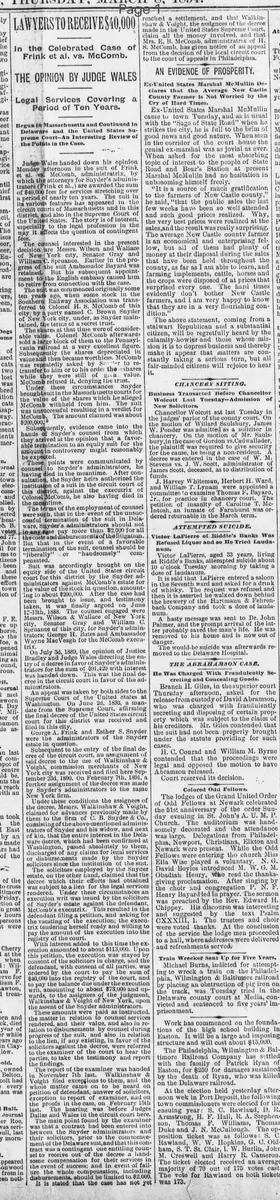
In the Celebrated Case of
Frink et al. vs. McComb.
THE OPINION BY JUDGE WALES
Legal Services Covering
a
Period of Ten Years.
Beginning in Massachusetts and Continued in
Delaware and the United States Supreme
Court—An Interesting Review of
the Points in the Case.
Judge Wales handed down his opinion
Monday afternoon in the suit of Frink
et al. vs.
McComb, administratrix, by
which the attorneys for Snyder's administrators (Frink et al.) are awarded the sum
of $40,000 fees for services stretching over
a period of nearly ten years. The suit in
its various features has appeared in the
circuit courts of Massachusetts and in this
district, and also in the Supreme Court of
the United States. The story is of interest,
especially to the legal profession in the
way it affects the question of contingent
fees.
The counsel interested in the present
decision are Messrs. Wilson and Wallace
of New York city, Senator Gray and
William C. Spruance. Earlier in the progress of the suit Ambassador Bayard was
retained. But his subsequent appointment to the English embassy caused him
to retire from connection with the case.
The suit was commenced originally some
ten years ago, when some stock in the
Southern Railway Association was transferred to Colonel H. S. McComb of this
city, by a party named C. Brown Snyder
of New York city, under, as Snyder maintained, the terms of a secret trust.
The shares at that time were of considerable value. Colonel McComb afterwards sold a large block of them to the Pennsylvania railroad at a very excellent figure.
Subsequently the shares depreciated in
value and then became worthless. McComb was repeatedly asked by Snyder to re-
transfer to him or to his order the shares
while they were still of value.
McComb refused it, denying the trust.
Under these circumstances Snyder
brought suit in the Massachusetts courts for
the value of the shares which he alleged
McComb withheld from him. The suit
was unsuccessful resulting in a verdict for
McComb. The amount claimed was about
$200,000
Subsequently, evidence came into the
hands of Snyder's counsel from which
they arrived at the opinion that a favorable termination to an equity suit for the
amount in controversy might reasonably
be expected.
These points were communicated by
counsel to Snyder's administrators, he
having died in the meantime. After consultation, the Snyder heirs authorized the
institution of a suit in the circuit court of
this district, against the executrix of
Colonel McComb, he also having died in
the meantime.
The terms of the employment of counsel
were such that in the event of the unsuccessful termination of the suit in Delaware, Snyder's administrators should not
in any case pay more than $2,000 for all
the costs and disbursements of the litigation.
But that in the event of a favorable
termination of the suit, counsel should be
"liberally"
or
"handsomely"
compensated.
Suit was accordingly brought on the
equity side of the United States circuit
court for this district by the Snyder administrators against McComb's estate for
the value of the stock in question, amounting to about $200,000. After the case had
been brought to issue, and testimony
taken, it was finally argued on June
12-13th, 1888. The counsel engaged were
Messrs. Wilson & Wallace of New York
city, Senator Gray and William C.
Spruance of this city, for Snyder's administrators; George H. Bates and Ambassador Wayne MacVeagh for the McComb executrix.
On July 3d, 1889, the opinion of Justice
Bradley and Judge Wales directing the entry of a decree in favor of Snyder's administrators for the sum of $91,420 with interest was handed down. This was the final decree in the circuit court in favor of the administrators.
An appeal was taken by both sides to the
Supreme Court of the United States at
Washington. On June 2d, 1893, a mandate from the Supreme Court, affirming the final decree of the United States circuit court for this district was received and
filed in this city.
George A. Frink and Esther S. Snyder
were the administrators of the Snyder
estate in question.
Subsequent to the entry of the final decree of the circuit court, an assignment of
said decree to the use of Walkinshaw &
Voight, commission merchants of New
York city was received and filed here September 23d, 1890. On February 7th, 1891, a
further assignment of the decree was made
by Snyder's administrators to the same
New York firm.
Under these conditions the assignees of
the decree, Messrs. Walkinshaw & Voight,
claimed for advances previously made by
them to the firm of C. B. Snyder & Co.,
consisting of the above-mentioned administrators of Snyder and his widow, and next
of kin, that the entire interest in the Delaware decree, which had been confirmed at
Washington, passed absolutely to them,
discharged of any claims for legal services
or disbursements made by the Snyder
solicitors since the institution of the suit.
The solicitors employed by the Snyder
estate, on the other hand, claimed that the
decree which their efforts had obtained
was subject to a lien for the legal services
rendered. Under these circumstances an
execution writ was issued by the solicitors of Snyder's estate against the defendant, McComb's executrix. This resulted in the
defendant filing a petition, and asking for
the vacating of the execution; the executrix tendering herself ready and willing to
pay the amount of the execution into the
registry of the court.
With interest added to this time the execution amounted to about $113,000. Upon
this petition, the execution was stayed by
consent of the solicitors in charge, and the
defendant, with consent of all parties, was
ordered by the court to pay the sum of
$40,000 into the registry of the court, and
to pay the balance due under the execution writ, amounting to about $73,000 and upwards, to the assignees of the judgment,
Walkinshaw & Voight of New York, upon
the assent of the Snyder administrators.
These amounts were paid as instructed.
The matter in relation to counsel services
rendered, and their value, and also in relation to disbursements by counsel during
progress of the suit, and also in relation
to the lien, if any existing, in favor of the
solicitors against the decree, were referred to the examiner of the court to hear the
parties, to take the testimony and report
the findings.
The report of the examiner was handed
in November 7th last. Walkinshaw &
Voight filed exceptions to them, and the
whole matter came on to be heard on
petition of defendant, answer of solicitors,
exception to report of examiner, and on
the proofs in the case, on February 15th
last. The hearing was before Judges
Dallas and Wales in the circuit court here.
The main point found by the examiner
was that a contract had been entered into
between the Snyder administrators and
their solicitors, prior to the commencement of the Delaware suit, and that this contract was a contingent one entitling counsel to receive out of the decree a handsome compensation for their services in
the event of success; and in event of failure the whole compensation, including
disbursements, should be limited to $2,000.
It is stated that the case has not yet
reached a settlement, and that Walkinshaw & Voight, the assignees of the decree
made in the United States Supreme Court,
claim all the money involved, and that
Mrs. E. B. McComb, administratrix of H.
S. McComb, has given notice of an appeal
from the decision of the local circuit court
to the court of appeals in Philadelphia.
What sub-type of article is it?
What themes does it cover?
What keywords are associated?
What entities or persons were involved?
Where did it happen?
Story Details
Key Persons
Location
Massachusetts Courts, Delaware District Court, United States Supreme Court, New York, Washington
Event Date
Over A Period Of Nearly Ten Years, Commencing Around 1883, With Key Dates: Argued June 12 13, 1888; Decree July 3, 1889; Mandate June 2, 1893
Story Details
C. Brown Snyder transferred Southern Railway stock to H. S. McComb under a secret trust, which McComb denied and sold. After failed Massachusetts suit, Snyder's estate pursued equity case in Delaware, winning $91,420 affirmed by Supreme Court. Lawyers awarded $40,000 contingent fees amid disputes with assignees Walkinshaw & Voight.