Thank you for visiting SNEWPapers!
Sign up free
The New Hampshire Gazette And Historical Chronicle
Portsmouth, Greenland, Rockingham County, New Hampshire
What is this article about?
Letter X from 'A Farmer in Pennsylvania' warns American colonists of ministerial abuse under the Townshend Acts, drawing parallels to Ireland's revenue misappropriation for pensions and offices, arguing it undermines colonial liberties through unrepresentative taxation and control. (248 characters)
Merged-components note: Continuation of 'Letters from a Farmer in Pennsylvania, Letter X', an opinionated political essay serialized across pages; relabeled from 'literary' to 'editorial' as it fits opinion pieces better than serialized fiction.
Clippings
1 of 2
OCR Quality
Full Text
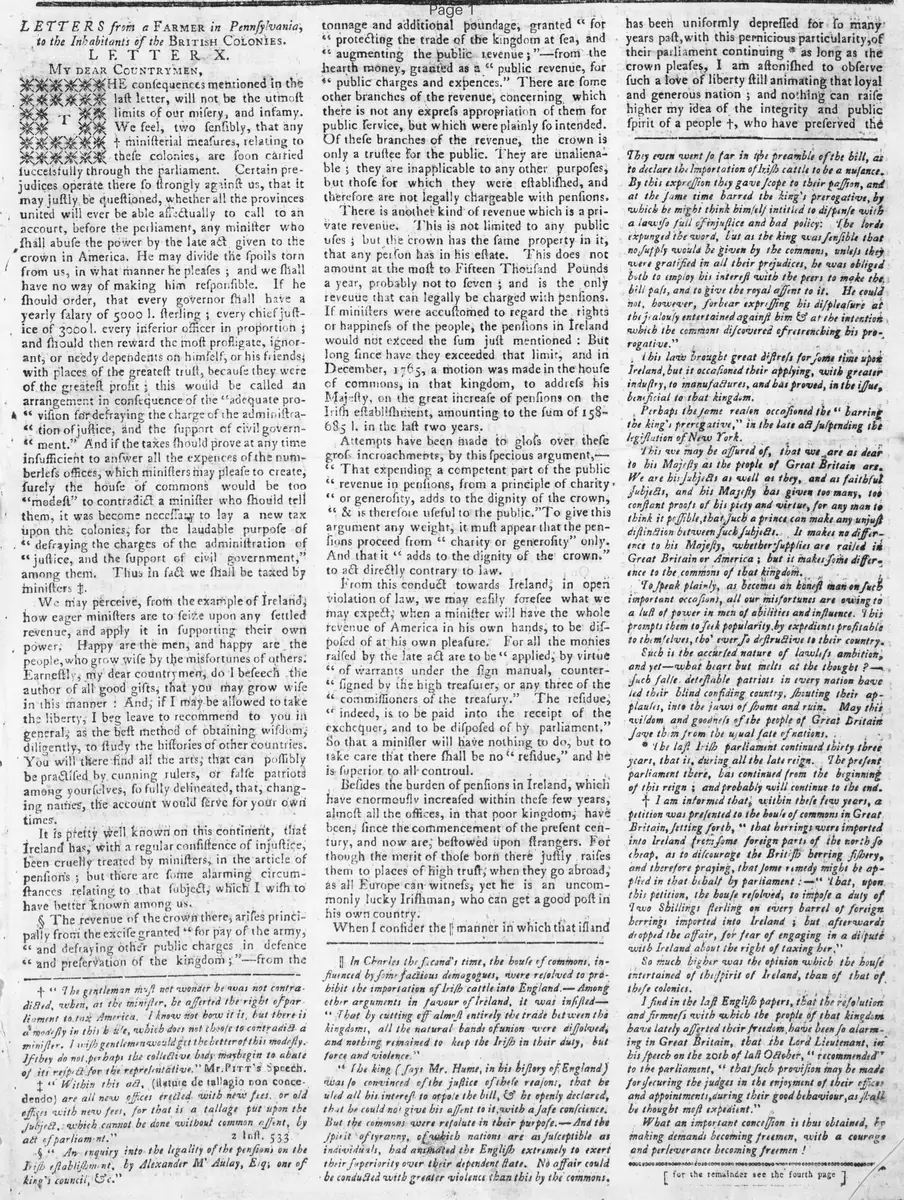
LETTER X.
My Dear COUNTRYMEN,
THE consequences mentioned in the last letter, will not be the utmost limits of our misery, and infamy. We feel too sensibly, that any ministerial measures, relating to these colonies, are soon carried successfully through the parliament. Certain prejudices operate there so strongly against us, that it may justly be questioned, whether all the provinces united will ever be able effectually to call to an account, before the parliament, any minister who shall abuse the power by the late act given to the crown in America. He may divide the spoils torn from us, in what manner he pleases: and we shall have no way of making him responsible. If he should order, that every governor shall have a yearly salary of 2000 l. sterling; every chief justice of 2000 l. every inferior officer in proportion; and should then reward the most profligate, ignorant, or needy dependents on himself, or his friends: with places of the greatest trust, because they were of the greatest profit; this would be called an arrangement in consequence of the "adequate provision for defraying the charge of the administration of justice, and the support of civil government." And if the taxes should prove at any time insufficient to answer all the expenses of the numberless offices, which ministers may please to create, surely the house of commons would be too "modest" to contradict a minister who should tell them, it was become necessary to lay a new tax upon the colonies; for the laudable purpose of defraying the charges of the administration of justice, and the support of civil government, among them. Thus in fact we shall be taxed by ministers to it.
We may perceive, from the example of Ireland, how eager ministers are to seize upon any settled revenue, and apply it in supporting their own power: Happy are the men, and happy are the people, who grow wise by the misfortunes of others: Earnestly, my dear countrymen, do I beseech the author of all good gifts, that you may grow wise in this manner: And, if I may be allowed to take the liberty, I beg leave to recommend to you in general, as the best method of obtaining wisdom, diligently, to study the histories of other countries. You will there find all the arts, that can possibly be practised by cunning rulers, or false patriots among yourselves, so fully delineated, that, changing names, the account would serve for your own times.
It is pretty well known on this continent, that Ireland has, with a regular consistence of injustice, been cruelly treated by ministers, in the article of pensions; but there are some alarming circumstances relating to that subject, which I wish to have better known among us.
The revenue of the crown there, arises principally from the excise granted "for pay of the army, and defraying other public charges in defence and preservation of the kingdom;"--from the tonnage and additional poundage: granted "for protecting the trade of the kingdom at sea, and augmenting the public revenue:" --from the hearth money, granted as a "public revenue, for public charges and expenses." There are some other branches of the revenue, concerning which there is not any express appropriation of them for public service, but which were plainly so intended. Of these branches of the revenue, the crown is only a trustee for the public. They are unalienable; they are inapplicable to any other purposes; but those for which they were established, and therefore are not legally chargeable with pensions. There is another kind of revenue which is a private revenue. This is not limited to any public uses: but the crown has the same property in it, that any person has in his estate. This does not amount at the most to Fifteen Thousand Pounds a year, probably not to seven; and is the only revenue that can legally be charged with pensions. If ministers were accustomed to regard the rights or happiness of the people: the pensions in Ireland would not exceed the sum just mentioned: But long since have they exceeded that limit, and in December, 1765, a motion was made in the house of commons, in that kingdom, to address his Majesty, on the great increase of pensions on the Irish establishment, amounting to the sum of 58,685 l. in the last two years. Attempts have been made to gloss over these gross incroachments, by this specious argument,-- That expending a competent part of the public revenue in pensions, from a principle of charity or generosity, adds to the dignity of the crown; and is therefore useful to the public. To give this argument any weight, it must appear that the pensions proceed from "charity or generosity" only. And that it "adds to the dignity of the crown," to act directly contrary to law.
From this conduct towards Ireland; in open violation of law, we may easily foresee what we may expect; when a minister will have the whole revenue of America in his own hands; to be disposed of at his own pleasure. For all the monies raised by the late act are to be "applied, by virtue of warrants under the sign manual, countersigned by the high treasurer; or any three of the commissioners of the treasury." The residue, indeed, is to be paid into the receipt of the exchequer; and to be disposed of by parliament. So that a minister will have nothing to do, but to take care that there shall be no "residue," and he is superior to all controul. Besides the burden of pensions in Ireland, which have enormously increased within these few years, almost all the offices, in that poor kingdom, have been, since the commencement of the present century, and now are, bestowed upon strangers. For though the merit of those born there justly raises them to places of high trust; when they go abroad; as all Europe can witness; yet he is an uncommonly lucky Irishman, who can get a good post in his own country:
When I consider the manner in which that island has been uniformly depressed for so many years past, with this pernicious particularity, of their parliament continuing as long as the crown pleases, I am astonished to observe such a love of liberty still animating that loyal and generous nation; and nothing can raise higher my idea of the integrity and public spirit of a people, who have preserved the sacred fire of freedom from being extinguished, though the altar on which it burned has been thrown down.
In the same manner shall we be ungratefully be treated, as soon as the late taxes laid upon us shall make posts in the "government," and the "administration of justice" here, worth the attention of persons of influence in Great-Britain. We know enough already to satisfy us of this truth. But this will not be the worst part of our case.
The principals in all great offices will reside in England, making some paltry allowance to deputies, for doing the business here. Let any man consider what an exhausting drain this must be upon us, when ministers are possessed of the power of affixing what salaries they please to posts, and he must be convinced how destructive the late act must be. The injured kingdom, lately mentioned, can tell us the mischiefs of absentees, and we may perceive already the same disposition taking place with us.
The government of New-York has been exercised by a deputy. That of Virginia is now held so; and we know of a number of secretaryships, collectorships, and other offices, held in the same manner.
True it is, that if the people of Great-Britain were not too much blinded, by the passions that have been artfully excited in their breasts against their dutiful children; the colonists, these considerations would be nearly as alarming to them as to us. The influence of the crown was thought, by wise men, many years ago, too great, by reason of the multitude of pensions and places bestowed by it; these have vastly increased since S, and perhaps it would be no difficult matter to prove that the people have decreased.
Surely, therefore, those who wish the welfare of their country, ought seriously to reflect what may be the consequence of such a new creation of offices, in the disposal of the crown.
The army, the administration of justice, and the civil government here, with such salaries as the crown shall please to annex, will extend ministerial influence as much beyond its former bounds, as the late war did the British dominions.
But whatever the people of Great-Britain may think on this occasion; I hope the people of these colonies will unanimously join in this sentiment, that the late act of parliament is injurious to their liberty; and that this sentiment will unite them in a firm opposition to it, in the same manner as the dread of the Stamp-Act did:
Some persons may imagine the sums to be raised by it are but small, and therefore may be inclined to acquiesce under it. A conduct more dangerous to freedom; as before has been observed, can never be adopted. Nothing is wanted at home but a precedent, the force of which shall be established, by the tacit submission of the colonies. With what zeal was the statute erecting a court of enquiry for the recovery of debts in America, urged and tortured as precedents in support of the Stamp-Act, though wholly inapplicable! If the parliament succeeds in this attempt, other statutes will impose other duties. Instead of taxing ourselves, as we have been accustomed to do, from the first Settlement of these provinces, all our usual taxes will be converted into parliamentary taxes on our importations; and thus the parliament will levy upon us such sums of money as they choose to take, without any other limitation than their pleasure.
We know how much labour and care have been bestowed by these colonies, in laying taxes in such a manner that they should be most easy to the people, by being laid on the proper articles; most equal, by being proportioned to every man's circumstances; & cheapest, by the method directed for collecting them.
But parliamentary taxes will be laid on us, without any consideration whether there is any easier mode. The only point regarded will be; the certainty of levying the taxes, and not the convenience of the people, on whom they are to be levied; and therefore all statutes on this head will be such as will be most likely, according to the favourite phrase, "to execute themselves."
Taxes in every free state have been, and ought to be, as exactly proportioned as is possible to the abilities of those who are to pay them. They cannot otherwise be just. Even a Hottentot could comprehend the unreasonableness of making a poor man pay as much for defending the property of a rich man, as the rich man pays himself.
Let any person look into the late act of parliament, and he will immediately perceive, that the immense estates of Lord Fairfax, Lord Baltimore, and our Proprietaries, which are, amongst "his Majesty's other dominions," to be "defended, protected and secured," by that act, will not pay a single farthing of the duties thereby imposed, except Lord Fairfax wants some of his windows glazed. Lord Baltimore and our proprietors are quite secure, as they live in England.
I mention these particular cases, as striking instances, how far the late act is a deviation from that principle of justice, which has so constantly distinguished our own laws on this continent.
The third consideration with our continental assemblies in laying taxes, has been the method of collecting them. This has been done by a few officers, under the inspection of the respective assemblies, with moderate allowances. No more was raised from the subject, than was used for the intended purpose. But, by the late act, a minister may appoint as many officers as he pleases for collecting the taxes; may assign them what salaries he thinks "adequate;" and they are to be subject to no inspection but his own.
In short, if the late act of parliament takes effect, these colonies must dwindle down into "common corporations," as their enemies, in the debates concerning the repeal of the Stamp-Act, strenuously insisted they were: and it is not improbable that some future historians will thus record our fall
"The eighth year of this reign was distinguished by a very memorable event; the American colonies then submitting, for the first time, to be taxed by the British parliament. An attempt of this kind was made about two years before, but was defeated; by the vigorous exertions of the several provinces in defence of their liberties. Their behaviour on that occasion rendered their name very celebrated, for a short time, all over Europe; all states being extremely attentive to a dispute between Great-Britain, and so considerable a part of her dominions. For as she was thought to be grown too powerful, by the successful conclusion of the late war, she had been engaged in, it was hoped by many, that as it had happened before to other kingdoms, civil discords would afford opportunities of revenging all the injuries supposed to be received from her. However the cause of dissension was removed, by a repeal of the statute that had given offence. This affair rendered the submissive conduct of the colonies, so soon after, the more extraordinary; there being no difference between the modes of taxation which they opposed, and that to which they submitted, but this, that by the first, they were to be continually reminded that they were taxed, by certain marks stamped on every piece of paper or parchment they used. The authors of that statute triumphed greatly on this conduct of the colonies, and insisted that if the people of Great-Britain had persisted in enforcing it, the Americans would have been, in a few months, so fatigued with the efforts of patriotism, that they would quickly have yielded obedience.
Certain it is, that though they had before their eyes so many illustrious examples, in their mother country: of the constant success attending firmness and perseverance; in opposition to dangerous encroachments on liberty, yet they quietly gave up a point of the last importance. From thence the decline of their freedom began, and its decay was extremely rapid: for as money was always raised upon them by the parliament, their assemblies grew immediately useless, and in a short time contemptible: And, in less than one hundred years, the people sunk down into that tameness and supineness of spirit by which they still continue to be distinguished."
Et majores vestros et posteros cogitate Remember your ancestors and your posterity.
A FARMER.
They even went so far in the preamble of the bill, as to declare the Importation of Irish cattle to be a nuisance. By this expression they gave scope to their passion, and at the same time barred the king's prerogative, by which he might think himself entitled to dispense with a law so full of injustice and bad policy: The lords expunged the word, but as the king was sensible that no supply could be given by the commons, unless they were gratified in all their prejudices, he was obliged both to employ his interest with the peers to make the bill pass, and to give the royal assent to it. He could not, however, forbear expressing his displeasure at the jealousy entertained against him & at the intention which the commons discovered of retrenching his prerogative."
This law brought great distress for some time upon Ireland, but it occasioned their applying, with greater industry, to manufactures, and has proved, in the issue, beneficial to that kingdom. Perhaps the same reason occasioned the "barring the king's prerogative," in the late act suspending the legislation of New York.
This we may be assured of, that we are as dear to his Majesty as the people of Great Britain are. We are his subjects as well as they, and as faithful subjects, and his Majesty has given too many, too constant proofs of his piety and virtue, for any man to think it possible, that such a prince can make any unjust distinction between such subjects.: It makes no difference to his Majesty, whether supplies are raised in Great Britain or America; but it makes some difference to the commons of that kingdom.
To speak plainly, as becomes an honest man on such important occasions, all our misfortunes are owing to a lust of power in men of abilities and influence. This prompts them to seek popularity by expedients profitable to themselves, tho' ever so destructive to their country. Such is the accursed nature of lawless ambition. and yet-what heart but melts at the thought ?- such false, detestable patriots in every nation have led their blind confiding country, shouting their applauses, into the jaws of shame and ruin. May this wisdom and goodness of the people of Great Britain save them from the usual fate of nations.
* The last Irish parliament continued thirty three years, that is, during all the late reign. The present parliament there, has continued from the beginning of this reign; and probably will continue to the end.
I am informed that within these few years, a petition was presented to the house of commons in Great Britain, setting forth, "that herrings were imported into Ireland from some foreign parts of the north so cheap, as to discourage the British herring fishery. and therefore praying, that some remedy might be applied in that behalf by parliament:-" That, upon this petition, the house resolved, to impose a duty of Two Shillings Sterling on every barrel of foreign herrings imported into Ireland; but afterwards dropped the affair, for fear of engaging in a dispute with Ireland about the right of taxing her."
So much higher was the opinion which the house entertained of the spirit of Ireland, than of that of these colonies.
I find in the last English papers, that the resolution and firmness with which the people of that kingdom have lately asserted their freedom have been so alarming in Great Britain, that the Lord Lieutenant, in his speech on the 20th of last October, "recommended" to the parliament, "that such provision may be made for securing the judges in the enjoyment of their offices and appointments, during their good behaviour, as shall be thought most expedient."
What an important concession is thus obtained, by making demands becoming freemen, with a courage and perseverance becoming freemen!
for the remainder see the fourth page
Footnotes:
The gentleman must not wonder he was not contradicted, when, as the minister, he asserted the right of parliament to tax America. I know not how it is, but there is a modesty in this bulk, which does not choose to contradict a minister. I wish gentlemen would get the better of this modesty. If they do not perhaps the collective body may begin to abate of its respect for the representative." Mr. PITT's Speech.
"Within this act. (statute de tallagio non concedendo) are all new offices erected with new fees, or old offices with new fees. for that is a tallage put upon the subject: which cannot be done without common assent, by act of parliament."
2 Inst. 533.
..."An enquiry into the legality of the pensions on the Irish Establishment: by Alexander M'Aulay, Esq; one of king's council, &c."
In Charles the Second's time, the house of commons, influenced by some factious demagogues, were resolved to prohibit the importation of Irish cattle into England.- Among other arguments in favour of Ireland, it was insisted- "That by cutting off almost entirely the trade between the kingdoms, all the natural bands of union were dissolved, and nothing remained to keep the Irish in their duty, but force and violence."
"The king (says Mr. Hume, in his history of England) was so convinced of the justice of these reasons, that he used all his interest to oppose the bill, & he openly declared, that he could not give his assent to it with a safe conscience. But the commons were resolute in their purpose.-- And the spirit of tyranny, of which nations are as susceptible as individuals, had animated the English extremely to exert their superiority over their dependent state. No affair could be conducted with greater violence than this by the commons.
§ One of the reasons urged by that great and honest Statesman, Sir William Temple, to Charles the Second, in his famous remonstrance to dissuade him from aiming at arbitrary power, was, the "king had few offices to bestow."
Hume's Hist. of England.
"As though the rings of prerogative have been clipped, the influence of the crown is greater than ever it was, in any period of our history. For when we consider, in how many boroughs the government has the voters at command; when we consider the vast body of persons employed in the collection of the revenue in every part of the kingdom, the inconceivable number of placemen, and candidates for places, in the customs, in the excise, in the post office, in the dock yards, in the ordnance, in the salt office, in the stamps, in the navy and victualling offices, & in a variety of other departments: When we consider again the extensive influence of the money corporations, subscription jobbers and contractors; the endless dependence created by the obligations conferred on the bulk of the gentlemen's families throughout the kingdom, who have relations preferred in our navy, and numerous standing army; when, I say, we consider how wide, how binding a dependence on the crown, is created by the above enumerated particulars; and the great, the enormous weight and influence which the crown derives from this extensive dependence upon its favour and power; any lord in waiting, any lord of the bedchamber, any man, may be appointed minister.]
A doctrine to this effect is said to have been the advice of L. H.
Late News Paper.
The people of Maryland & Pennsylvania have been engaged in the warmest disputes, in order to obtain an equal & just taxation of their proprietaries estates; but the late act of parliament does more for those proprietaries, than they themselves would venture to demand. It totally exempts them from taxation.
What sub-type of article is it?
What keywords are associated?
What entities or persons were involved?
Editorial Details
Primary Topic
Critique Of Parliamentary Acts Enabling Ministerial Abuse Of Colonial Revenues
Stance / Tone
Strongly Oppositional To Ministerial Power And Taxation Without Representation
Key Figures
Key Arguments
- ministers can abuse power granted by the late act without accountability
- ireland's revenues misused for pensions violating public trust
- parliamentary taxes lack consideration for colonial convenience and equality
- exemption of proprietary estates from taxes unjust
- precedent of submission leads to loss of liberties and assembly irrelevance