Thank you for visiting SNEWPapers!
Sign up free
The New Hampshire Gazette
Portsmouth, Rockingham County, New Hampshire
What is this article about?
Commentary on the British King's proclamation offering pardons and aid to deserters, as interpreted by British Consul Phineas Bond in Philadelphia, who assured a pretended deserter of pardon, protection, money, and free transport home.
Clipping
OCR Quality
Full Text
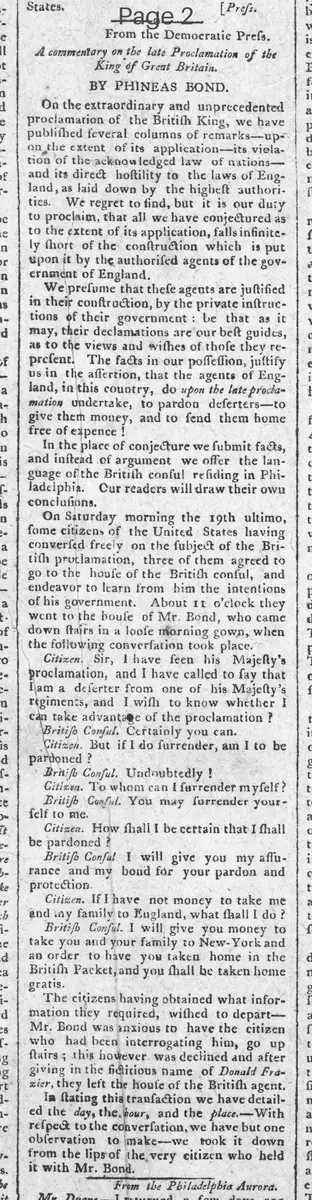
A commentary on the late Proclamation of the King of Great Britain.
BY PHINEAS BOND.
On the extraordinary and unprecedented proclamation of the British King, we have published several columns of remarks—upon the extent of its application—its violation of the acknowledged law of nations—and its direct hostility to the laws of England, as laid down by the highest authorities. We regret to find, but it is our duty to proclaim, that all we have conjectured as to the extent of its application, falls infinitely short of the construction which is put upon it by the authorized agents of the government of England.
We presume that these agents are justified in their construction, by the private instructions of their government: be that as it may, their declamations are our best guides, as to the views and wishes of those they represent. The facts in our possession, justify us in the assertion, that the agents of England, in this country, do upon the late proclamation undertake, to pardon deserters—to give them money, and to send them home free of expense!
In the place of conjecture we submit facts, and instead of argument we offer the language of the British consul residing in Philadelphia. Our readers will draw their own conclusions.
On Saturday morning the 19th ultimo, some citizens of the United States having conversed freely on the subject of the British proclamation, three of them agreed to go to the house of the British consul, and endeavor to learn from him the intentions of his government. About 11 o'clock they went to the house of Mr. Bond, who came down stairs in a loose morning gown, when the following conversation took place.
Citizen. Sir, I have seen his Majesty's proclamation, and I have called to say that I am a deserter from one of his Majesty's regiments, and I wish to know whether I can take advantage of the proclamation?
British Consul. Certainly you can.
Citizen. But if I do surrender, am I to be pardoned?
British Consul. Undoubtedly!
Citizen. To whom can I surrender myself?
British Consul. You may surrender yourself to me.
Citizen. How shall I be certain that I shall be pardoned?
British Consul I will give you my assurance and my bond for your pardon and protection
Citizen. If I have not money to take me and my family to England, what shall I do?
British Consul. I will give you money to take you and your family to New-York and an order to have you taken home in the British Packet, and you shall be taken home gratis.
The citizens having obtained what information they required, wished to depart—Mr. Bond was anxious to have the citizen who had been interrogating him, go up stairs; this however was declined and after giving in the fictitious name of Donald Frazier, they left the house of the British agent.
In stating this transaction we have detailed the day, the hour, and the place.—With respect to the conversation, we have but one observation to make—we took it down from the lips of the very citizen who held it with Mr. Bond.
What sub-type of article is it?
What keywords are associated?
What entities or persons were involved?
Where did it happen?
Foreign News Details
Primary Location
Philadelphia
Event Date
Saturday Morning The 19th Ultimo
Key Persons
Outcome
pardon and protection for deserters, money provided, free transport home via british packet from new-york
Event Details
Citizens visited British Consul Phineas Bond in Philadelphia to inquire about the King's proclamation. Posing as deserter Donald Frazier, the consul assured pardon upon surrender to him, provided assurance and bond, offered money to New-York for the deserter and family, and free passage home. The proclamation seen as violating law of nations and English laws, with agents extending its application beyond expectations.