Thank you for visiting SNEWPapers!
Sign up free
Story
October 12, 1862
The Nashville Daily Union
Nashville, Davidson County, Tennessee
What is this article about?
The Nashville Union publishes extracts from captured private letters written to Confederate soldiers, mostly from Alabama families, revealing sentiments of war weariness, economic hardships, family separations, and hopes for peace amid the 1862 rebellion.
Clipping
OCR Quality
98%
Excellent
Full Text
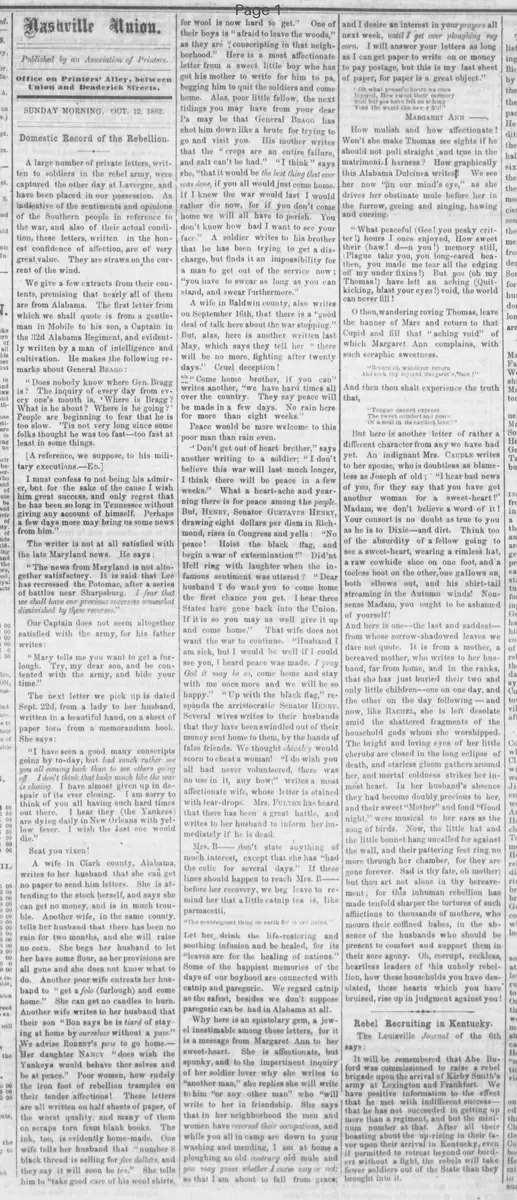
Nashville Union.
Published by an Association of Printers.
Office on Printers' Alley, between Union and Deaderick Streets.
SUNDAY MORNING, OCT. 12, 1862.
Domestic Record of the Rebellion.
A large number of private letters, written to soldiers in the rebel army, were captured the other day at Lavergne, and have been placed in our possession. As indicative of the sentiments and opinions of the Southern people in reference to the war, and also of their actual condition, these letters, written in the honest confidence of affection, are of very great value. They are straws on the current of the wind
We give a few extracts from their contents, premising that nearly all of them are from Alabama. The first letter from which we shall quote is from a gentleman in Mobile to his son, a Captain in the 32d Alabama Regiment, and evidently written by a man of intelligence and cultivation. He makes the following remarks about General Bragg:
"Does nobody know where Gen. Bragg is? The inquiry of every day from every one's mouth is, 'Where is Bragg? What is he about? Where is he going?' People are beginning to fear that he is too slow. 'Tis not very long since some folks thought he was too fast—too fast at least in some things."
[A reference, we suppose, to his military executions.—ED.]
I must confess to not being his admirer, but for the sake of the cause I wish him great success, and only regret that he has been so long in Tennessee without giving any account of himself. Perhaps a few days more may bring us some news from him."
The writer is not at all satisfied with the late Maryland news. He says:
"The news from Maryland is not altogether satisfactory. It is said that Lee has recrossed the Potomac, after a series of battles near Sharpsburg. I fear that we shall have our previous successes somewhat diminished by these reverses."
Our Captain does not seem altogether satisfied with the army, for his father writes:
"Mary tells me you want to get a furlough. Try, my dear son, and be contented with the army, and bide your time."
The next letter we pick up is dated Sept. 22d, from a lady to her husband, written in a beautiful hand, on a sheet of paper torn from a memorandum book. She says:
"I have seen a good many conscripts going by to-day, but had much rather see you all coming back than to see others going off I don't think that looks much like the war is closing. I have almost given up in despair of its ever closing. I am sorry to think of you all having such hard times out there. I hear they (the Yankees) are dying daily in New Orleans with yellow fever. I wish the last one would die."
Scat you vixen!
A wife in Clark county, Alabama, writes to her husband that she can get no paper to send him letters. She is attending to the stock herself, and says she can get no money, and is in much trouble. Another wife, in the same county tells her husband that there has been no rain for two months, and she will raise no corn. She begs her husband to let her have some flour, as her provisions are all gone and she does not know what to do. Another poor wife entreats her husband to "get a folo (furlough) and come home." She can get no candles to burn. Another wife writes to her husband that their son "Bon says he is tired of staying at home by ourselves without a paw."
We advise Bon's paw to go home.—
Her daughter Nancy "does wish the Yankees would behave themselves and be at peace." Poor women, how rudely the iron foot of rebellion tramples on their tender affections! These letters are all written on half sheets of paper, of the worst quality, and many of them on scraps torn from blank books. The ink, too, is evidently home-made. One wife tells her husband that "number 8 black thread is selling for five dollars, and they say it will soon be ten." She tells him to "take good care of his wool shirts, for wool is now hard to get." One of their boys is "afraid to leave the woods," as they are "conscripting in that neighborhood." Here is a most affectionate letter from a sweet little boy who has got his mother to write for him to pa, begging him to quit the soldiers and come home. Alas, poor little fellow, the next tidings you may have from your dear Pa may be that General Bragg has shot him down like a brute for trying to go and visit you. His mother writes that the "crops are an entire failure, and salt can't be had." "I think" says she, "that it would be the best thing that ever was done, if you all would just come home. If I knew the war would last I would rather die now, for if you don't come home we will all have to perish. You don't know how bad I want to see your face." A soldier writes to his brother that he has been trying to get a discharge, but finds it an impossibility for a man to get out of the service now; "you have to swear as long as you can stand, and swear furthermore." A wife in Baldwin county, also writes on September 16th, that there is a "good deal of talk here about the war stopping." But, alas, here is another written last May, which says they tell her "there will be no more fighting after twenty days." Cruel deception! "Come home brother, if you can" writes another, "we have hard times all over the country. They say peace will be made in a few days. No rain here for more than eight weeks."
Peace would be more welcome to this poor man than rain even.
"Don't get out of heart brother," says another writing to a soldier: "I don't believe this war will last much longer, I think there will be peace in a few weeks." What a heart-ache and yearning there is for peace among the people. But, Henry, Senator Gustavus Henry, drawing eight dollars per diem in Richmond, rises in Congress and yells: "No peace! Hoist the black flag, and begin a war of extermination!" Didn't Hell ring with laughter when the infamous sentiment was uttered? "Dear husband I do want you to come home the first chance you get. I hear three States have gone back into the Union. If it is so you may as well give it up and come home." That wife does not want the war to continue. "Husband I am sick, but I would be well if I could see you, I heard peace was made. I pray God it may be so, come home and stay with me once more and we will be so happy." "Up with the black flag," responds the aristocratic Senator Henry. Several wives write to their husbands that they have been swindled out of their money sent home to them, by the hands of false friends. We thought chivalry would scorn to cheat a woman! "I do wish you all had never volunteered, there was no use in it, any how;" writes a most affectionate wife, whose letter is stained with tear-drops. Mrs. Fulton has heard that there has been a great battle, and writes to her husband to inform her immediately if he is dead. Mrs. B—don't state anything of much interest, except that she has "had the colic for several days." If these lines should happen to reach Mrs. B— before her recovery, we beg leave to remind her that a little catnip tea is, like parmacetti,
"The sovereignest thing on earth for colic pains."
Let her drink the life-restoring and soothing infusion and be healed, for its
"leaves are for the healing of nations."
Some of the happiest memories of the days of our boyhood are connected with catnip and paregoric. We regard catnip as the safest, besides we don't suppose paregoric can be had in Alabama at all. Why here is an epistolary gem, a jewel inestimable among these letters, for it is a message from Margaret Ann to her sweet-heart. She is affectionate, but spunky, and to the impertinent inquiry of her soldier lover why she writes to "another man," she replies she will write to him "or any other man" who "will write to her in friendship. She says that in her neighborhood the men and women have reversed their occupations, and while you all in camp are down to your washing and mending, I am at home a ploughing an old contrary old mule and you may guess whether I curse any or not; so that I am about to fall from grace; and I desire an interest in your prayers all next week, until I get over ploughing my corn. I will answer your letters as long as I can get paper to write on or money to pay postage, but this is my last sheet of paper, for paper is a great object."
Oh what peaceful hours we once enjoyed, How sweet their memory still! But you have left an aching void the world can never fill!
MARGARET ANN
How mulish and how affectionate! Won't she make Thomas see sights if he should not pull straight and true in the matrimonial harness? How graphically this Alabama Dulcinea writes! We see her now "in our mind's eye," as she drives her obstinate mule before her in the furrow, geeing and singing, hawing and cursing.
"What peaceful (Gee! you pesky critter!) hours I once enjoyed, How sweet their (haw! d—n you!) memory still,
Plague take you, you long-eared heathen, you made me tear all the edging off my under fixins!) But you (oh my Thomas!) have left an aching (Quit kicking, blast your eyes!) void, the world can never fill!"
O thou, wandering roving Thomas, leave the banner of Mars and return to that of Cupid and fill that "aching void" of which Margaret Ann complains, with such seraphic sweetness.
"Return oh wanderer return
And seek thy injured Margaret's face!"
And then thou shalt experience the truth that,
"Tongue cannot express
The sweet comfort and peace
Of a soul in its earliest love!"
But here is another letter of rather a different character from any we have had yet. An indignant Mrs. Couple writes to her spouse, who is doubtless as blameless as Joseph of old; "I hear bad news of you, for they say that you have got another woman for a sweet-heart!"
Madam, we don't believe a word of it! Your consort is no doubt as true to you as he is to Dixie—and dirt. Think too of the absurdity of a fellow going to see a sweet-heart, wearing a rimless hat, a raw cowhide shoe on one foot, and a toeless boot on the other, one gallows on both elbows out, and his shirt-tail streaming in the Autumn winds! Nonsense Madam, you ought to be ashamed of yourself!
And here is one—the last and saddest—from whose sorrow-shadowed leaves we dare not quote. It is from a mother, a bereaved mother, who writes to her husband, far from home, and in the ranks, that she has just buried their two and only little children—one on one day, and the other on the day following—and now, like Rachel, she is left desolate amid the shattered fragments of the household gods whom she worshipped. The bright and loving eyes of her little cherubs are closed in the long eclipse of death, and starless gloom gathers around her, and mortal coldness strikes her inmost heart. In her husband's absence they had become doubly precious to her, and their sweet "Mother" and fond "Good night," were musical to her ears as the song of birds. Now, the little hat and the little bonnet hang uncalled for against the wall, and their pattering feet ring no more through her chamber, for they are gone forever. Sad is thy fate, oh mother; but thou art not alone in thy bereavement; for this inhuman rebellion has made tenfold sharper the tortures of such afflictions to thousands of mothers, who mourn their coffined babes, in the absence of the husbands who should be present to comfort and support them in their sore agony. Oh, corrupt, reckless, heartless leaders of this unholy rebellion, how these households you have desolated, these hearts which you have bruised, rise up in judgment against you!
Published by an Association of Printers.
Office on Printers' Alley, between Union and Deaderick Streets.
SUNDAY MORNING, OCT. 12, 1862.
Domestic Record of the Rebellion.
A large number of private letters, written to soldiers in the rebel army, were captured the other day at Lavergne, and have been placed in our possession. As indicative of the sentiments and opinions of the Southern people in reference to the war, and also of their actual condition, these letters, written in the honest confidence of affection, are of very great value. They are straws on the current of the wind
We give a few extracts from their contents, premising that nearly all of them are from Alabama. The first letter from which we shall quote is from a gentleman in Mobile to his son, a Captain in the 32d Alabama Regiment, and evidently written by a man of intelligence and cultivation. He makes the following remarks about General Bragg:
"Does nobody know where Gen. Bragg is? The inquiry of every day from every one's mouth is, 'Where is Bragg? What is he about? Where is he going?' People are beginning to fear that he is too slow. 'Tis not very long since some folks thought he was too fast—too fast at least in some things."
[A reference, we suppose, to his military executions.—ED.]
I must confess to not being his admirer, but for the sake of the cause I wish him great success, and only regret that he has been so long in Tennessee without giving any account of himself. Perhaps a few days more may bring us some news from him."
The writer is not at all satisfied with the late Maryland news. He says:
"The news from Maryland is not altogether satisfactory. It is said that Lee has recrossed the Potomac, after a series of battles near Sharpsburg. I fear that we shall have our previous successes somewhat diminished by these reverses."
Our Captain does not seem altogether satisfied with the army, for his father writes:
"Mary tells me you want to get a furlough. Try, my dear son, and be contented with the army, and bide your time."
The next letter we pick up is dated Sept. 22d, from a lady to her husband, written in a beautiful hand, on a sheet of paper torn from a memorandum book. She says:
"I have seen a good many conscripts going by to-day, but had much rather see you all coming back than to see others going off I don't think that looks much like the war is closing. I have almost given up in despair of its ever closing. I am sorry to think of you all having such hard times out there. I hear they (the Yankees) are dying daily in New Orleans with yellow fever. I wish the last one would die."
Scat you vixen!
A wife in Clark county, Alabama, writes to her husband that she can get no paper to send him letters. She is attending to the stock herself, and says she can get no money, and is in much trouble. Another wife, in the same county tells her husband that there has been no rain for two months, and she will raise no corn. She begs her husband to let her have some flour, as her provisions are all gone and she does not know what to do. Another poor wife entreats her husband to "get a folo (furlough) and come home." She can get no candles to burn. Another wife writes to her husband that their son "Bon says he is tired of staying at home by ourselves without a paw."
We advise Bon's paw to go home.—
Her daughter Nancy "does wish the Yankees would behave themselves and be at peace." Poor women, how rudely the iron foot of rebellion tramples on their tender affections! These letters are all written on half sheets of paper, of the worst quality, and many of them on scraps torn from blank books. The ink, too, is evidently home-made. One wife tells her husband that "number 8 black thread is selling for five dollars, and they say it will soon be ten." She tells him to "take good care of his wool shirts, for wool is now hard to get." One of their boys is "afraid to leave the woods," as they are "conscripting in that neighborhood." Here is a most affectionate letter from a sweet little boy who has got his mother to write for him to pa, begging him to quit the soldiers and come home. Alas, poor little fellow, the next tidings you may have from your dear Pa may be that General Bragg has shot him down like a brute for trying to go and visit you. His mother writes that the "crops are an entire failure, and salt can't be had." "I think" says she, "that it would be the best thing that ever was done, if you all would just come home. If I knew the war would last I would rather die now, for if you don't come home we will all have to perish. You don't know how bad I want to see your face." A soldier writes to his brother that he has been trying to get a discharge, but finds it an impossibility for a man to get out of the service now; "you have to swear as long as you can stand, and swear furthermore." A wife in Baldwin county, also writes on September 16th, that there is a "good deal of talk here about the war stopping." But, alas, here is another written last May, which says they tell her "there will be no more fighting after twenty days." Cruel deception! "Come home brother, if you can" writes another, "we have hard times all over the country. They say peace will be made in a few days. No rain here for more than eight weeks."
Peace would be more welcome to this poor man than rain even.
"Don't get out of heart brother," says another writing to a soldier: "I don't believe this war will last much longer, I think there will be peace in a few weeks." What a heart-ache and yearning there is for peace among the people. But, Henry, Senator Gustavus Henry, drawing eight dollars per diem in Richmond, rises in Congress and yells: "No peace! Hoist the black flag, and begin a war of extermination!" Didn't Hell ring with laughter when the infamous sentiment was uttered? "Dear husband I do want you to come home the first chance you get. I hear three States have gone back into the Union. If it is so you may as well give it up and come home." That wife does not want the war to continue. "Husband I am sick, but I would be well if I could see you, I heard peace was made. I pray God it may be so, come home and stay with me once more and we will be so happy." "Up with the black flag," responds the aristocratic Senator Henry. Several wives write to their husbands that they have been swindled out of their money sent home to them, by the hands of false friends. We thought chivalry would scorn to cheat a woman! "I do wish you all had never volunteered, there was no use in it, any how;" writes a most affectionate wife, whose letter is stained with tear-drops. Mrs. Fulton has heard that there has been a great battle, and writes to her husband to inform her immediately if he is dead. Mrs. B—don't state anything of much interest, except that she has "had the colic for several days." If these lines should happen to reach Mrs. B— before her recovery, we beg leave to remind her that a little catnip tea is, like parmacetti,
"The sovereignest thing on earth for colic pains."
Let her drink the life-restoring and soothing infusion and be healed, for its
"leaves are for the healing of nations."
Some of the happiest memories of the days of our boyhood are connected with catnip and paregoric. We regard catnip as the safest, besides we don't suppose paregoric can be had in Alabama at all. Why here is an epistolary gem, a jewel inestimable among these letters, for it is a message from Margaret Ann to her sweet-heart. She is affectionate, but spunky, and to the impertinent inquiry of her soldier lover why she writes to "another man," she replies she will write to him "or any other man" who "will write to her in friendship. She says that in her neighborhood the men and women have reversed their occupations, and while you all in camp are down to your washing and mending, I am at home a ploughing an old contrary old mule and you may guess whether I curse any or not; so that I am about to fall from grace; and I desire an interest in your prayers all next week, until I get over ploughing my corn. I will answer your letters as long as I can get paper to write on or money to pay postage, but this is my last sheet of paper, for paper is a great object."
Oh what peaceful hours we once enjoyed, How sweet their memory still! But you have left an aching void the world can never fill!
MARGARET ANN
How mulish and how affectionate! Won't she make Thomas see sights if he should not pull straight and true in the matrimonial harness? How graphically this Alabama Dulcinea writes! We see her now "in our mind's eye," as she drives her obstinate mule before her in the furrow, geeing and singing, hawing and cursing.
"What peaceful (Gee! you pesky critter!) hours I once enjoyed, How sweet their (haw! d—n you!) memory still,
Plague take you, you long-eared heathen, you made me tear all the edging off my under fixins!) But you (oh my Thomas!) have left an aching (Quit kicking, blast your eyes!) void, the world can never fill!"
O thou, wandering roving Thomas, leave the banner of Mars and return to that of Cupid and fill that "aching void" of which Margaret Ann complains, with such seraphic sweetness.
"Return oh wanderer return
And seek thy injured Margaret's face!"
And then thou shalt experience the truth that,
"Tongue cannot express
The sweet comfort and peace
Of a soul in its earliest love!"
But here is another letter of rather a different character from any we have had yet. An indignant Mrs. Couple writes to her spouse, who is doubtless as blameless as Joseph of old; "I hear bad news of you, for they say that you have got another woman for a sweet-heart!"
Madam, we don't believe a word of it! Your consort is no doubt as true to you as he is to Dixie—and dirt. Think too of the absurdity of a fellow going to see a sweet-heart, wearing a rimless hat, a raw cowhide shoe on one foot, and a toeless boot on the other, one gallows on both elbows out, and his shirt-tail streaming in the Autumn winds! Nonsense Madam, you ought to be ashamed of yourself!
And here is one—the last and saddest—from whose sorrow-shadowed leaves we dare not quote. It is from a mother, a bereaved mother, who writes to her husband, far from home, and in the ranks, that she has just buried their two and only little children—one on one day, and the other on the day following—and now, like Rachel, she is left desolate amid the shattered fragments of the household gods whom she worshipped. The bright and loving eyes of her little cherubs are closed in the long eclipse of death, and starless gloom gathers around her, and mortal coldness strikes her inmost heart. In her husband's absence they had become doubly precious to her, and their sweet "Mother" and fond "Good night," were musical to her ears as the song of birds. Now, the little hat and the little bonnet hang uncalled for against the wall, and their pattering feet ring no more through her chamber, for they are gone forever. Sad is thy fate, oh mother; but thou art not alone in thy bereavement; for this inhuman rebellion has made tenfold sharper the tortures of such afflictions to thousands of mothers, who mourn their coffined babes, in the absence of the husbands who should be present to comfort and support them in their sore agony. Oh, corrupt, reckless, heartless leaders of this unholy rebellion, how these households you have desolated, these hearts which you have bruised, rise up in judgment against you!
What sub-type of article is it?
Historical Event
Family Drama
Curiosity
What themes does it cover?
Misfortune
Family
Tragedy
What keywords are associated?
Civil War Letters
Southern Hardships
Confederate Soldiers
Family Separation
War Weariness
Conscription
Furlough Pleas
Economic Shortages
What entities or persons were involved?
General Bragg
Senator Gustavus Henry
Margaret Ann
Mrs. Fulton
Mrs. B
Where did it happen?
Alabama, Tennessee, Maryland
Story Details
Key Persons
General Bragg
Senator Gustavus Henry
Margaret Ann
Mrs. Fulton
Mrs. B
Location
Alabama, Tennessee, Maryland
Event Date
1862
Story Details
Captured letters from Southern families to Confederate soldiers express war fatigue, economic shortages, crop failures, conscription fears, pleas for furloughs, and desperate hopes for peace, contrasted with leaders' calls for continued war.