Thank you for visiting SNEWPapers!
Sign up free
Alexandria Gazette
Alexandria, Alexandria County, District Of Columbia
What is this article about?
A letter to the Alexandria Gazette editor criticizes its favorable portrayal of the March 18, 1839, Fairfax County Whig meeting, noting divisions over Dr. Mason's ambiguous support for Mr. Rives, defending Whig preferences for Chapman Johnson and Henry Clay, and denouncing a resolution on Van Buren's alleged proscription as unfair to Postmaster Dr. Gunnell.
Clipping
OCR Quality
Full Text
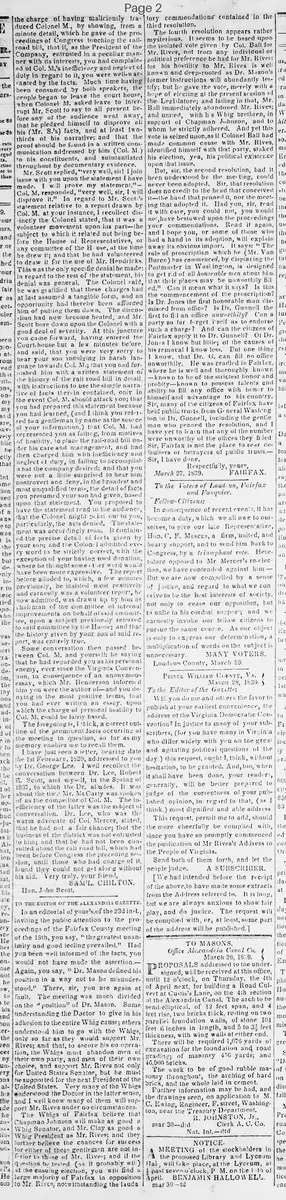
In an editorial of yours, of the 23d inst. inviting the public attention to the proceedings of the Fairfax County meeting of the 18th, you say, "the greatest unanimity and good feeling prevailed." Had you been well informed of the facts, you would not have made the assertion.—
Again, you say, "Dr. Mason defined his position in a way not to be misunderstood." There, sir, you are again at fault. The meeting was much divided on the "position" of Dr. Mason. Some understanding the Doctor to give in his adhesion to the entire Whig cause; others understood him to go with the Whigs, only so far as they would support Mr. Rives: and that, to secure his co-operation, the Whigs must abandon men of their own party, and men of their own choice, and support Mr. Rives not only for United States Senator, but he must be supported for the next President of the United States. Very many of the Whigs understood the Doctor in the latter sense, and I well know many of them will support Mr. Rives under no circumstances.
The Whigs of Fairfax believe that Chapman Johnson will make as good a Whig Senator, and Mr. Clay as good a Whig President as Mr. Rives; and they further believe the chances for success for either of these gentlemen are not inferior to those of Mr. Rives; and if the question be tested (as it probably will) at the ensuing election, you will find a large majority of Fairfax in opposition to Mr. Rives, notwithstanding the laudatory commendations contained in the third resolution.
The fourth resolution appears rather mysterious. It seems to be based upon the isolated vote given by Col. Ball for Mr. Rives, not from any individual or political preference he had for Mr. Rives: for his hostility to Mr. Rives is well known and deep-rooted as Dr. Mason's former instructions will abundantly testify; but he gave the vote, merely with a hope of electing at the present session of the Legislature; and failing in that, Mr. Ball immediately abandoned Mr. Rives; and united, with his Whig brethren, in support of Chapman Johnson, and to whom he strictly adhered. And yet this vote is seized upon, as if Colonel Ball had identified himself with that party, staked his election, yea, his political existence upon that issue.
But, sir, the second resolution, had it been understood by the meeting, could never have been adopted. Sir, that resolution does no credit to the head that conceived it—the hand that penned it, nor the meeting that adopted it. Had you, sir, read it with care, you could not, you would not, have bestowed upon the proceedings your commendations. Read it again, and I hope you, or some of those who had a hand in its adoption, will explain away its obvious import. It says: "The rule of proscription which he (Mr. Van Buren) has commenced, by displacing the Postmaster in Washington, is designed to get rid of all honorable men about him that their places may be unworthily filled." Can it mean what it says? Is this the commencement of the proscription? Is Dr. Jones the first honorable man dismissed from office? Is Dr. Gunnell the first to fill an office unworthily? Can a party so far forget itself as to endorse such a charge? And can the citizens of Fairfax apply it to Dr. Gunnell? Of Dr. Jones I know but little; of the causes of his removal I know less. But one thing I know, that Dr. G. can fill no office unworthily. He was cradled in Fairfax, where he is well and thoroughly known—known to be of the strictest honor and probity—known to possess talents and ability to fill any office with honor to himself and advantage to his country.
Sir, many of the citizens of Fairfax have held public trusts, from General Washington to Dr. Gunnell, including the gentleman who penned the resolution, and I have yet to learn that any of the number were unworthy of the offices they filled. Sir, Fairfax is not the place to rear defaulters or betrayers of public trusts.—
Sir, I have done.
Respectfully, yours,
FAIRFAX.
March 27, 1839.
What sub-type of article is it?
What themes does it cover?
What keywords are associated?
What entities or persons were involved?
Letter to Editor Details
Author
Fairfax
Recipient
The Editor Of The Alexandria Gazette
Main Argument
the editor's portrayal of the fairfax county whig meeting as unanimous and clear is inaccurate; the meeting was divided over dr. mason's support for mr. rives, whigs prefer chapman johnson and henry clay, and the second resolution unjustly accuses van buren of proscription while slandering the honorable dr. gunnell.
Notable Details