Thank you for visiting SNEWPapers!
Sign up free
The Virginia Gazette
Richmond, Williamsburg, Richmond County, Virginia
What is this article about?
In a lengthy letter to the printer, John Mercer of Marlborough defends his sons George and James against anonymous attacks in Virginia gazettes accusing them of involvement in the Stamp Act. He recounts George's military service, unwitting appointment and quick resignation as Stamp Distributor, and denounces critics like Richard Henry Lee as hypocrites and defamers promoting division amid colonial resistance to British taxation.
Merged-components note: These four components form a single continuous letter to the editor by John Mercer, spanning pages 1-3, defending his son against slanders. The text flows directly from one to the next without interruption.
Clippings
1 of 3
OCR Quality
Full Text
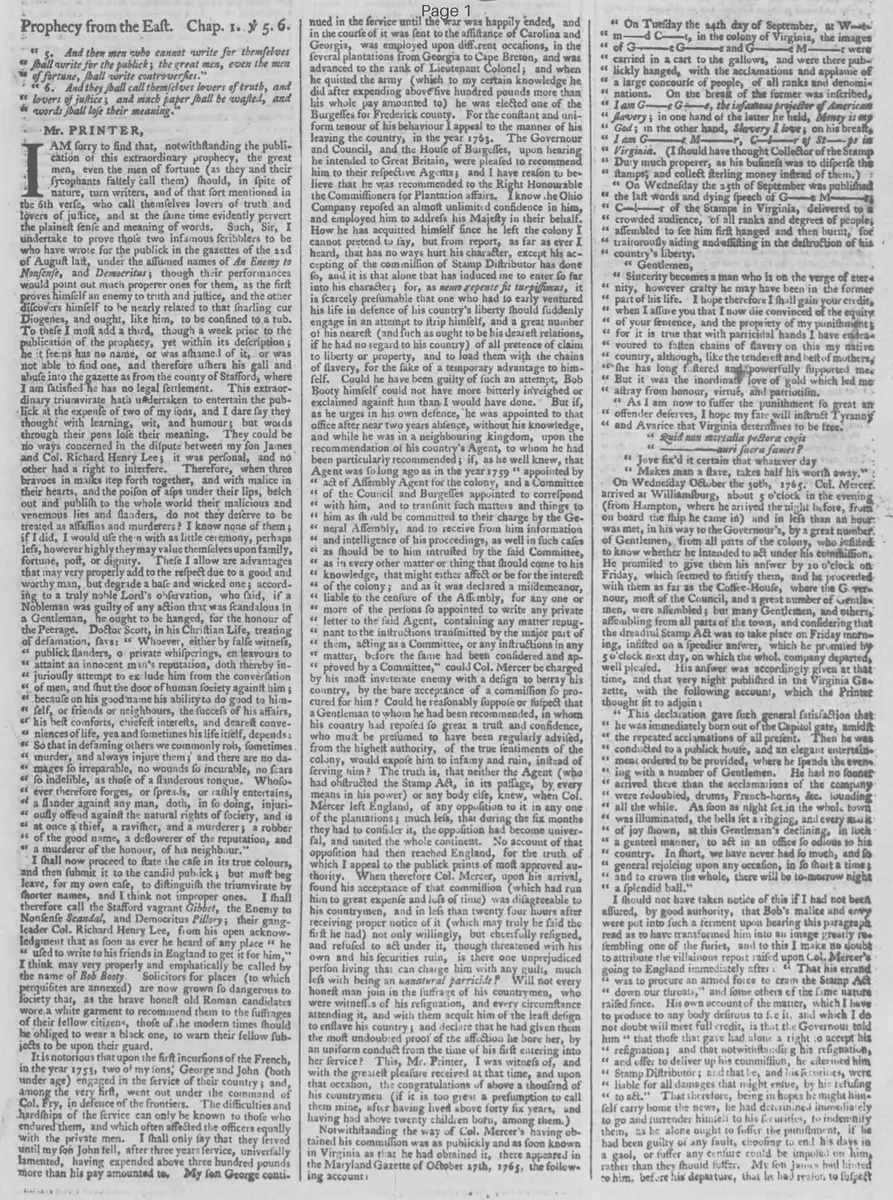
5. And then men who cannot write for themselves shall write for the publick; the great men, even the men of fortune, shall write controversies."
"6. And they shall call themselves lovers of truth, and lovers of justice; and much paper shall be wasted, and words shall lose their meaning."
Mr. PRINTER,
I am sorry to find that, notwithstanding the publication of this extraordinary prophecy, the great men, even the men of fortune (as they and their sycophants falsely call them) should, in spite of nature, turn writers, and of that sort mentioned in the 6th verse, who call themselves lovers of truth and lovers of justice, and at the same time evidently pervert the plainest sense and meaning of words. Such, Sir, I undertake to prove those two infamous scribblers to be who have wrote for the publick in the gazettes of the 22d of August last, under the assumed names of An Enemy to Nonsense, and Democritus; though their performances would point out much properer ones for them, as the first proves himself an enemy to truth and justice, and the other discovers himself to be nearly related to that snarling cur Diogenes, and ought, like him, to be confined to a tub.
To these I must add a third, though a week prior to the publication of the prophecy, yet within its description; he it seems has no name, or was ashamed of it, or was not able to find one, and therefore ushers his gall and abuse into the gazette as from the county of Stafford, where I am satisfied he has no legal settlement. This extraordinary triumvirate hath undertaken to entertain the publick at the expense of two of my sons, and I dare say they thought with learning, wit, and humour; but words through their pens lose their meaning. They could be no ways concerned in the dispute between my son James and Col. Richard Henry Lee; it was personal, and no other had a right to interfere. Therefore, when three bravoes in masks step forth together, and with malice in their hearts, and the poison of asps under their lips, belch out and publish to the whole world their malicious and venomous lies and slanders, do not they deserve to be treated as assassins and murderers? I know none of them; if I did, I would use them with as little ceremony, perhaps less, however highly they may value themselves upon family, fortune, post, or dignity. These I allow are advantages that may very properly add to the respect due to a good and worthy man, but degrade a base and wicked one; according to a truly noble Lord's observation, who said, if a Nobleman was guilty of any action that was scandalous in a Gentleman, he ought to be hanged, for the honour of the Peerage. Doctor Scott, in his Christian Life, treating of defamation, says: "Whoever, either by false witness, publick slanders, or private whisperings, endeavours to attaint an innocent man's reputation, doth thereby injuriously attempt to exclude him from the conversation of men, and shut the door of human society against him; because on his good name his ability to do good to himself, or friends or neighbours, the success of his affairs, his best comforts, chiefest interests, and dearest conveniences of life, yea and sometimes his life itself, depends: So that in defaming others we commonly rob, sometimes murder, and always injure them; and there are no damages so irreparable, no wounds so incurable, no scars so indelible, as those of a slanderous tongue. Whosoever therefore forges, or spreads, or rashly entertains, a slander against any man, doth, in so doing, injuriously offend against the natural rights of society, and is at once a thief, a ravisher, and a murderer; a robber of the good name, a deflowerer of the reputation, and a murderer of the honour, of his neighbour."
I shall now proceed to state the case in its true colours, and then submit it to the candid publick; but must beg leave, for my own ease, to distinguish the triumvirate by shorter names, and I think not improper ones. I shall therefore call the Stafford vagrant Gibbet, the Enemy to Nonsense Scandal, and Democritus Pillory; their gang-leader Col. Richard Henry Lee, from his open acknowledgment that as soon as ever he heard of any place "he used to write to his friends in England to get it for him," I think may very properly and emphatically be called by the name of Bob Booty. Solicitors for places (to which perquisites are annexed) are now grown so dangerous to society that, as the brave honest old Roman candidates wore a white garment to recommend them to the suffrages of their fellow citizens, those of the modern times should be obliged to wear a black one, to warn their fellow subjects to be upon their guard.
It is notorious that upon the first incursions of the French, in the year 1753, two of my sons, George and John (both under age) engaged in the service of their country; and, among the very first, went out under the command of Col. Fry, in defence of the frontiers. The difficulties and hardships of the service can only be known to those who endured them, and which often affected the officers equally with the private men. I shall only say that they served until my son John fell, after three years service, universally lamented, having expended above three hundred pounds more than his pay amounted to. My son George continued
in the service until the war was happily ended, and in the course of it was sent to the assistance of Carolina and Georgia, was employed upon different occasions, in the several plantations from Georgia to Cape Breton, and was advanced to the rank of Lieutenant Colonel; and when he quitted the army (which to my certain knowledge he did after expending above five hundred pounds more than his whole pay amounted to) he was elected one of the Burgesses for Frederick county. For the constant and uniform tenor of his behaviour I appeal to the manner of his leaving the country, in the year 1763. The Governour and Council, and the House of Burgesses, upon hearing he intended to Great Britain, were pleased to recommend him to their respective Agents; and I have reason to believe that he was recommended to the Right Honourable the Commissioners for Plantation affairs. I know he Ohio Company reposed an almost unlimited confidence in him, and employed him to address his Majesty in their behalf. How he has acquitted himself since he left the colony I cannot pretend to say, but from report, as far as ever I heard, that has no ways hurt his character, except his accepting of the commission of Stamp Distributor has done so, and it is that alone that has induced me to enter so far into his character; for, as nemo repente fit turpissimus, it is scarcely presumable that one who had so early ventured his life in defence of his country's liberty should suddenly engage in an attempt to strip himself, and a great number of his nearest (and such as ought to be his dearest relations, if he had no regard to his country) of all pretence of claim to liberty or property, and to load them with the chains of slavery, for the sake of a temporary advantage to himself. Could he have been guilty of such an attempt, Bob Booty himself could not have more bitterly inveighed or exclaimed against him than I would have done. But if, as he urges in his own defence, he was appointed to that office after near two years absence, without his knowledge, and while he was in a neighbouring kingdom, upon the recommendation of his country's Agent, to whom he had been particularly recommended; if, as he well knew, that Agent was so long ago as in the year 1759 "appointed by act of Assembly Agent for the colony, and a Committee of the Council and Burgesses appointed to correspond with him, and to transmit such matters and things to him as should be committed to their charge by the General Assembly, and to receive from him information and intelligence of his proceedings, as well in such cases as should be to him intrusted by the said Committee, as in every other matter or thing that should come to his knowledge, that might either affect or be for the interest of the colony; and as it was declared a misdemeanor, liable to the censure of the Assembly, for any one or more of the persons so appointed to write any private letter to the said Agent, containing any matter repugnant to the instructions transmitted by the major part of them, acting as a Committee, or any instructions in any matter, before the same had been considered and approved by a Committee," could Col. Mercer be charged by his most inveterate enemy with a design to betray his country, by the bare acceptance of a commission so procured for him? Could he reasonably suppose or suspect that a Gentleman to whom he had been recommended, in whom his country had reposed so great a trust and confidence, who must be presumed to have been regularly advised, from the highest authority, of the true sentiments of the colony, would expose him to infamy and ruin, instead of serving him? The truth is, that neither the Agent (who had obstructed the Stamp Act, in its passage, by every means in his power) or any body else, knew, when Col. Mercer left England, of any opposition to it in any one of the plantations; much less, that during the six months they had to consider it, the opposition had become universal, and united the whole continent. No account of that opposition had then reached England, for the truth of which I appeal to the publick prints of most approved authority. When therefore Col. Mercer, upon his arrival, found his acceptance of that commission (which had run him to great expense and loss of time) was disagreeable to his countrymen, and in less than twenty four hours after receiving proper notice of it (which may truly be said the first he had) not only willingly, but cheerfully resigned, and refused to act under it, though threatened with his own and his securities ruin, is there one unprejudiced person living that can charge him with any guilt, much less with being an unnatural parricide? Will not every honest man join in the suffrage of his countrymen, who were witnesses of his resignation, and every circumstance attending it, and with them acquit him of the least design to enslave his country; and declare that he had given them the most undoubted proof of the affection he bore her, by an uniform conduct from the time of his first entering into her service? This, Mr. Printer, I was witness of, and with the greatest pleasure received at that time, and upon that occasion, the congratulations of above a thousand of his countrymen (if it is too great a presumption to call them mine, after having lived above forty six years, and having had above twenty children born, among them.)
Notwithstanding the way of Col. Mercer's having obtained his commission was as publickly and as soon known in Virginia as that he had obtained it, there appeared in the Maryland Gazette of October 25th, 1765, the following account
"On Tuesday the 24th day of September, at W-ts md Ct, in the colony of Virginia, the images of G-e G-e and G-e M-r were carried in a cart to the gallows, and were there publicly hanged, with the acclamations and applause of a large concourse of people of all ranks and denominations.
On the breast of the former was inscribed, I am G-e G-e, the infamous projector of American slavery; in one hand of the latter he held, Money is God; in the other hand, Slavery I love; on his breast I am G-e M-r, Collector of Stamps in Virginia. (I should have thought Collector of the Stamp Duty much properer, as his business was to disperse the stamps; and collect sterling money instead of them.)
"On Wednesday the 25th of September was published the last words and dying speech of G-e M-r, Collector of the Stamps in Virginia, delivered to a crowded audience, of all ranks and degrees of people; assembled to see him first hanged and then burnt, for traitorously aiding and assisting in the destruction of his country's liberty.
"Gentlemen,
"Sincerity becomes a man who is on the verge of eternity, however crafty he may have been in the former part of his life.
I hope therefore I shall gain your credit, when I assure you that I now die convinced of the equity of your sentence, and the propriety of my punishments for it is true that with parricidal hands I have endeavoured to fasten chains of slavery on this my native country, although, like the tenderest and best of mothers, she has long fostered and powerfully supported me
"But it was the inordinate love of gold which led me astray from honour, virtue, and patriotism.
"As I am now to suffer the punishment of great an offender deserves, I hope my fate will instruct tyranny and Avarice that Virginia determines to be free.
"Quid non mortalia pectora cogis auri sacra fames?
"Jove fix'd it certain that whatever day Makes man a slave, takes half his worth away."
On Wednesday October the 30th, 1765, Col. Mercer arrived at Williamsburg, about 5 o'clock in the evening (from Hampton, where he arrived the night before, from on board the ship he came in) and in less than an hour was met, in his way to the Governour's, by a great number of Gentlemen, from all parts of the colony, who insisted to know whether he intended to act under his commission. He promised to give them his answer by 10 o'clock on Friday, which seemed to satisfy them, and he proceeded with them as far as the Coffee-House, where the Governour, most of the Council, and a great number of Gentlemen, were assembled; but many Gentlemen, and others assembling from all parts of the town, and considering that the dreadful Stamp Act was to take place on Friday morning, insisted on a speedier answer, which he promised by 5 o'clock next day, on which the whole company departed, well pleased.
His answer was accordingly given at that time, and that very night published in the Virginia Gazette, with the following account, which the Printer thought fit to adjoin:
"This declaration gave such general satisfaction that he was immediately borne out of the Capitol gate, amidst the repeated acclamations of all present. Then he was conducted to a publick house, and an elegant entertainment ordered to be provided, where he spends the evening with a number of Gentlemen. He had no sooner arrived there than the acclamations of the company were redoubled, drums, French-horns, &c. sounding all the while. As soon as night set in the whole town was illuminated, the bells set a ringing, and every mark of joy shown, at this Gentleman's declining, in such a genteel manner, to act in an office so odious to his country. In short, we have never had so much, and so general rejoicing upon any occasion, in so short a time and to crown the whole, there will be to-morrow night a splendid ball."
I should not have taken notice of this if I had not been assured, by good authority, that Bob's malice and envy were put into such a ferment upon hearing this paragraph read last to have transformed him into an image greatly resembling one of the furies, and to this I make no doubt to attribute the villainous report raised upon Col. Mercer's going to England immediately after: That his errand was to procure an armed force to cram the Stamp Act down our throats, and some others of the same nature raised since.
His own account of the matter, which I have to produce to any body desirous to see it, and which I do not doubt will meet full credit, is that the Governour told him that those that gave had alone a right to accept his resignation; and that notwithstanding his resignation, and offer to deliver up his commission, he esteemed him Stamp Distributor; and that he, and his securities, were liable for all damages that might ensue, by his refusing to act."
That therefore, being in hopes he might himself carry home the news, he had determined immediately to go and surrender himself to his securities, to indemnify them, as he alone ought to suffer the punishment, if he had been guilty of any fault, choosing to end his days in a gaol, or suffer any censure could be imposed on him rather than they should suffer. My son James had hinted to him, before his departure, that he had reason to suspect
that Bob was not only the author of the infamous speech
distributed to him, but tried himself solicited the commission
of Stamp Distributor, and recommended to him to make
a proper inquiry when he got to London. Upon the in-
formation he received from his brother, with that from a
friend James Last, and upon Col. Francis Lee's ack-
nowledging to him, on the 7th day of July following, at
Prince William Court, that his brother Richard Henry
was the author of the dying speech, though he prevaricated
as to his solicitation, he thought proper to publish that
piece in the Virginia Gazette of July the 8th, under the
name of An Enemy to Hypocrisy, in order that Bob might
either deny or acknowledge the infamous slander and
forgery he had been guilty of. I shall confine myself to
consider the truth of the Facts mentioned in it, and the
calumny it is said to contain, without regarding the sense-
less cavils raised against the grammar or diction of it. As
to what relates to Col. Mercer, Bob does not dispute it,
nor can any one deny the facts; indeed they do not affect
Bob, except he cannot bear to hear that there is any such
thing as an honest man. The facts he is charged with are,
that he, being more culpable than Col. Mercer, fa-
bricated a meagre effigy, created after his own likeness,
and inspired with his own soul, which he baptized with
the name of Col. Mercer, whom (because more than three
thousand miles distant in) he treated with unheard of scar-
rility and base detraction, for which he refers to the dying
speech. Lastly, Bob's own confession, of soliciting by his
own, as well as his friend's letters. My essay in note
the 2d, the first report he heard of a Stamp Duty was in
October 1764 and that copies of the votes of the House
of Commons arrived in Virginia in that month (which he
dared to say was prior to the date of the Confessor's letters)
and then in notes 4th, 5th, and 6th, he charges that Bob
must have known the sentiments of his countrymen better
than Col. Mercer, who had been twenty two months ab-
sent, that his Solicitation (being from the post) made it
presumable that the act was agreeable to his countrymen;
that Bob could not recollect his solicitation until his me-
mory was refreshed by a letter from Col. Mercer to the
late Speaker; and, lastly, that he did not discover the
consequences of the act until he was asked his solicitation
was ineffectual: So that it was to be presumed his patri-
otic spirit was set on fire by envy and disappointment, the
flame of which was so hot as to burn a meagre effigy and
old house, in presence of many Negroes. An honourable
multitude indeed! The first fact confesses by his-
self; it was acknowledged by his brother, and seems to
be certified by Gibbet and Scandal. As to the second, I
apply to Bob's own justification; and, besides, can fix
an earlier notice of a Stamp Duty being to be imposed on
the Colonies, by referring to the Virginia Gazette of April
27th, 1764, which Bob certainly knew of, in which,
under the article of New York intelligence, dated April
4th, was published the following extract of a letter from a
Gentleman in London to his friend here (that is, New
York) dated February 7th, 1764
"There is nothing new that is agreeable, but we have
every thing to fear that may hurt our purses, in the line
of colonies; you will soon have a parcel of Myrmidonian
ravens, who will feed upon and rip up your very vitals,
Such as officers of Stamp Duties, Appraisers of Lands,
Houses, Furniture, &c."
In the Virginia Gazette of April 26th, 1765, was pub-
lished an alphabetical table of the Stamp Duties, extracted
from the votes and resolves of the House of Commons of
February 7th, 1765, which I had prepared for the press,
immediately upon their arrival, about a fortnight before,
as the most effectual method of demonstrating the exorbi-
tance of the duty, and to put my fellow subjects upon their
guard. The publication was delayed, by the Printer's
refusing to publish my introduction (which he had pro-
mised) till I offered to put my name to it, and give
him any security for his indemnity. I was there-
fore obliged to send the introduction to one of the Northward
presses, with the reasons of its not being published here;
and in the meantime distributed many written copies, sev-
eral of which were in the hands of the Burgesses during
their session in May 1765. The times being thus ascer-
tained, I shall examine Bob's answer; to which, being so
recently published, and in every body's hands, I must beg
leave to refer. And if it does not amount to a full con-
fession of every thing my essay charged him with, and a
manifest proof of his hypocrisy and equivocation, I do
acknowledge that I do not understand it. That his ap-
plication was made in November 1764, he admits. That
he would not omit the first opportunity to forward his let-
ters, every body will be satisfied. That not one ship in
forty is forty days upon her passage in the winter, is no-
torious. How then will he make out that his letters did
not get home until many months after the appointment of
a Distributor was made (which, by the way, is not very
proper English.) Are not these glaring absurdities, and
contradictions? And are there idiots to be found that can
implicitly swallow them? If his error was discovered in
a few days, after his letters were sent away, was it not
incumbent on him to have given his friend notice of the
alteration of his sentiments? And was not a promulgation
of his application become absolutely necessary? As he lay
by, and left his friend to pursue his solicitation, can it be
doubted that if his friend had succeeded in it he would not
have accepted the commission? Was not his solicitation
during that very session in which he values himself upon
the part he bore in preparing the address to his Majesty,
the memorial to the Lords, and remonstrance to the House
of Commons? Let me then ask you, Bob, when you as-
sumed that part in publick, were you not endeavouring to
counteract it in private? Was your eagerness and impa-
tience so excessive that you could not wait until it had been
established, or at least until some steps had been taken to-
wards bringing in a bill to establish it? Must not such
premature applications of persons whose reputations are
shielded (as a new whipper-in, hereafter mentioned, one
Clysterpip, says) by the love of every true Virginian, con-
vince the Ministry that such an act would be readily re-
ceived and easily executed? And do not the Lords in their
second protest appeal to the Governor's letters, and the
application of many of the most intelligent and respectable
persons in the American provinces for the practicability
thereof of carrying the act into execution in every colony,
if the experiment had been properly tried? What then can
avail any appeal you make? Is it not notorious that your
application (to whomsoever you might have acknowledged
it in private) was not only a secret to every one I have
ever heard speak of the subject, but was absolutely as May
last expressly denied by some of your nearest friends and
relations, with little respect to Col. Corbin, whose kind
tender of his interest they said you rejected with disdain?
What part did you take in the session of May 1765, when
the resolves were agreed to, when no Stamp Distributor
was appointed, when the success of your application con-
tinued doubtful? Must it not then raise the indignation
of every honest man to know that you were the person who
treated Col. Mercer with such unheard of scurrility, and
base detraction, in his absence; when, to your disap-
pointment, you understood that he was appointed? To
charge a man who you knew had faithfully served his
country, and had left it as well respected and beloved,
and with as fair and unblemished a character and reputa-
tion, as perhaps any man of his age had ever acquired,
with being a traitor to his country, an unnatural and un-
grateful parricide, being seduced by avarice; to impose it
on the publick as his own confession, and to publish the
hellish slander in the publick gazette of another province,
in order to scatter and perpetuate the infamous calumny;
I will undertake to affirm is a crime that richly deserves
the gallows, and cannot be expiated or excused by any of
your hypocritical appeals, or proud and insolent boastings.
But I have dwelt too long on so vile a subject, and it is
high time to think of your friend Gibbet.
This mangles council begins with observing that the
publick received a very friendly admonition, not long ago,
from some honest quarter and says it was couched in the
words of Sallust, ascribed to Micipsa; quem alienum fidem
(instead of fidum) inrieres, si tuis hostis fueris? And then
tells that he fancies it imports this question in English,
How can you expect that strangers will entertain a friendly
opinion of you when you are always jarring among your-
elves? Buckskin (from whom he borrowed his quotation)
very properly applied Micipsa's (and not Sallust's) words
of advice to his sons, to recommend concord and unani-
mity to the colonists, as the only means of preserving their
constitutional rights. Gibbet enters the lists not with any
intention of promoting union, but with a cankered heart,
to interpose in the most partial manner in behalf of the
Colonel of Westmoreland, as if there was no other Colonel
in that county, against Squire James, or Master James of
St. James's (as he sneeringly styles him) and, like a true
incendiary, endeavours to inflame and increase a difference
(which he had nothing to do with) being merely personal
between them, until he and some other incendiaries inter-
posed. The Squire, or Master James, from the first of
Micipsa's words, quis autem amicior quam frater fratri,
seems to be well justified in attempting to vindicate a bro-
ther villainously traduced, behind his back, by a parcel of
rufians; yet Gibbet, by sounding the trumpet of discord,
has called out the rest of the gang to his and his master's
assistance, though not one of them has the honesty to ap-
pear under his true name, and some without any at all.
What right can such scoundrels have to attack an honest
man, who appears openly, and without disguise, and in an
honest and laudable cause; and especially at a time when he
was at a place where he could not hear or be informed of
the poisonous shafts they were so profusely scattering every
post to wound and defame him? Gibbet, in order to im-
pover this personal difference into a party quarrel, informs
the publick that there were many in company at the read-
ing Squire James's paper, and says the sentiments upon it
differed as much as the countries in which the several hear-
ets were born. Then adds, some North Britons grinned
a general applause, and skipped about with great levity;
and introduces a Gentleman of much approved gravity,
from whose witty remark upon the harp and bagpipe in
concert, I think it very evident that that same grave Gen-
tleman is one of Gibbet's, or rather his master Bob's gang,
and a very proper member of it. But, Gibbet, you and
your Gentleman of much approved gravity are much mis-
taken if you take this for wit and humour; it only serves
to expose your ignorance and ill breeding; if either of you
is, or ever was possessed of any property, you could not be
ignorant how much this colony, in particular, is indebted
to the Harp and Bagpipe for the trade they have promoted
here. The first is unfortunately cramped, and cannot ex-
extend its trade so far as might be wished; the last, which
is not fettered, now purchases and exports more of your
commodities than all England, and greatly more to your
advantage. They surely then are at least entitled to good
manners, and it would much better become you to add
your Banjo to the concert than disturb a harmony that
ought by no means to be interrupted. I must agree with
Gibbet that these are not proper times to attempt to expose
hypocrisy, yet I hope there are some people who detest it,
and would be pleased to see it exposed. Gibbet then in-
dulges the rancour and malice of his heart, in giving such
a state of the main point (as he calls it) as could only be
suggested to him by his good friend the Devil, the father
and first author of lying; and, rather than Col. Mercer
should escape his venomous and contagious slanders, is
content to give up his master, to admit him to be guilty of
that severe indisposition of the heart the auri sacra fames,
and to be a solicitor for the office of executioner to the
freedom of his country, but partially attributes it to his
being surprised into it, and at the same time takes upon
himself to charge Col. Mercer with ingratitude to his
country, after having been genteelly rewarded for his ten
years past services (which with more than infernal impu-
dence and falsehood he says is confessed by the St. James's
writer.) The main point has been already fully stated;
Col. Mercer ought not to have been drawn into the dis-
pute. Bob never once mentioned his name in his perform-
ance, "as he must have known, as well as I do, that he
never got a single shilling, but impaired his own fortune,
in the service of his country, which he served with zeal
and integrity; and that he always had, and still has, her
honour and interest more at heart than Bob Booty or any
of his gang. And therefore nobody but such a foul-
mouthed infamous scoundrel and liar as Gibbet, or some
of his gang, would have drawn him into it, and so infa-
mously traduced him; but Gibbet knew that he was three
thousand miles distant, and upon his return would be un-
able to discover who was the infamous assassin that en-
deavoured to defame him.
Scandal, who comes next in turn, like the other great
men, has plunged into controversy, without knowing, or
perhaps caring, what was the true state of the case, but
merely to indulge himself in slander and defamation.
Though he has not honesty enough to own his name, but
fights under a mask, yet he informs the publick whose tool
he is. His reflections upon calumny, and the fear he
seems to be under that His Good Name might fall a vic-
tim to it, when his whole performance consists of nothing
else, must convince the publick of his bare-faced impudence
and audacity; at the same time it gives them an ample
specimen of his talents in lying, scurrility, and detraction.
With these talents he runs in and joins the cry, with the
other yelping curs, to run down the Biographer. As his
piece contains nothing relating to the main point, I shall
only take notice of such parts of it as this whelp of the
pack seems to distinguish his abilities by, and make some
remarks upon them. But first, it may be proper to let
him know (as he could not discover it) why the Biogra-
pher thought fit to inform the publick that he lived at St.
James's in Frederickburg. It seems the Biographer
thought, as I do, that every man who taxes another in
publick ought either to sign his true name or let the pub-
lic and person taxed know where he was to be found, to
make good what he asserted: and was this rule established,
and strictly adhered to, I am satisfied that it would more
effectually put a stop to defamation than any other method
I can think of. As a specimen of Scandal's scurrility, I
have from his piece elected the following nosegay, col-
lected out of his garden: Scandalous misrepresentation of a
man remarkable for neither publick nor private merit
very grossly malevolent, ill-bred, and illiterate—the cha-
grin arising from the disappointed hopes of wealth flowing
in abundance upon his family at the expense of publick
ruin—this petty, confident, prejudiced biographical re-
porter of facts—in defiance of truth has presumed to
calumniate a Gentleman's character—it is his insignifi-
cancy only gives him the privilege of being ignorant and
supercilious with impunity—Scandal, let me tell you the
Biographer you abuse is a Gentleman of both publick and
private merit, a lover of his country, and well esteemed
by many of the principal Gentlemen in it; and is besides
an honest man, who detests lying and defamation, as well
as hypocrisy, and has spirit enough to vindicate both him-
self and his friends, when attacked with those infernal
weapons. On the other hand, you, Scandal, not having
the fear of God before your eyes, but being moved and
seduced by the instigation of the Devil, are a vile malicious
incendiary, villainous detractor, and infamous liar, and
deserve to have your ears cut off and your nose slit; which
sentence perhaps Col. Mercer, whom you have drawn into
the dispute, and so villainously slandered, without any
occasion, would have caused to have been executed on you
if you had dared to have said in his hearing what you have
dared to publish. Your assertion that he did not desist from
his office but by absolute compulsion carries a charge that
affects a great number of worthy Gentlemen, and contra-
dicts the account of that transaction in the Virginia Gazette,
already mentioned; which, I make no doubt, the publick
will pay more regard to than the bare assertion of a sense-
less detractor and infamous villain.
I should now have concluded with Scandal, if I had not
recollected that he had assumed the title of An Enemy to
Nonsense. Upon examining his whole piece to find upon
what grounds he had founded his pretensions to that title,
I cannot find one instance he gives of the Biographer's.
He says the publick was not concerned to know Colonel
Mercer was burnt in effigy, and that quid non mortalia
pector a cogis, auri sacra fames, was its last words; and
adds this extraordinary remark, Such is this Biographer's
skill in grammar (I did not know that false grammar was
nonsense.) Scandal, not content with this insult, concludes
in these words: I have only now to inform this little Bio-
grapher that his petulance shall ne'er again provoke me to
the trouble of writing, and to admonish him from Horace,
scribendi recte sapere est principium et fons; which I shall
explain for him, as it is by no means presumable that
an English Biographer, who understands not English,
should know any thing of Latin. To be a good Biographer
you should understand grammar. Was there ever such an
impudent scoundrel and impostor? Does not every school-
boy know that the true English of Horace's Latin is, wis-
dom (or to be wise) is the beginning and fountain of
writing rightly (or well.) And in answer to his gram-
matical observation, I must refer him to Bob Booty's ac-
count of the dying speech, in these words:
On Wednesday the 5th of September was published the
last words and dying speech, &c. I shall now conclude
with a piece of advice: Scandal, repent; and take care
of your ears, and the gallows.
The next scoundrel enters the lists under the name of
Democritus, but whom I have more properly called Pillory,
from his infamous attempt to impose upon the publick, by
dating his performance from St. James's in the out skirts
of Frederickburg. This Fellow sets up for a wit, and
proposes printing by subscription some essays, of which
(as he very truly says) he gives a very imperfect sketch.
His wit I must leave to the publick to discover, as well as
what he means by the author having found by experience
that it was the best way to sell books before—and. I must
own both are beyond my comprehension, and therefore I
must proceed to consider his essays. His first relates to a
comparison between Bob Booty's solicitation and Colonel
Mercer's acceptance, a point already so fully treated of
that it would be impertinent to say any more about it.
The second, he says, shows that the style and titles by
which the GREAT ONES of the world have distinguished
themselves are mere usurpations, and the author declares
his fixed purpose of setting an example to free his fellow
creatures from this insufferable tyranny. Rium teneatis
amici? What mean grovelling abject minion must Pillory
be? Who could imagine there was a wretch breathing
who could set up Bob Booty for one of the great ones of
the world!! Should Bob distinguish himself (as Pillory has
wanted very rightly to word) by such a style and title,
would he not be fit for Bedlam, and undergo the regimen
of the place, until he was reduced to his proper senses?
His third essay, The whole Art of Lying, I make no doubt
but Pillory is an adept in, and can very properly treat of
in all its parts, as well as of defamation. Of these he has
given so undoubted a specimen in his publication that I
dare engage, if he will let the publick know where he is
to be found, he will soon have a numerous subscription
for this essay, as the qualifications seem at present to be
much in the modern taste. Pillory's fourth essay I make
nothing of, except he means the mob who attended
Booty's sham execution; if he does, I think it would be
better for their own, as well as the country's interest, that
they could be changed into Blacks, as they would be kept
to hard labour, and the country would not be so overrun
with vagabonds. Some of Pillory's masters can instruct
him in another secret, that of making Whites out of Blacks,
so as not to be distinguished; but I forgot of whom I was
writing, it is not only very presumable that Pillory knows
the trick, but that he may be employed by some of his
masters, as a jack ass, in that profitable secret. As to his
invention of a sure method of inspiring effigies with souls,
the subject of his first essay, Pillory endeavours to rob his
master of the honour of that discovery. He had long ago
made an image that made a speech, so strictly agreeable
to the rules of grammar, and in such a style, that I dare
say not one soul of the mob that attended the execution
had sense enough to understand one half of it; and I think
he well deserves a patent, to prevent Pillory, or any other
coundrel, from robbing him of the profit he might reap
from it. The hodge-podge Pillory has mixed up for his
late essay I can make nothing of. Whether, by the con-
tents and flavour of that delectable pleasure-giving dish
called a haggis, and the most exquisite delight to the pa-
lates accustomed to the good flavour of that mixture, he
intended to second his brother Gibbet with another fling
at the North Britons, I must submit to the public; and
confign Pillory to his tub, where his excrements will soon
supply him with a mixture whose good flavour will exceed
that of the most delectable pleasure-giving haggis that
ever was made.
But what an endless undertaking, Mr. Printer, have I
plunged myself in? Mr. Rind's last supplement of Au-
gust 29th furnished me with a new antagonist, who from
addressing the publick without a name, but in all of the
rest of the pack, I have great reason to believe is as great
a coundrel as any of them; nay, from his translation of
the word faber-carpenter, which he has distinguished by
a different type, I take him to be a more mean pirited
rascal than the rest. and must believe, notwithstanding his
Greek (however he came by it) that he had the first of
his education in a Negro quarter. But before entering
upon any answer to his piece, I judged it requisite to fix
upon a proper name for him; that I assure you, Mr. Printer,
cost me no small trouble; I was obliged to read his per-
formance over and over and over again. Sometimes I
concluded he must certainly be one of the great ones of the
world, and from his Greek (I am sorry Mr. Rind had no
Greek types; I hope both you and he will provide some,
and Hebrew ones too: For though I do not understand
them, I love to look at them; and perhaps I can get our
parson, or some other friend, when I want to address the
publick, to pick out a Greek or Hebrew motto for me.)
But to return from my digression. I say, from his Greek,
I concluded that he was, as Mrs. Slipslop says, a perdi-
gious scholar; but after three or four more readings, and
the help of my notes, which I carefully took every time,
and finding the words--class of vile arts--to speak in
the medical way--a morbid disposition of the mind--
endemic in another country--disposes the brain to those
monstrous conceptions---and considering his puffing and
bombast, I could not help suspecting that he was some
apothecary or mountebank, or one of those itinerant
Doctor's retainers commonly known and distinguished by
the name of Jack Pudding. Merry Andrew, or Pickled
Herring. At length, to avoid any further plague or trouble,
I determined to call him Clysterpipe. And now, Mr.
Clysterpipe, a word with you. You will find (if you have
a dictionary, and will consult it) that faber, simply and
properly taken, signifies a smith, a forger, a hammerer,
but with a proper addition may be made to signify any
thing; with that of aerarius, a coppersmith; clysterum, a
clysterpipe maker; ferrarius, a blacksmith; lignarius, a
carpenter (but a master carpenter is in Latin architectus)
lastly, sua quique fortunae faber, includes the greatest part
of mankind, the shoeboy, pickpocket, gambler, mounte-
bank, and a thousand others. But as it may be inquired
how Clysterpipe came to fix on the term carpenter, and
distinguish it among the class of vile arts (as he calls them)
by a different type, I shall acquaint the publick that the
Biographer, when a youth, took a particular liking to that
vile art, and one Bromley (who I believe was the best
architect that ever was in America) assuring me that he
had a most extraordinary turn to mechanicks, I, who
thought the professors of those vile arts were more beneficial
members of society, and more likely to make a fortune,
with credit, than the young Gentlemen of those times,
who with laced jackets attended for improvement at ordina-
ries, horse races, cock matches, and gaming tables, readily
consented to indulge his inclination, and he was accord-
ingly bound apprentice to Mr. Waite, a master carpenter
and undertaker, who covenanted to instruct him in all the
different branches of that business. At the same time I
bound four young Negro fellows (which I had given him)
to Mr. Waite, who covenanted to instruct each of them
in a particular branch. These, I expected, when they
were out of their time, would place him in such a situation
as might enable him to provide for himself, if I should not
be able to do any more for him. It is notorious that I
received the compliments of the Governour, several of the
Council, and many of the best Gentlemen in the country,
for having set such an example; which, they said, they
hoped would banish that false pride that too many of their
countrymen were actuated by. After a little time, the
English forces who arrived in Virginia encamped at Alex-
andria; and my brother, who was first Captain in Dunbar's
regiment, quartering at Mr. Waite's, found means to
make his nephew uneasy under his choice; and I was
from that time incessantly teazed, by those who well
knew their interest over me, until I was brought to consent
very reluctantly that he should quit the plumb and square,
and betake himself to that business which, Clysterpipe says,
is the most beneficial to a man's fellow creatures, and
which one would have thought might have restored him
to Clysterpipe's good opinion; but it seems that vile art of
a carpenter is a blemish not to be effaced. Certainly
Clysterpipe cannot be a freemason. For my part, I must
own that I have never got the better of my vulgar preju-
dice. and that I still wish he had never quitted the square,
not that I have reason to think that he will fail of success
in his second choice; on the contrary, I am sure he has
hitherto succeeded beyond my expectations, and I verily
believe beyond his own: But I am certain that, with what
I have been since able to give him (and which I should as
willingly have done, if not more so, if he had continued
a carpenter) he might at this time have been more happy
under his vine and fig tree, and been possessed of a fortune
that would have rendered him independent of courts,
clients, and great men; and that he might yearly have
acquired, at his ease, more than any lawyer ever did, or
I believe ever will do, by attending the bar, in this
country. I speak from experience; I have attended the
bar thirty six years, through a perpetual hurry and unea-
miness, and have been more truly a slave than any one I
am, or ever was, master of; yet have not been able, since
the first day of last January, to command ten pounds, out
of near ten thousand due to me. And I am now con-
vvinced, beyond a possibility of doubt, that had I quitted
the bar seven years ago, and minded my own estate, and
that vile art of brewing, I could have been able to have
commanded some thousands, even in this time of distress,
and might have looked with contempt upon those falsely
called great men (those who are really so no body living
does more sincerely honour and esteem) but the others
always did despise, and would do so if I was not worth a
groat. I readily agree with Clysterpipe as to his obser-
vation on the freedom of the press, and have before remarked
on the very mischievous consequences that attend its licen-
tiousness; and, as instances, mentioned Bob Booty's in-
famous prostitution of the Maryland press, and Gibbet's,
Scandal's, and Pillory's, abuse of ours; and Clysterpipe
has given another instance of it.
I have already spent so much time on Clysterpipe that I
will pass by his laboured style, and attempts to display his
oratory, which might pass on a mountebank's stage in a
country village, and only observe that the Biographer and
Carpenter whom he treats with so much contempt is, be-
sides what I said before of him, of as good a family as
Clysterpipe, but which ought not to be regarded, if he had
not approved himself in every station of life, in which he
has ever appeared, by a proper and becoming behaviour, a
dutiful son, an affectionate brother, a diligent and faithful
apprentice, and, since his arrival at manhood. a loyal and
faithful subject, a lover of his country, particularly zealous
for the interest of the county he had the honour to be chosen
to represent, diligent and faithful in his clients business, a
true friend, a good neighbour, a kind master, and, to
conclude the whole, an honest man; who, by such his
behaviour. has so far acquired the esteem of those who
have best known and been acquainted with him in every
station of life as may entitle him, without the least degree
of pride and vanity; to despise Clysterpipe, and an army
of such nameless coundrels, who may attempt to defame
him. Clysterpipe seems to be at a great loss to understand
the latter part of the Biographer's note--burnt a meagre
effigy and old house, notwithstanding there were many
Negroes present; had he proceeded to the next words, An
honourable multitude indeed! he might have discovered
that it was not to charge Bob with murder, as he would
insinuate, but a sneer on his crowded audience, of all
ranks and degrees of people, assembled to see the images
(as he calls them) sit hanged and then burnt. To justify
my son's observation, and for Clysterpipe's information,
as perhaps he may know nothing of the matter, I shall
supply a defect of Bob's, in his account of the execution;
which, as he was the principal, if not the sole undertaker
to marshal and settle the order of procession, it was incum-
bent on him to have given an account of. This I am
enabled to do. from the information of a distant spectator,
whose business had drawn him, and many others, to West-
moreland court-house, on that county court day; Bob
having, craftily enough, pitched upon that day to indulge
his malice, and at the same time have a piece of boast-
ing of a crowded audience of all ranks and degrees of
people, whereas in fact this tragi-comi farcical execution
was exhibited in the following order: First entered two of
Bob Booty's Negroes, with long clubs, clothed in Wilkes's
livery; which Bob, either to demonstrate his patriotism or
his great affection to the North Britons, had, in Wilkes's
exile, thought proper to assume to distinguish himself by.
Next appeared a confused rabble of other Negroes, and
Whites of the lowest rank. if it could be properly said they
were of any rank at all. These were followed by what
was termed the main guard, with the two criminals, not
that there was any occasion for guards, there being no
danger of the criminals escape, but there was an absolute
necessity for some persons to carry them to the place fixed
upon by Bob for the execution, the expense of which Bob
frugally saved by employing his own Negroes, whom he
engaged under pretence of having a holiday. These,
either by way of mourning, or for want of clothes, ap-
peared in their birthday suits, and officiated in the several
offices of sheriffs, gaolers, constables, bailiffs, and hang-
men. After the image of George Mercer followed Bob
Booty himself, as ordinary, to take his confession, and
publish his last speech and dying words. The procession
was closed by those ranks and degrees of people generally,
and not improperly, known and distinguished by the appella-
tion of Tag Rag and Bobtail. Judge! O Clysterpipe, was
not this an honourable multitude indeed! To conclude,
shrewd Master Clysterpipe, when you own it impossible to
suppose that the Biographer had ever looked into a book
of literature, how could you imagine that he had drawn
his rule of life from your Greek motto? Which, to show
your great learning, and for the edification of the publick,
you have thought proper to translate into English, with
only one witty interpolation of the word Carpenter. Allow
me only to change it for the word Mountebank, and your
performance will prove to a demonstration that when you
first discovered this piece of advice you adopted it for the
rule of your life, and have strictly adhered to it. I shall
now take my leave of you, with a piece of advice: Take
a strong clyster, and administer one to each of the gang;
which, to speak in the medical way, may cause an evacu-
ation of the gross, morbid, and peccant humours, with
which you and they appear to be too replete.
MARLBOROUGH,
JOHN MERCER.
Sept. 12, 1766.
What sub-type of article is it?
What themes does it cover?
What keywords are associated?
What entities or persons were involved?
Letter to Editor Details
Author
John Mercer
Recipient
Mr. Printer
Main Argument
john mercer defends his sons george and james against anonymous slanderers who accused george of betraying the colony by accepting the stamp distributor role and james of improper conduct; he exposes the hypocrisy of critics like richard henry lee, who solicited the position himself, and condemns their defamation as worse than assassination.
Notable Details