Thank you for visiting SNEWPapers!
Sign up free
Editorial
September 15, 1813
Daily National Intelligencer
Washington, District Of Columbia
What is this article about?
Introduction to and reprint of the third 'Publius' letter from the Baltimore Whig, justifying the U.S. War of 1812 against Britain for maritime violations including impressment, blockades, and Orders in Council. Critiques Federalist calls for peace and urges support in Maryland's election.
Clipping
OCR Quality
98%
Excellent
Full Text
LETTERS OF PUBLIUS.
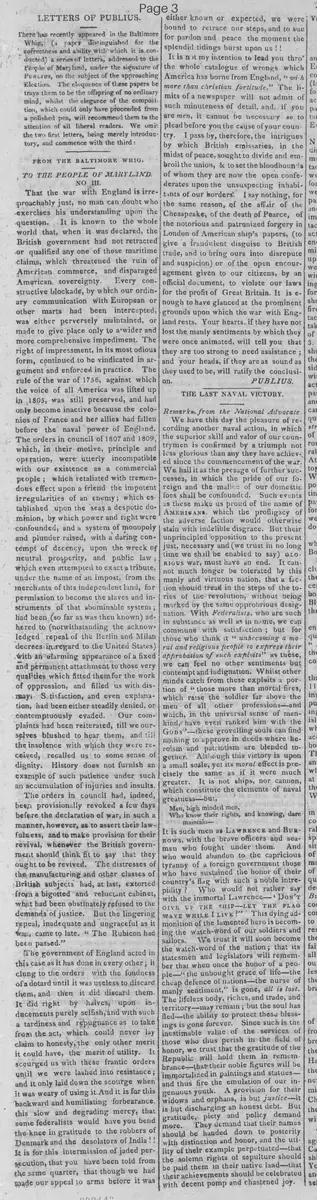
There has recently appeared in the Baltimore Whig, (a paper distinguished for the correctness and ability with which it is conducted) a series of letters, addressed to the People of Maryland, under the signature of Publius, on the subject of the approaching Election. The eloquence of these papers betrays them to be the offspring of no ordinary mind, whilst the elegance of the composition, which could only have proceeded from a polished pen, will recommend them to the attention of all liberal readers. We omit the two first letters, being merely introductory, and commence with the third:
FROM THE BALTIMORE WHIG.
TO THE PEOPLE OF MARYLAND.
NO. III.
That the war with England is irreproachably just, no man can doubt who exercises his understanding upon the question. It is known to the whole world that, when it was declared, the British government had not retracted or qualified any one of those maritime claims, which threatened the ruin of American commerce, and disparaged American sovereignty. Every constructive blockade, by which our ordinary communication with European or other marts had been intercepted, was either perversely maintained, or made to give place only to a wider and more comprehensive impediment. The right of impressment, in its most odious form, continued to be vindicated in argument and enforced in practice. The rule of the war of 1756, against which the voice of all America was lifted up in 1805, was still preserved, and had only become inactive because the colonies of France and her allies had fallen before the naval power of England. The orders in council of 1807 and 1809, which, in their motive, principle and operation, were utterly incompatible with our existence as a commercial people; which retaliated with tremendous effect upon a friend the impotent irregularities of an enemy; which established upon the seas a despotic dominion, by which power and right were confounded, and a system of monopoly and plunder raised, with a daring contempt of decency, upon the wreck of neutral prosperity, and public law; which even attempted to exact a tribute, under the name of an impost, from the merchants of this independent land, for permission to become the slaves and instruments of that abominable system; had been (so far as was then known) adhered to (notwithstanding the acknowledged repeal of the Berlin and Milan decrees in regard to the United States) with an alarming appearance of a fixed and permanent attachment to those very qualities which fitted them for the work of oppression, and filled us with dismay. Satisfaction, and even explanation, had been either steadily denied, or contemptuously evaded. Our complaints had been reiterated, till we ourselves blushed to hear them, and till the insolence with which they were received, recalled us to some sense of dignity. History does not furnish an example of such patience under such an accumulation of injuries and insults. The orders in council had, indeed, been provisionally revoked a few days before the declaration of war, in such a manner, however, as to assert their lawfulness, and to make provision for their revival, whenever the British government should think fit to say that they ought to be revived. The distresses of the manufacturing and other classes of British subjects had, at last, extorted from a bigotted and reluctant cabinet, what had been obstinately refused to the demands of justice. But the lingering repeal, inadequate and ungraceful as it was, came too late. "The Rubicon had been passed."
The government of England acted in this case as it has done in every other; it clung to the orders with the fondness of a dotard until it was useless to discard them, and then it did discard them. It did right by halves, upon inducements purely selfish, and with such a tardiness and repugnance as to take from the act, which could never lay claim to honesty, the only other merit it could have, the merit of utility. It scourged us with these frantic orders until we were lashed into resistance; and it only laid down the scourge when it was weary of using it. And it is for this backward and humiliating forbearance, this slow and degrading mercy, that some federalists would have you bend the knee in gratitude to the robbers of Denmark and the desolators of India!! It is for this intermission of jaded persecution, that you have been told from the same quarter, that though we had made our appeal to arms before it was either known or expected, we were bound to retrace our steps, and to sue for pardon and peace the moment the splendid tidings burst upon us!! It is not my intention to lead you thro' the whole catalogue of wrongs which America has borne from England, "with more than christian fortitude." The limits of a newspaper will not admit of such minuteness of detail, and, if you are men, it cannot be necessary so to plead before you the cause of your country. I pass by, therefore, the intrigues by which British emissaries, in the midst of peace, sought to divide and embroil the union, & to set the bloodhounds of whom they are now the open confederates upon the unsuspecting inhabitants of our borders. I say nothing, for the same reason, of the affair of the Chesapeake, of the death of Pearce, of the notorious and patronized forgery in London of American ship's papers, (to give a fraudulent disguise to British trade, and to bring ours into disrepute and suspicion) or of the open encouragement given to our citizens, by an official document, to violate our laws for the profit of Great Britain. It is enough to have glanced at the prominent grounds upon which the war with England rests. Your hearts, if they have not lost the manly sentiments by which they were once animated, will tell you that they are too strong to need assistance; and your heads, if they are as sound as they used to be, will ratify the conclusion.
PUBLIUS.
There has recently appeared in the Baltimore Whig, (a paper distinguished for the correctness and ability with which it is conducted) a series of letters, addressed to the People of Maryland, under the signature of Publius, on the subject of the approaching Election. The eloquence of these papers betrays them to be the offspring of no ordinary mind, whilst the elegance of the composition, which could only have proceeded from a polished pen, will recommend them to the attention of all liberal readers. We omit the two first letters, being merely introductory, and commence with the third:
FROM THE BALTIMORE WHIG.
TO THE PEOPLE OF MARYLAND.
NO. III.
That the war with England is irreproachably just, no man can doubt who exercises his understanding upon the question. It is known to the whole world that, when it was declared, the British government had not retracted or qualified any one of those maritime claims, which threatened the ruin of American commerce, and disparaged American sovereignty. Every constructive blockade, by which our ordinary communication with European or other marts had been intercepted, was either perversely maintained, or made to give place only to a wider and more comprehensive impediment. The right of impressment, in its most odious form, continued to be vindicated in argument and enforced in practice. The rule of the war of 1756, against which the voice of all America was lifted up in 1805, was still preserved, and had only become inactive because the colonies of France and her allies had fallen before the naval power of England. The orders in council of 1807 and 1809, which, in their motive, principle and operation, were utterly incompatible with our existence as a commercial people; which retaliated with tremendous effect upon a friend the impotent irregularities of an enemy; which established upon the seas a despotic dominion, by which power and right were confounded, and a system of monopoly and plunder raised, with a daring contempt of decency, upon the wreck of neutral prosperity, and public law; which even attempted to exact a tribute, under the name of an impost, from the merchants of this independent land, for permission to become the slaves and instruments of that abominable system; had been (so far as was then known) adhered to (notwithstanding the acknowledged repeal of the Berlin and Milan decrees in regard to the United States) with an alarming appearance of a fixed and permanent attachment to those very qualities which fitted them for the work of oppression, and filled us with dismay. Satisfaction, and even explanation, had been either steadily denied, or contemptuously evaded. Our complaints had been reiterated, till we ourselves blushed to hear them, and till the insolence with which they were received, recalled us to some sense of dignity. History does not furnish an example of such patience under such an accumulation of injuries and insults. The orders in council had, indeed, been provisionally revoked a few days before the declaration of war, in such a manner, however, as to assert their lawfulness, and to make provision for their revival, whenever the British government should think fit to say that they ought to be revived. The distresses of the manufacturing and other classes of British subjects had, at last, extorted from a bigotted and reluctant cabinet, what had been obstinately refused to the demands of justice. But the lingering repeal, inadequate and ungraceful as it was, came too late. "The Rubicon had been passed."
The government of England acted in this case as it has done in every other; it clung to the orders with the fondness of a dotard until it was useless to discard them, and then it did discard them. It did right by halves, upon inducements purely selfish, and with such a tardiness and repugnance as to take from the act, which could never lay claim to honesty, the only other merit it could have, the merit of utility. It scourged us with these frantic orders until we were lashed into resistance; and it only laid down the scourge when it was weary of using it. And it is for this backward and humiliating forbearance, this slow and degrading mercy, that some federalists would have you bend the knee in gratitude to the robbers of Denmark and the desolators of India!! It is for this intermission of jaded persecution, that you have been told from the same quarter, that though we had made our appeal to arms before it was either known or expected, we were bound to retrace our steps, and to sue for pardon and peace the moment the splendid tidings burst upon us!! It is not my intention to lead you thro' the whole catalogue of wrongs which America has borne from England, "with more than christian fortitude." The limits of a newspaper will not admit of such minuteness of detail, and, if you are men, it cannot be necessary so to plead before you the cause of your country. I pass by, therefore, the intrigues by which British emissaries, in the midst of peace, sought to divide and embroil the union, & to set the bloodhounds of whom they are now the open confederates upon the unsuspecting inhabitants of our borders. I say nothing, for the same reason, of the affair of the Chesapeake, of the death of Pearce, of the notorious and patronized forgery in London of American ship's papers, (to give a fraudulent disguise to British trade, and to bring ours into disrepute and suspicion) or of the open encouragement given to our citizens, by an official document, to violate our laws for the profit of Great Britain. It is enough to have glanced at the prominent grounds upon which the war with England rests. Your hearts, if they have not lost the manly sentiments by which they were once animated, will tell you that they are too strong to need assistance; and your heads, if they are as sound as they used to be, will ratify the conclusion.
PUBLIUS.
What sub-type of article is it?
War Or Peace
Partisan Politics
What keywords are associated?
War Of 1812
British Orders In Council
Impressment
Publius Letters
Maryland Election
Federalists
Chesapeake Affair
What entities or persons were involved?
Publius
British Government
Federalists
England
Maryland People
Editorial Details
Primary Topic
Justification Of The War Of 1812 Against British Maritime Aggressions
Stance / Tone
Strongly Pro War And Anti Federalist
Key Figures
Publius
British Government
Federalists
England
Maryland People
Key Arguments
War With England Is Just Due To Unaddressed Maritime Claims Like Blockades And Impressment
Orders In Council Of 1807 And 1809 Oppressed American Commerce And Sovereignty
Provisional Repeal Of Orders In Council Came Too Late After War Declaration
British Actions Show Selfish Reluctance, Not Justice
Federalists Wrongly Urge Gratitude And Peace To Britain Despite Provocations
Other British Wrongs Include Chesapeake Affair And Intrigues Against The Union