Thank you for visiting SNEWPapers!
Sign up free
The Daily Madisonian
Washington, District Of Columbia
What is this article about?
On February 1, 1843, the U.S. Senate received the annual report of the Commissioner of Patents, presented memorials from Pennsylvania counties on financial and bankruptcy issues, introduced a joint resolution on commercial treaties, debated a bill prohibiting private expresses for mail service, and discussed a bill providing military protection and land grants in the Oregon Territory, ultimately postponing further action.
Clipping
OCR Quality
Full Text
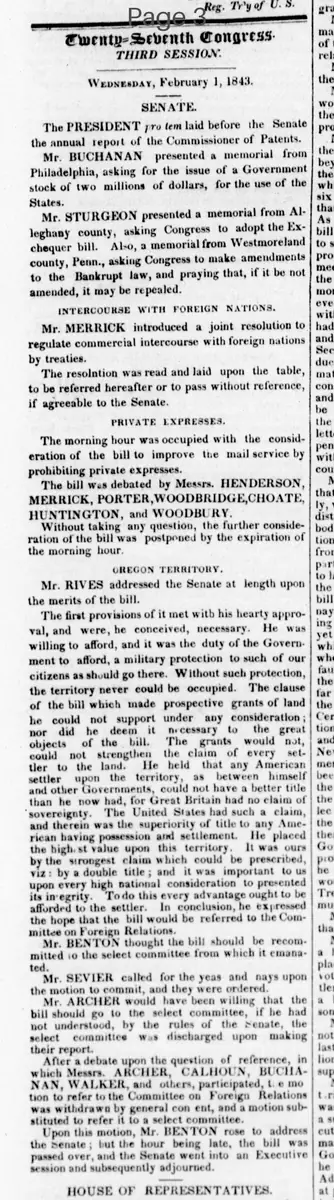
THIRD SESSION.
Wednesday, February 1, 1843.
SENATE.
The PRESIDENT pro tem laid before the Senate the annual report of the Commissioner of Patents.
Mr. BUCHANAN presented a memorial from Philadelphia, asking for the issue of a Government stock of two millions of dollars, for the use of the States.
Mr. STURGEON presented a memorial from Alleghany county, asking Congress to adopt the Exchequer bill. Also, a memorial from Westmoreland county, Penn., asking Congress to make amendments to the Bankrupt law, and praying that, if it be not amended, it may be repealed.
INTERCOURSE WITH FOREIGN NATIONS.
Mr. MERRICK introduced a joint resolution to regulate commercial intercourse with foreign nations by treaties.
The resolution was read and laid upon the table, to be referred hereafter or to pass without reference, if agreeable to the Senate.
PRIVATE EXPRESSES.
The morning hour was occupied with the consideration of the bill to improve the mail service by prohibiting private expresses.
The bill was debated by Messrs. HENDERSON, MERRICK, PORTER, WOODBRIDGE, CHOATE, HUNTINGTON, and WOODBURY.
Without taking any question, the further consideration of the bill was postponed by the expiration of the morning hour.
OREGON TERRITORY.
Mr. RIVES addressed the Senate at length upon the merits of the bill.
The first provisions of it met with his hearty approbation, and were, he conceived, necessary. He was willing to afford, and it was the duty of the Government to afford, a military protection to such of our citizens as should go there. Without such protection, the territory never could be occupied. The clause of the bill which made prospective grants of land he could not support under any consideration; nor did he deem it necessary to the great objects of the bill. The grants would not, could not strengthen the claim of every settler to the land. He held that any American settler upon the territory, as between himself and other Governments, could not have a better title than he now had, for Great Britain had no claim of sovereignty. The United States had such a claim, and therein was the superiority of title to any American having possession and settlement. He placed the highest value upon this territory. It was ours by the strongest claim which could be prescribed, viz: by a double title; and it was important to us upon every high national consideration to preserve its integrity. To do this every advantage ought to be afforded to the settler. In conclusion, he expressed the hope that the bill would be referred to the Committee on Foreign Relations.
Mr. BENTON thought the bill should be recommitted to the select committee from which it emanated.
Mr. SEVIER called for the yeas and nays upon the motion to commit, and they were ordered.
Mr. ARCHER would have been willing that the bill should go to the select committee, if he had not understood, by the rules of the Senate, the select committee was discharged upon making their report.
After a debate upon the question of reference, in which Messrs. ARCHER, CALHOUN, BUCHANAN, WALKER, and others, participated, the motion to refer to the Committee on Foreign Relations was withdrawn by general consent, and a motion substituted to refer it to a select committee.
Upon this motion, Mr. BENTON rose to address the Senate; but the hour being late, the bill was passed over, and the Senate went into an Executive session and subsequently adjourned.
What sub-type of article is it?
What keywords are associated?
What entities or persons were involved?
Domestic News Details
Event Date
Wednesday, February 1, 1843
Key Persons
Outcome
the annual report was laid before the senate. memorials were presented. the joint resolution was read and laid on the table. the private expresses bill was debated and postponed. the oregon territory bill debate continued, with motions to refer withdrawn and substituted, then passed over due to late hour.
Event Details
The Senate session included presentation of the Commissioner of Patents' annual report, memorials from Philadelphia on government stock issuance, from Alleghany county on the Exchequer bill, and from Westmoreland county on Bankrupt law amendments or repeal. A joint resolution to regulate commercial intercourse with foreign nations via treaties was introduced and tabled. The bill to prohibit private expresses for mail improvement was debated by several senators and postponed. Extensive debate on the Oregon Territory bill covered military protection, land grants, and territorial claims, with motions for committee reference discussed and adjusted before postponement.