Thank you for visiting SNEWPapers!
Sign up free
Literary
August 7, 1801
The National Intelligencer And Washington Advertiser
Washington, District Of Columbia
What is this article about?
Excerpt from Rousseau's Social Compact arguing against slavery and absolute authority. It refutes the idea that individuals or peoples can alienate their liberty, emphasizing natural freedom, the invalidity of such contracts, and limits on paternal or conquest-based power.
Clipping
OCR Quality
95%
Excellent
Full Text
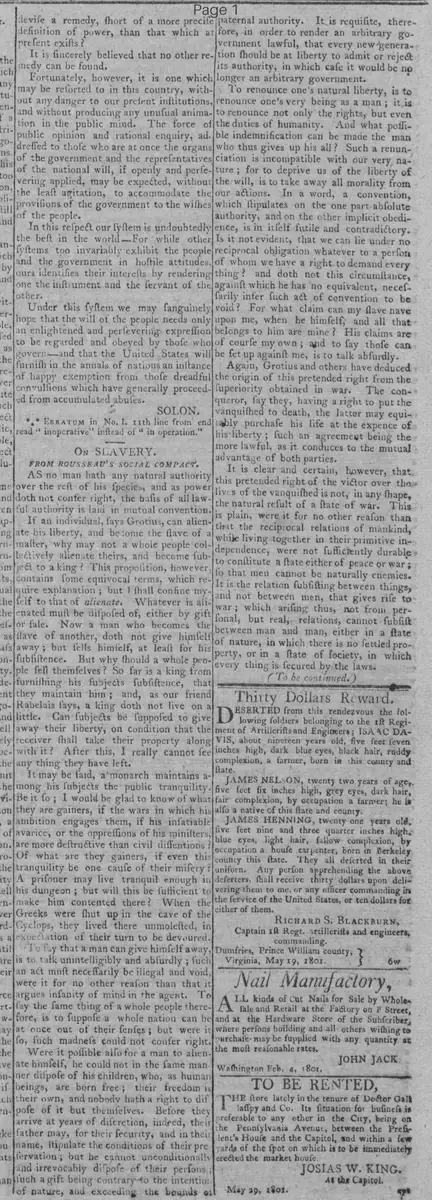
On SLAVERY.
FROM ROUSSEAU'S SOCIAL COMPACT.
AS no man hath any natural authority over the rest of his species, and as power doth not confer right, the basis of all lawful authority is laid in mutual convention. If an individual, says Grotius, can alienate his liberty, and become the slave of a master, why may not a whole people collectively alienate theirs, and become subject to a king? This proposition, however, contains some equivocal terms, which require explanation; but I shall confine myself to that of alienate. Whatever is alienated must be disposed of, either by gift or sale. Now a man who becomes the slave of another, doth not give himself away; but sells himself, at least for his subsistence. But why should a whole people sell themselves? So far is a king, from furnishing his subjects subsistence, that they maintain him; and, as our friend Rabelais says, a king doth not live on a little. Can subjects be supposed to give away their liberty, on condition that the receiver shall take their property along with it? After this, I really cannot see any thing they have left.
It may be said, a monarch maintains among his subjects the public tranquility. Be it so; I would be glad to know of what they are gainers, if the wars in which his ambition engages them, if his insatiable avarice, or the oppressions of his ministers, are more destructive than civil dissensions? Of what are they gainers, if even this tranquility be one cause of their misery? A prisoner may live tranquil enough in his dungeon; but will this be sufficient to make him contented there? When the Greeks were shut up in the cave of the Cyclops, they lived there unmolested, in expectation of their turn to be devoured. To say that a man can give himself away, is to talk unintelligibly and absurdly; such an act must necessarily be illegal and void, were it for no other reason than that it argues insanity of mind in the agent. To say the same thing of a whole people therefore, is to suppose a whole nation can be at once out of their senses; but were it so, such madness could not confer right.
Were it possible also for a man to alienate himself, he could not in the same manner dispose of his children, who, as human beings, are born free; their freedom is their own, and nobody hath a right to dispose of it but themselves. Before they arrive at years of discretion, indeed, their father may, for their security, and in their name, stipulate the conditions of their preservation; but he cannot unconditionally and irrevocably dispose of their persons; such a gift being Contrary to the intention of nature: and paternal authority. It is requisite, therefore, -in order to render an arbitrary government lawful, that every new generation should be at liberty to admit or reject its authority, in which case it would be no longer an arbitrary government.
To renounce one's natural liberty, is to renounce one's very being as a man; it is to renounce not only the rights, but even the duties of humanity. And what possible indemnification can be made the man who thus gives up his all? Such a renunciation is incompatible with our very nature; for to deprive us of the liberty of the will, is to take away all morality from our actions. In a word, a convention, which stipulates on the one part absolute authority, and on the other implicit obedience, is in itself futile and contradictory.
Is it not evident, that we can lie under no reciprocal obligation whatever to a person of whom we have a right to demand every thing? and doth not this circumstance, against which he has no equivalent, necessarily infer such act of convention to be void? For what claim can my slave have upon me, when he himself, and all that belongs to him are mine? His claims are of course my own; and to say those can be set up against me, is to talk absurdly.
Again, Grotius and others have deduced the origin of this pretended right from the superiority obtained in war. The conqueror, say they, having a right to put the vanquished to death, the latter may equitably purchase his life at the expense of his liberty; such an agreement being the more lawful, as it conduces to the mutual advantage of both parties.
It is clear and certainly, however, that this pretended right of the victor over the lives of the vanquished is not, in any shape, the natural result of a state of war. This is plain, were it for no other reason than that the reciprocal relations of mankind, while living together in their primitive independence, were not sufficiently durable to constitute a state either of peace or war; so that men cannot be naturally enemies. It is the relation subsisting between things, and not between men, that gives rise to war; which arising thus, not from personal, but real, relations, cannot subsist between man and man, either in a state of nature, in which there is no settled property, or in a state of society, in which every thing is secured by the laws.
(To be continued.)
FROM ROUSSEAU'S SOCIAL COMPACT.
AS no man hath any natural authority over the rest of his species, and as power doth not confer right, the basis of all lawful authority is laid in mutual convention. If an individual, says Grotius, can alienate his liberty, and become the slave of a master, why may not a whole people collectively alienate theirs, and become subject to a king? This proposition, however, contains some equivocal terms, which require explanation; but I shall confine myself to that of alienate. Whatever is alienated must be disposed of, either by gift or sale. Now a man who becomes the slave of another, doth not give himself away; but sells himself, at least for his subsistence. But why should a whole people sell themselves? So far is a king, from furnishing his subjects subsistence, that they maintain him; and, as our friend Rabelais says, a king doth not live on a little. Can subjects be supposed to give away their liberty, on condition that the receiver shall take their property along with it? After this, I really cannot see any thing they have left.
It may be said, a monarch maintains among his subjects the public tranquility. Be it so; I would be glad to know of what they are gainers, if the wars in which his ambition engages them, if his insatiable avarice, or the oppressions of his ministers, are more destructive than civil dissensions? Of what are they gainers, if even this tranquility be one cause of their misery? A prisoner may live tranquil enough in his dungeon; but will this be sufficient to make him contented there? When the Greeks were shut up in the cave of the Cyclops, they lived there unmolested, in expectation of their turn to be devoured. To say that a man can give himself away, is to talk unintelligibly and absurdly; such an act must necessarily be illegal and void, were it for no other reason than that it argues insanity of mind in the agent. To say the same thing of a whole people therefore, is to suppose a whole nation can be at once out of their senses; but were it so, such madness could not confer right.
Were it possible also for a man to alienate himself, he could not in the same manner dispose of his children, who, as human beings, are born free; their freedom is their own, and nobody hath a right to dispose of it but themselves. Before they arrive at years of discretion, indeed, their father may, for their security, and in their name, stipulate the conditions of their preservation; but he cannot unconditionally and irrevocably dispose of their persons; such a gift being Contrary to the intention of nature: and paternal authority. It is requisite, therefore, -in order to render an arbitrary government lawful, that every new generation should be at liberty to admit or reject its authority, in which case it would be no longer an arbitrary government.
To renounce one's natural liberty, is to renounce one's very being as a man; it is to renounce not only the rights, but even the duties of humanity. And what possible indemnification can be made the man who thus gives up his all? Such a renunciation is incompatible with our very nature; for to deprive us of the liberty of the will, is to take away all morality from our actions. In a word, a convention, which stipulates on the one part absolute authority, and on the other implicit obedience, is in itself futile and contradictory.
Is it not evident, that we can lie under no reciprocal obligation whatever to a person of whom we have a right to demand every thing? and doth not this circumstance, against which he has no equivalent, necessarily infer such act of convention to be void? For what claim can my slave have upon me, when he himself, and all that belongs to him are mine? His claims are of course my own; and to say those can be set up against me, is to talk absurdly.
Again, Grotius and others have deduced the origin of this pretended right from the superiority obtained in war. The conqueror, say they, having a right to put the vanquished to death, the latter may equitably purchase his life at the expense of his liberty; such an agreement being the more lawful, as it conduces to the mutual advantage of both parties.
It is clear and certainly, however, that this pretended right of the victor over the lives of the vanquished is not, in any shape, the natural result of a state of war. This is plain, were it for no other reason than that the reciprocal relations of mankind, while living together in their primitive independence, were not sufficiently durable to constitute a state either of peace or war; so that men cannot be naturally enemies. It is the relation subsisting between things, and not between men, that gives rise to war; which arising thus, not from personal, but real, relations, cannot subsist between man and man, either in a state of nature, in which there is no settled property, or in a state of society, in which every thing is secured by the laws.
(To be continued.)
What sub-type of article is it?
Essay
What themes does it cover?
Slavery Abolition
Liberty Freedom
Political
What keywords are associated?
Slavery
Liberty
Rousseau
Social Compact
Authority
Grotius
Natural Rights
Conquest
What entities or persons were involved?
From Rousseau's Social Compact.
Literary Details
Title
On Slavery.
Author
From Rousseau's Social Compact.
Key Lines
As No Man Hath Any Natural Authority Over The Rest Of His Species, And As Power Doth Not Confer Right, The Basis Of All Lawful Authority Is Laid In Mutual Convention.
To Renounce One's Natural Liberty, Is To Renounce One's Very Being As A Man; It Is To Renounce Not Only The Rights, But Even The Duties Of Humanity.
It Is Clear And Certainly, However, That This Pretended Right Of The Victor Over The Lives Of The Vanquished Is Not, In Any Shape, The Natural Result Of A State Of War.