Thank you for visiting SNEWPapers!
Sign up free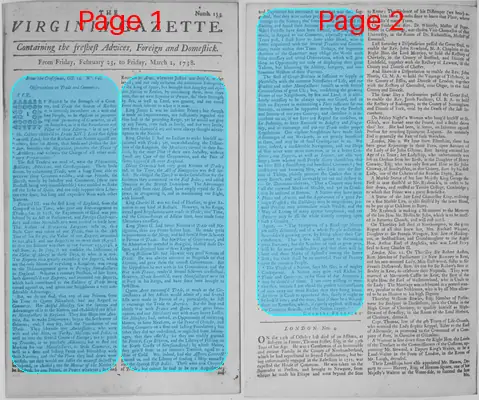
The Virginia Gazette
Richmond, Williamsburg, Richmond County, Virginia
What is this article about?
Historical overview of British trade and commerce from ancient traders to Queen Anne, emphasizing the importance of trade for national strength, past encouragements under monarchs like Edward III and Elizabeth I, and warnings about recent declines in trade balance due to poor policies, advocating vigilance and regulation.
Merged-components note: This is a continuation of the essay on trade and commerce from page 1 to page 2, with direct textual flow. The content is opinionated and historical-argumentative, fitting 'editorial' better than 'story'.
Clippings
1 of 2
OCR Quality
Full Text
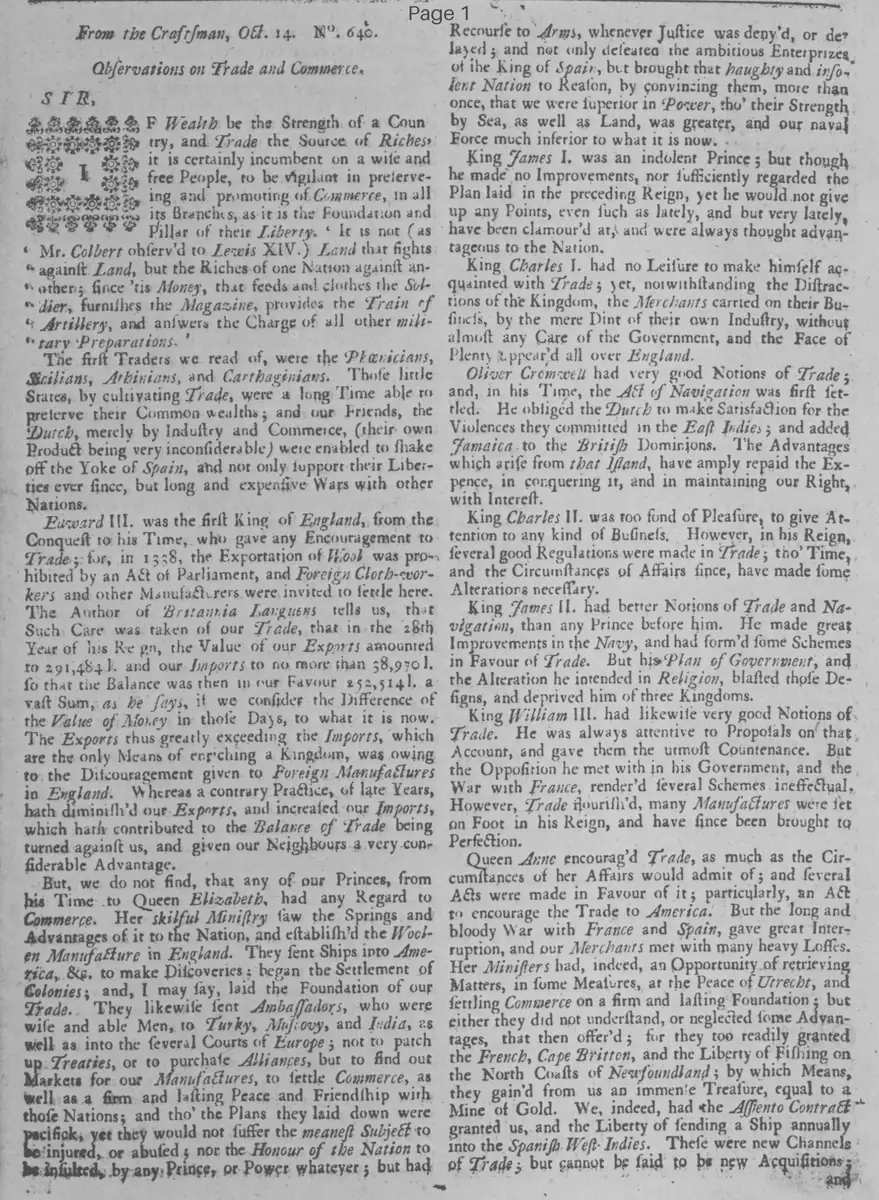
Observations on Trade and Commerce.
SIR,
If Wealth be the Strength of a Country, and Trade the Source of Riches it is certainly incumbent on a wise and free People, to be vigilant in preserving and promoting of Commerce, in all its Branches, as it is the Foundation and Pillar of their Liberty. It is not (as Mr. Colbert observ'd to Lewis XIV.) Land that fights against Land, but the Riches of one Nation against another; since 'tis Money, that feeds and clothes the Soldier, furnishes the Magazine, provides the Train of Artillery, and answers the Charge of all other military Preparations.
The first Traders we read of, were the Phœnicians, Sicilians, Athenians, and Carthaginians. Those little States, by cultivating Trade, were a long Time able to preserve their Common wealths; and our Friends, the Dutch, merely by Industry and Commerce, (their own Product being very inconsiderable) were enabled to shake off the Yoke of Spain, and not only support their Liberties ever since, but long and expensive Wars with other Nations.
Edward III. was the first King of England, from the Conquest to his Time, who gave any Encouragement to Trade; for, in 1338, the Exportation of Wool was prohibited by an Act of Parliament, and Foreign Cloth-workers and other Manufacturers were invited to settle here.
The Author of Britannia Languens tells us, that Such Care was taken of our Trade, that in the 28th Year of his Reign, the Value of our Exports amounted to 291,484l. and our Imports to no more than 38,970l. so that the Balance was then in our Favour 252,514l. a vast Sum, as he says, if we consider the Difference of the Value of Money in those Days, to what it is now.
The Exports thus greatly exceeding the Imports, which are the only Means of enriching a Kingdom, was owing to the Discouragement given to Foreign Manufactures in England. Whereas a contrary Practice, of late Years, hath diminish'd our Exports, and increased our Imports, which hath contributed to the Balance of Trade being turned against us, and given our Neighbours a very considerable Advantage.
But, we do not find, that any of our Princes, from his Time to Queen Elizabeth, had any Regard to Commerce. Her skilful Ministry Saw the Springs and Advantages of it to the Nation, and establish'd the Woolen Manufacture in England. They sent Ships into America, &c. to make Discoveries; began the Settlement of Colonies; and, I may say, laid the Foundation of our Trade. They likewise sent Ambassadors, who were wise and able Men, to Turkey, Muscovy, and India, as well as into the several Courts of Europe; not to patch up Treaties, or to purchase Alliances, but to find out Markets for our Manufactures, to settle Commerce, as well as a firm and lasting Peace and Friendship with those Nations; and tho' the Plans they laid down were pacifick, yet they would not suffer the meanest Subject to be injured, or abused; nor the Honour of the Nation to be insulted by any Prince, or Power whatever; but had Recourse to Arms, whenever Justice was deny'd, or delayed; and not only defeated the ambitious Enterprizes of the King of Spain, but brought that haughty and insolent Nation to Reason, by convincing them, more than once, that we were superiour in Power, tho' their Strength by Sea, as well as Land, was greater, and our naval Force much inferior to what it is now.
King James I. was an indolent Prince; but though he made no Improvements, nor sufficiently regarded the Plan laid in the preceding Reign, yet he would not give up any Points, even such as lately, and but very lately, have been clamour'd at, and were always thought advantageous to the Nation.
King Charles I. had no Leisure to make himself acquainted with Trade; yet, notwithstanding the Distractions of the Kingdom, the Merchants carried on their Business, by the mere Dint of their own Industry, without almost any Care of the Government, and the Face of Plenty appear'd all over England.
Oliver Cromwell had very good Notions of Trade; and, in his Time, the Act of Navigation was first settled. He obliged the Dutch to make Satisfaction for the Violences they committed in the East Indies; and added Jamaica to the British Dominions. The Advantages which arise from that Island, have amply repaid the Expence, in conquering it, and in maintaining our Right, with Interest.
King Charles II. was too fond of Pleasure, to give Attention to any kind of Business. However, in his Reign, Several good Regulations were made in Trade; tho' Time, and the Circumstances of Affairs since, have made some Alterations necessary.
King James II. had better Notions of Trade and Navigation, than any Prince before him. He made great Improvements in the Navy, and had form'd some Schemes in Favour of Trade. But his Plan of Government, and the Alteration he intended in Religion, blasted those Designs, and deprived him of three Kingdoms.
King William III. had likewise very good Notions of Trade. He was always attentive to Proposals on that Account, and gave them the utmost Countenance. But the Opposition he met with in his Government, and the War with France, render'd several Schemes ineffectual. However, Trade flourish'd, many Manufactures were set on Foot in his Reign, and have since been brought to Perfection.
Queen Anne encourag'd Trade, as much as the Circumstances of her Affairs would admit of; and several Acts were made in Favour of it; particularly, an Act to encourage the Trade to America. But the long and bloody War with France and Spain, gave great Interruption, and our Merchants met with many heavy Losses.
Her Ministers had, indeed, an Opportunity of retrieving Matters, in some Measure, at the Peace of Utrecht, and Settling Commerce on a firm and lasting Foundation; but either they did not understand, or neglected some Advantages, that then offer'd; for they too readily granted the French, Cape Breton, and the Liberty of Fishing on the North Coasts of Newfoundland; by which Means, they gain'd from us an immense Treasure, equal to a Mine of Gold. We, indeed, had the Asiento Contract granted us, and the Liberty of sending a Ship annually into the Spanish West-Indies. These were new Channels of Trade; but cannot be said to be new Acquisitions;
and Experience has convinced us of what was then suggested, that they were rather prejudicial than of any Advantage to the Nation; tho' some Persons have tasted the Sweets, and found their Account in promoting of them.
What Projects have since been formed, and Stipulations made, in Regard to our Commerce, especially within 18 Years past, I shall leave to some abler Hand, who is better acquainted with the several Treaties and Conventions, made within that Time. Perhaps, the ingenious Authors of the Gazeteer may oblige the World with some necessary and useful Observations, which will give them an Opportunity not only of displaying their great Talents, but blazoning the Ability, Integrity, and consummate Wisdom of their Patrons.
The Soil of Great-Britain is sufficient to supply us plentifully with the common Necessaries of Life, and our Woollen and other Manufactures furnish us with several Commodities of great Use; but, considering the growing Power of our Neighbours, by Sea and Land, it is absolutely necessary to be always upon our Guard, and at such an Expence in maintaining a Fleet sufficient for our Security, as cannot be supported merely by the Product and Income of our own Country; and therefore it is incumbent on us, if we have any Regard for ourselves, or for Posterity, to have Recourse to Industry and Frugality, and to encourage and put our Trade under proper Regulations. Our vigilant Neighbours have made such Advantages of our Weakness, as are greatly beneficial to them, and may be of fatal Consequence to us. We have, indeed, a considerable Navigation, and our Ships of War never were more numerous, or in a better Condition; our Exports, as well as Imports, are also very large; from whence most People flatter themselves that we have still a flourishing and beneficial Commerce: but considerate and knowing Men, who look into the Bottom of Things, plainly perceive the Canker that is in every Branch, and will inevitably eat out and destroy it.
-- Dr. Davenant observes, That a Country may have all the outward Marks of Wealth, and yet its Condition be unsound at Bottom. A Nation may have great Fleets and Armies, and the Appearance of a great Foreign Traffick; the Buildings may be magnificent, private Persons may accumulate much Wealth, and the Way of Living of many appear sumptuous; and yet Poverty may be all the while secretly creeping upon such a Country.
Again, -- The Symptoms of a Bankrupt Nation are easily discerned, and of a whole People collectively consider'd growing poor, by living above their Circumstances. That a few will gather to themselves great Fortunes; but the Number of such as grow poor, will be far more considerable; and that there will be here and there Marks of Splendour among the better Sort; but there shall be an universal Face of Poverty upon the common People.
The Trade of a Nation, says Mr. Gee, is of mighty Consequence. A Nation may gain vast Riches by Trade and Commerce, or for Want of due Attention; may be drain'd of them. I am more willing to mention this, because I am afraid the present Circumstances of ours carry out more Riches than they bring home. As there is Cause to apprehend this, surely it ought to be look'd into; and the more, since if there be a Wound, there are Remedies, which, if rightly applied, will make our Commerce flourish, and the Nation happy.
CHARLES FREEPORT
What sub-type of article is it?
What keywords are associated?
What entities or persons were involved?
Editorial Details
Primary Topic
Historical Observations On British Trade Policies And Their Impact On National Wealth
Stance / Tone
Cautionary Advocacy For Vigilant Promotion And Regulation Of Trade To Prevent National Decline
Key Figures
Key Arguments