Thank you for visiting SNEWPapers!
Sign up free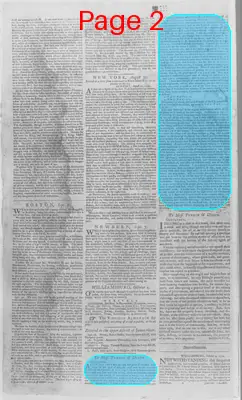
Letter to Editor
October 4, 1770
The Virginia Gazette
Richmond, Williamsburg, Richmond County, Virginia
What is this article about?
Writer B responds to C.R.'s piece defending his view of 'The Customer' as an enemy, reviews his arguments, provides a mathematical proof of comet-to-star velocity proportion (1:3), and challenges critics with witty astronomical and literary references.
Clipping
OCR Quality
98%
Excellent
Full Text
To Messrs. Purdie & Dixon.
GENTLEMEN,
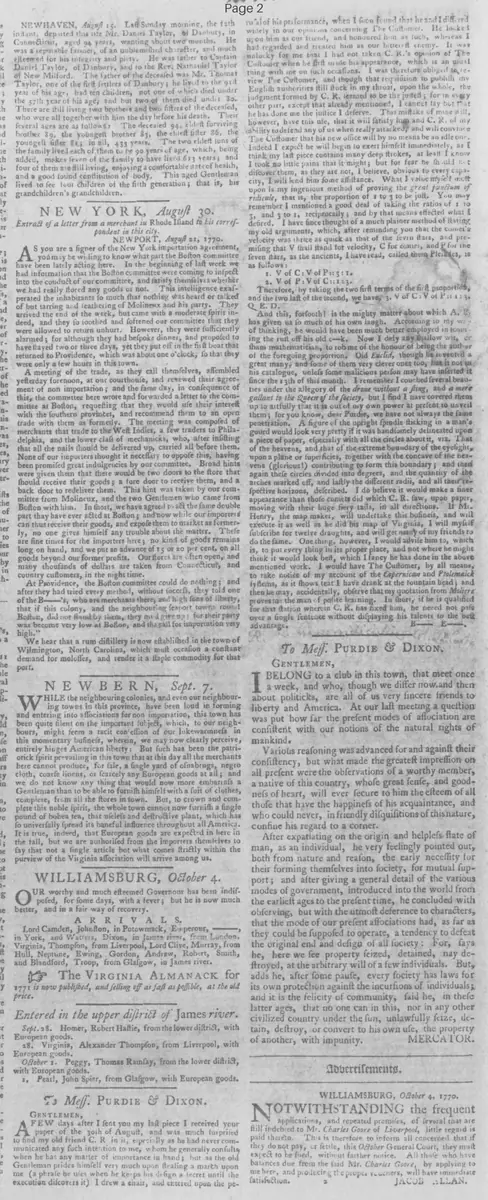
A few days after I sent you my last piece I received your paper of the 30th of August, and was much surprised to find my old friend C. R. in it, especially as he had never communicated any such intention to me, whom he generally consults when he has any matter of importance in hand; but as the old gentleman prides himself very much upon traling a march upon me (a phrase he uses when he keeps his design a secret until the execution discovers it) I drew a chair, and entered upon the perusal of his performance, when I soon found that he and I differed wholly in our opinions concerning The Customer. He looked upon him as our friend, and honoured him as such, whereas I had regarded and treated him as our bitterest enemy. It was unlucky for me that I had not taken C. R.'s opinion of The Customer when he first made his appearance, which is an unusual thing with me on such occasions. I was therefore obliged to review The Customer, and though that requisition to publish my English authorities still stuck in my throat, upon the whole, the judgment formed by C. R. seemed to be the justest; for in every other part, except that already mentioned, I cannot say but that he has done me the justice I deserve. This mistake of mine will, however, have this use, that it will satisfy him and C. R. of my ability to defend any of us when really attacked, and will convince The Customer that his new office will by no means be an idle one. Indeed I expect he will begin to exert himself immediately, as I think my last piece contains many deep strokes, at least I know I took no little pains that it might; but for fear he should not discover them, as they are not, I believe, obvious to every capacity, I will lend him some assistance. What I value myself upon is my ingenious method of proving the great punctum of ridicule, that is, the proportion of 1 to 3 to be just. You may remember I mentioned a good deal of taking the ratios of 1 to 3, and 3 to 1, reciprocally; and by that means effected what I desired. I have since thought of a much plainer method of stating my old arguments, which, after reminding you that the comet's velocity was thrice as quick as that of the seven stars, and premising that V shall stand for velocity, C for comet, and P for the seven stars, as the ancients, I have read, called them Pleiades, is as follows:
1. V of C : V of P :: 3 : 1.
2. V of P : V of C :: 1 : 3.
Therefore, by taking the two first terms of the first proportion, and the two last of the second, we have, 3. V of C : V of P :: 1 : 3.
Q. E. D.
And this, forsooth! is the mighty matter about which A. has given us so much of his own laugh. According to my way of thinking, he would have been much better employed in counting the rust off his old jack. Now I defy any shallow wit, or sham mathematician, to rob me of the honour of being the author of the foregoing proportion. Old Euclid, though he invented a great many, and some of them very clever ones too, has it not in his catalogue, unless some malicious person may have inserted it since the 13th of this month. I remember I couched several beauties under the allegory of the drone without a sting, and a mere gallant to the Queen of the society, but I find I have covered them up so artfully that it is out of my own power at present to unveil them; for you know, dear Purdie, we have not always the same penetration. A figure of the upright spindle sticking in a man's gourd would look very pretty if it was handsomely delineated upon a piece of paper, especially with all the circles about it, viz. that of the heavens, and that of the extreme boundary of the eyesight, upon a plane or superficies, together with the concave of the heavens (glorious!) contributing to form this boundary; and then these circles divided into degrees, and the quantity of the arches marked off, and lastly the different radii, and all their respective horizons, described. I do believe it would make a finer appearance than those comets did which C. R. saw, upon paper, moving with their huge fiery tails, in all directions. If Mr. Henry, the map maker, will undertake this business, and will execute it as well as he did his map of Virginia, I will myself subscribe for twelve draughts, and will get many of my friends to do the same. One thing, however, I would advise him to, which is, to put everything in its proper place, and not where he might think it would look best, which I fancy he has done in the above mentioned work. I would have The Customer, by all means, to take notice of my account of the Copernican and Ptolemaick systems, as it shows that I have drank at the fountain head; and then he may, accidentally, observe that my quotation from Moliere proves me the man of polite learning. In short, if he is qualified for that station wherein C. R. has fixed him, he need not pass over a single sentence without displaying his talents to the best advantage.
B
GENTLEMEN,
A few days after I sent you my last piece I received your paper of the 30th of August, and was much surprised to find my old friend C. R. in it, especially as he had never communicated any such intention to me, whom he generally consults when he has any matter of importance in hand; but as the old gentleman prides himself very much upon traling a march upon me (a phrase he uses when he keeps his design a secret until the execution discovers it) I drew a chair, and entered upon the perusal of his performance, when I soon found that he and I differed wholly in our opinions concerning The Customer. He looked upon him as our friend, and honoured him as such, whereas I had regarded and treated him as our bitterest enemy. It was unlucky for me that I had not taken C. R.'s opinion of The Customer when he first made his appearance, which is an unusual thing with me on such occasions. I was therefore obliged to review The Customer, and though that requisition to publish my English authorities still stuck in my throat, upon the whole, the judgment formed by C. R. seemed to be the justest; for in every other part, except that already mentioned, I cannot say but that he has done me the justice I deserve. This mistake of mine will, however, have this use, that it will satisfy him and C. R. of my ability to defend any of us when really attacked, and will convince The Customer that his new office will by no means be an idle one. Indeed I expect he will begin to exert himself immediately, as I think my last piece contains many deep strokes, at least I know I took no little pains that it might; but for fear he should not discover them, as they are not, I believe, obvious to every capacity, I will lend him some assistance. What I value myself upon is my ingenious method of proving the great punctum of ridicule, that is, the proportion of 1 to 3 to be just. You may remember I mentioned a good deal of taking the ratios of 1 to 3, and 3 to 1, reciprocally; and by that means effected what I desired. I have since thought of a much plainer method of stating my old arguments, which, after reminding you that the comet's velocity was thrice as quick as that of the seven stars, and premising that V shall stand for velocity, C for comet, and P for the seven stars, as the ancients, I have read, called them Pleiades, is as follows:
1. V of C : V of P :: 3 : 1.
2. V of P : V of C :: 1 : 3.
Therefore, by taking the two first terms of the first proportion, and the two last of the second, we have, 3. V of C : V of P :: 1 : 3.
Q. E. D.
And this, forsooth! is the mighty matter about which A. has given us so much of his own laugh. According to my way of thinking, he would have been much better employed in counting the rust off his old jack. Now I defy any shallow wit, or sham mathematician, to rob me of the honour of being the author of the foregoing proportion. Old Euclid, though he invented a great many, and some of them very clever ones too, has it not in his catalogue, unless some malicious person may have inserted it since the 13th of this month. I remember I couched several beauties under the allegory of the drone without a sting, and a mere gallant to the Queen of the society, but I find I have covered them up so artfully that it is out of my own power at present to unveil them; for you know, dear Purdie, we have not always the same penetration. A figure of the upright spindle sticking in a man's gourd would look very pretty if it was handsomely delineated upon a piece of paper, especially with all the circles about it, viz. that of the heavens, and that of the extreme boundary of the eyesight, upon a plane or superficies, together with the concave of the heavens (glorious!) contributing to form this boundary; and then these circles divided into degrees, and the quantity of the arches marked off, and lastly the different radii, and all their respective horizons, described. I do believe it would make a finer appearance than those comets did which C. R. saw, upon paper, moving with their huge fiery tails, in all directions. If Mr. Henry, the map maker, will undertake this business, and will execute it as well as he did his map of Virginia, I will myself subscribe for twelve draughts, and will get many of my friends to do the same. One thing, however, I would advise him to, which is, to put everything in its proper place, and not where he might think it would look best, which I fancy he has done in the above mentioned work. I would have The Customer, by all means, to take notice of my account of the Copernican and Ptolemaick systems, as it shows that I have drank at the fountain head; and then he may, accidentally, observe that my quotation from Moliere proves me the man of polite learning. In short, if he is qualified for that station wherein C. R. has fixed him, he need not pass over a single sentence without displaying his talents to the best advantage.
B
What sub-type of article is it?
Persuasive
Comedic
Satirical
What themes does it cover?
Science Nature
What keywords are associated?
Customer Debate
Astronomical Proportions
Comet Velocity
Euclid Reference
Copernican System
Pleiades
Moliere Quotation
What entities or persons were involved?
B
Messrs. Purdie & Dixon
Letter to Editor Details
Author
B
Recipient
Messrs. Purdie & Dixon
Main Argument
the writer defends his previous satirical arguments against 'the customer,' whom he views as an enemy, provides a mathematical proof of the 1:3 velocity proportion between comet and pleiades, and challenges critics while highlighting his astronomical and literary knowledge.
Notable Details
Mathematical Proportion Proof Using V For Velocity, C For Comet, P For Pleiades
References To Euclid, Copernican And Ptolemaic Systems, Moliere
Allegory Of Drone Without A Sting
Offer To Subscribe To Diagram By Mr. Henry