Thank you for visiting SNEWPapers!
Sign up free
The Enquirer
Richmond, Henrico County, Virginia
What is this article about?
In the Batavian Republic's Secret Assembly on December 21, Citizen Van Hasselar opposes the State Directory's proposal for a third extraordinary contribution on property and income for 1804 to cover revenue shortfalls due to war obligations with France, criticizing government waste and lack of economies.
Clipping
OCR Quality
Full Text
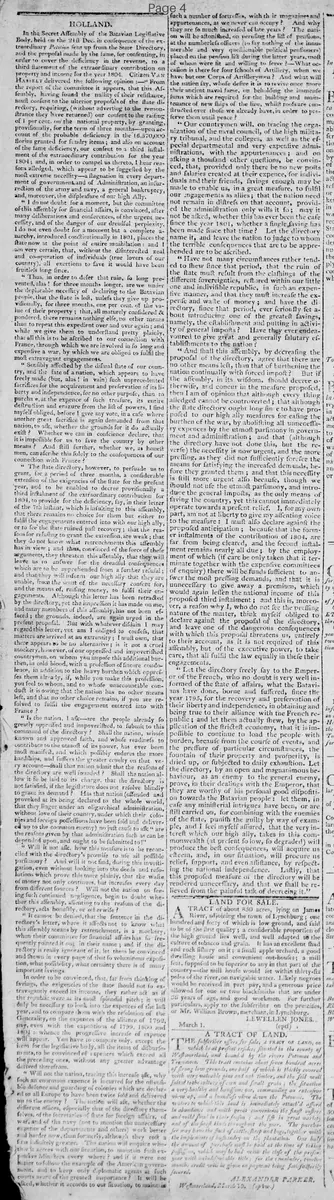
In the Secret Assembly of the Batavian Legislative Body, held on the 21st Dec. in consequence of the extraordinary Petition sent up from the State Directory, and the proposal made by the same, for consenting, in order to cover the deficiency in the revenue, to a third statement of the extraordinary contribution on property and income for the year 1804. Citizen Van Hasselar delivered the following opinion:--"From the report of the committee it appears, that this Assembly, having found the nullity of their resistance, must consent to the ulterior proposals of the state directory, requiring, (without adverting to the remonstrance they have returned) our consent to the raising of 1 per cent. on the national property, by granting, provisionally, for the term of three months--upon account of the probable deficiency in the 16,570,000 florins granted for sundry items; and also on account of the same deficiency, our consent to a third instalment of the extraordinary contribution for the year 1804; and, in order to compel us thereto, I hear reasons alleged, which appear to be suggested by the most extreme necessity--a stagnation in every department of government and of Administration, an insurrection of the army and navy, a general bankruptcy, and, moreover, the displeasure of our high Ally.
"I do not doubt for a moment, but the committee of this assembly for financial affairs, is convinced, after many deliberations and conferences, of the urgent necessity, and of the danger of our dreadful perplexity. I do not even doubt for a moment but a complete anarchy, introduced constitutionally in 1801, places the state now at the point of entire annihilation: and I am very certain, that, without the disinterested zeal and co-operation of individuals (true lovers of our country), all exertions to save it would have been fruitless long since.
"Thus, in order to defer that ruin, so long prevented, alas! for three months longer, are we under the deplorable necessity of declaring to the Batavian people, that the state is lost, unless they give up provisionally, for three months, one per cent. of the value of their property; that, all maturely considered & pondered, there remains nothing else, no other means than to repeat this expedient over and over again; and while we give them to understand pretty plainly, that all this is to be ascribed to our connection with France, through which we are involved in so long and expensive a war, by which we are obliged to fulfil the most extravagant engagements.
"Sensibly affected by the dismal state of our country, and the fate of a nation, which appears to have freely made (but, alas! in vain) such unprecedented sacrifices for the acquirement and preservation of its liberty and independence, for no other purpose, than to purchase, at the expense of such treasure, its entire destruction and erasure from the list of powers, I find myself obliged, before I give my vote, in a case where another great sacrifice is again demanded from that nation, to ask, whether the grounds for it do actually exist? Whether we can in conscience declare, that it is impossible for us to save the country by other means? And still further, whether we, as honest men, can ascribe this solely to the consequences of our connection with France?
"The state directory, however, to persuade us to grant, for a period of three months, a considerable extension of the exigencies of the state for the present year, and to be enabled to decree provisionally a third instalment of the extraordinary contribution for 1804, to provide for the deficiency, say, in their letter of the 7th instant, which is insulting to this assembly, that there remains no choice for them but either to fulfil the engagements entered into with our high ally, or to see the state ruined past recovery; that the reasons for refusing to grant the extension, are weak; that they do not know what retrenchments this assembly has in view; and thus, convinced of the force of these arguments, they threaten this assembly, that they will leave us to answer for the dreadful consequences which are to be apprehended from a farther refusal: and that they will inform our high ally that they are unable, from the want of the necessary consent for, and the means of, raising money, to fulfil their engagements. Although this letter has been retracted by the directory, yet the impression it has made on me, and many members of this assembly, has not been effaced; the grounds, indeed, are again urged in the present proposal. But with whatever disdain I may regard this letter, yet am I obliged to confess, that matters are arrived at an extremity; I must own, that there appears to be no alternative; is it not a cruel mockery, however, of our oppressed and impoverished countrymen, on whom you impose this additional burden, in cold blood, with a profession of sincere condolence, in addition to the heavy burthen which oppresses them already, if, while you make this profession, you feel to whom, and to whose unaccountable conduct it is owing that the nation has no other means left, and that no other choice remains, if you are resolved to fulfil the engagement entered into with France?
"Is the nation, I ask--are the people already so greatly oppressed and impoverished, to submit to this command of the directory? Shall the nation, whose known and approved faith, and whose readiness to contribute to the utmost of its power, has ever been most manifest, and which possibly endures the more hardships, and suffers the greater cruelty on that very account--shall that nation admit that the reasons of the directory are well founded? Shall the national--low it so be laid to its charge, that the directory is not satisfied, if the legislature does not resolve blindly to grant its demand? Has that nation (offended and provoked at its being declared to the whole world that they linger under an oligarchical administration, without love of their country, under which their colonies and foreign possessions have been sold and delivered up to the common enemy) no just cause to ask 'are the reasons given by that administration such as can be depended upon, and ought to be submitted to!'
"Will it not ask, how this measure is to be reconciled with the directory's promise to use all possible parsimony? And will it not find, during this investigation, even without looking into the deeds and resolutions which prove this more plainly, that the waste of money not only continues, but increases every day from different sources? Will not the nation on seeing such continued negligence, begin to doubt whether this assembly, assenting to the reasons of the directory, acts honestly, or otherwise?
"It cannot be denied, that the sentence in the directory's letter, where it affects not to know what this assembly means by retrenchment, is a mockery, when their committee for financial affairs has so frequently pointed it out in their name; and if the directory is really ignorant of it, let them be convinced and shewn in every page of that so voluminous exposition, what possibility, what certainty there is of many important savings.
In order to be convinced, that, far from thinking of savings, the exigencies of the state should not so extravagantly exceed its income, they rather act as if the republic were at its most splendid pitch; it will only be necessary to look into the expenses of the last year, and to compare them with the resolution of the Generality, on the expenses of the alliance of 1792, nay, even with the expositions of 1799, 1800 and 1801: whence the progressive increase of expense will appear. You have to compare only, except the item for the legislative body, all the items of disbursements, to be convinced of expenses which exceed all the preceding ones, without any greater advantage derived therefrom.
"Will not the nation, tracing this increase ask, why such an enormous expense is incurred for the offensive defence and guarding of colonies which are declared to all Europe to have been twice sold and delivered up to the enemy? The nation will ask, whether the different offices, especially that of the directory themselves, of the secretaries of State for foreign affairs, of war, and of the navy (not to mention the unnecessary expense of the departments and others) work better and harder now, than formerly, although they cost a sum infinitely greater. The nation will enquire whether it agrees with our situation, to maintain such expensive Ministers every where? and if it were not better to follow the example of the American government, and to keep only diplomatic agents at such courts as are of the greatest importance? It will be asked, whether it accords to our situation, to maintain such a number of fortresses, with their magazines and appurtenances, as we never can occupy? And why they are so much increased of late years? The nation will be astonished, on perusing the list of pensions, at the numberless officers (to say nothing of the innumerable and very questionable political pensioners) placed on the pension list during the latter years, most of whom were fit and willing to serve?--What occasion is there for four schools of Artillery, when we have but one Corps of Artillerymen? And what will the nation say, whose desire it is to revive once more their ancient naval fame, on beholding the immense sums which are required for the building and maintenance of new ships of the line, whilst roofs are constructed over those we already have, in order to preserve them until peace?
"Our countrymen will, on tracing the organization of the naval council, of the high military tribunal, and the colleges, as well as the especial departmental and very expensive administrations, with the appurtenances; and on asking a thousand other questions, be convinced, that, provided only there be no new posts and salaries created at their expense, for individuals and their friends, savings enough may be made to enable us, in a great measure, to fulfil our engagements as allies: that the nation need not remain in distress on that account, provided the administration only wills it so: may it not be asked, whether this has ever been the case since the year 1801, whether a single saving has been made since that time? Let the directory name it, and leave the nation to judge to whom the terrible consequences that are to be apprehended are to be ascribed.
"Have not many circumstances rather tended to shew since that period, that the ruin of the state must result from the clashings of the different sovereignties, restored within our little one and indivisible republic, in such an expensive manner, and that they must increase the expense and waste of money; and have the directory, since that period, ever seriously set about introducing one of the greatest savings, namely, the establishment and putting in activity of general imposts? Have they ever endeavoured to give great and generally salutary establishments to the nation?
"And shall this assembly, by decreeing the proposal of the directory, agree that there are no other means left, than that of burthening the nation continually with forced impost? But if the assembly, in its wisdom, should decree otherwise, and concur in the measure proposed, then I am of opinion that although every thing alleged cannot be controverted; that although the state directory ought long since to have proposed to our high ally measures for easing the burthen of the war, by abolishing all unnecessary expenses by the utmost parsimony in government and administration; and that (although the directory have not done this, but the reverse) the necessity is now urgent, and the more pressing, as they did not sufficiently foresee the means for satisfying the increased demands, before they granted them; and that this necessity is still more urgent also because, though we should not use the utmost parsimony, and introduce the general imposts, as the only means of saving the country, yet this cannot immediately operate towards a present relief. I, for my own part, am not at liberty to give my assenting voice to the measure: I must also declare against the proposed anticipation; because that the former instalments of the contribution of 1804, are far from being cleared, and the second instalment remains nearly all due; by the employment of which (if care be only taken that it terminate together with the expensive committees of enquiry) there will be funds sufficient to answer the most pressing demands, and that it is unnecessary to give away a premium, which would again lessen the national income of this proposed third instalment; and this is, moreover, a reason why I, who do not see the pressing nature of the matter, think myself obliged to declare against the proposal of the directory, and leave one of the dangerous consequences with which this proposal threatens us, entirely to their account, as it is not required of this assembly, but of the executive power, to take care, that all fulfil the law equally in these their engagements.
"Let the directory freely say to the Emperor of the French, who no doubt is very well informed of the state of affairs, what the Batavians have done, borne and suffered, since the year 1795, for the recovery and preservation of their liberty and independence, in obtaining and being true to their alliance with the French republic; and let them actually shew, by the application of the strictest economy, that it is impossible to continue to load the people with burden, because from the course of events, and the pressure of particular circumstances, the fountain of their property and prosperity, is dried up, or subjected to daily exhaustion. Let the directory, by an open and magnanimous behaviour, as an enemy to the general enemy, prove, in their dealings with the Emperor, that they are worthy of his personal good disposition towards the Batavian people: let them, in case any ministerial intrigues have been, or are still carried on, for combining with the enemies of the state, punish the guilty by way of example, and I feel myself assured, that the very interest which our high ally, takes in this commonwealth (at present so low, so degraded) will produce the best consequences, will acquire us esteem, and, in our situation, will procure us relief, support, and even assistance, by respecting the national independence. Lastly, that this proposed measure of the directory will be rendered unnecessary, and that we shall be relieved from the painful task of decreeing it."
What sub-type of article is it?
What keywords are associated?
What entities or persons were involved?
Where did it happen?
Foreign News Details
Primary Location
Holland
Event Date
21st Dec.
Key Persons
Outcome
van hasselar declares against the proposal for a third instalment of the extraordinary contribution and the 1% property levy, advocating for economies and negotiations with france instead.
Event Details
In the Secret Assembly of the Batavian Legislative Body, Citizen Van Hasselar delivers an opinion opposing the State Directory's proposal to consent to a 1% levy on national property for three months and a third instalment of the 1804 extraordinary contribution to cover revenue deficiencies due to war engagements with France. He criticizes government waste, lack of retrenchments, and blames the alliance with France for the financial crisis, urging economies and diplomatic relief.