Thank you for visiting SNEWPapers!
Sign up free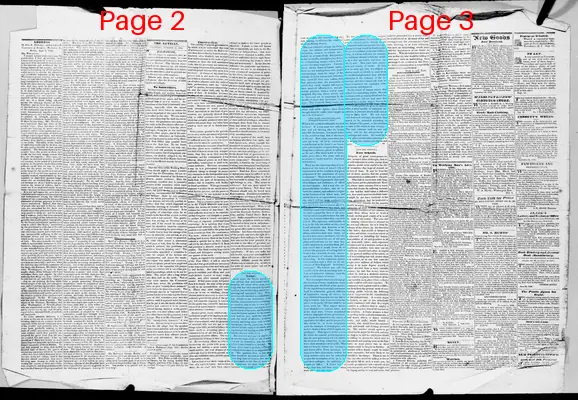
Editorial
October 18, 1832
New England Artisan, And Laboring Man's Repository
Providence, Providence County, Rhode Island
What is this article about?
This editorial advocates for reducing laborers' working hours to allow time for mental cultivation and moral improvement, criticizing exploitative capitalists and emphasizing benefits for republican governance, public morals, and human dignity.
Merged-components note: Sequential across-page components continuing the same editorial on 'Labor' and the need to reduce working hours.
Clippings
1 of 2
OCR Quality
95%
Excellent
Full Text
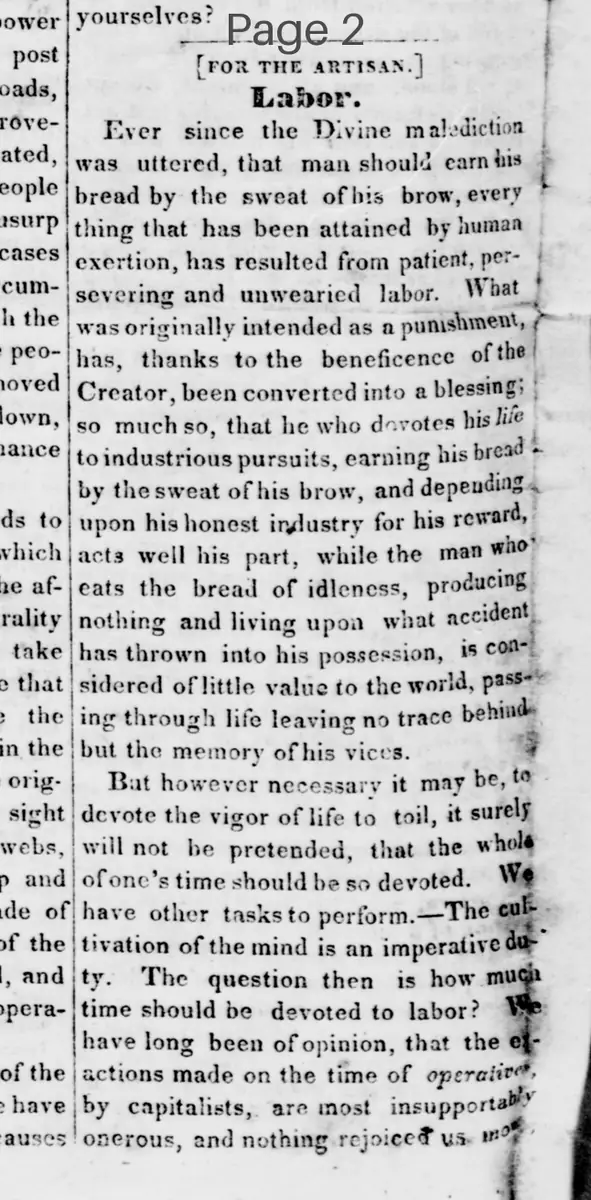
[FOR the Artisan.]
Labor.
Ever since the Divine malediction was uttered, that man should earn his bread by the sweat of his brow, every thing that has been attained by human exertion, has resulted from patient, persevering and unwearied labor. What was originally intended as a punishment, has, thanks to the beneficence of the Creator, been converted into a blessing; so much so, that he who devotes his life to industrious pursuits, earning his bread by the sweat of his brow, and depending upon his honest industry for his reward, acts well his part, while the man who eats the bread of idleness, producing nothing and living upon what accident has thrown into his possession, is considered of little value to the world, passing through life leaving no trace behind, but the memory of his vices.
But however necessary it may be, to devote the vigor of life to toil, it surely will not be pretended, that the whole of one's time should be so devoted. We have other tasks to perform.—The cultivation of the mind is an imperative duty. The question then is how much time should be devoted to labor? We have long been of opinion, that the exactions made on the time of operatives, by capitalists, are most insupportably onerous, and nothing rejoiced us more than to witness the exertions that are now making, to alleviate the condition of the producing classes.
The true character of man, his divine origin, his sublime and transcendent destination, seem to be entirely overlooked, or at least wholly disregarded, in that insatiable, and all-grasping desire of accumulating money, which distinguishes too many employers. Unfortunately for the honor of human nature, there are not wanting those who would unhesitatingly erase the image of the divinity from the human soul, if thereby they could fill their own coffers, with that glittering dust, the possession of which they vainly imagine will expiate their manifold offences here, and ultimately purchase them a seat in some imagined Elysium, where felicity will be measured out in proportion to the wealth of those who participate in its joys. This is not all fancy, many generous and noble spirits, have been brought down to earth, when caught in the toils of Avarice?
"How quickly nature falls into revolt,
When gold becomes her object."
What is life worth if continually devoted to labor? If a man must rise with the sun, and toil till long after its beams have left the horizon, how much better is his condition than that of the horse or the ox? How many years must pass over his head, till he be rendered as unintellectual as the horse?—as insensible and incapable of appreciating anything that is virtuous, grand, or sublime, as the ox?—The world is full of irrefutable proof, that a few years only are necessary to render him thus degraded and debased.
What are the objections then to a reduction of the hours of labor? To an improvement in the condition of a great proportion of the population of every community? There is but one real objection, and that originates in that spirit of sordidness and selfishness, of which we have spoken. Ask a man who employs the labor of others, why he refuses his consent, and influence to lighten the burdens of his fellow men, and enable them to occupy a station in society which will be more conducive to their happiness and respect, he will tell you that he cannot afford it, that his profits are now very small, and should he cease to be a barbarian, should he cease to grind the face of the poor, that he will not be able to leave his children, the fortunes which they expect to inherit. This objection, contemptible as it is, is the only one which we have ever heard advanced, that deserves a moment's consideration. True there are others, and but a short time since, we heard a man, once a mechanic, but who has now renounced the use of the jack plane and hand saw for the more honorable employment of selling them, publicly assert that it would never do to tolerate the principle of working but ten hours a day—it would, he said, encourage all manner of idleness, dissipation and rioting. Is this community prepared to sanction such a libel on the mechanics of New England? Is this their character? We believe not, and the candid will be slow in fastening such a foul, and malicious calumny, upon the most useful classes of society.
This is a subject which should engage the attention of every republican; every philanthropist, the friend of his species. To the republican it strongly commends itself for without the general diffusion of information among all classes, his long cherished hope that this fair fabric of government, may be preserved unimpaired in its purity till time shall be no more, must fail. Men cannot devote their whole lives to manual labor, and at the same time, become acquainted with the principles of their government, investigate for themselves the claims of candidates for office, and be prepared as they should be, to frown indignantly upon the attempts of demagogues, who seek to deprive them of their rights and privileges. Rely upon it, let the system for which we contend, go into operation, and the next generation will not require the services of drag committees to enforce their attendance at the polls. Men will not then be forced into carriages, and driven off to Town meetings, nor require to have their names written for them on their votes, nor be compelled to play the automaton so far as to record their suffrages, for ambitious aspirants for office. A better state of things than this, will then exist, when each knows his own rights.
To the philanthropist this subject comes directly home; for were the hours of labor reduced, public morals would be improved and consequently the commission of crime would be less frequent. We need not adduce particular evidence of this, it will be sufficient to examine the testimony already before the world, to show that ignorance, and vice, run side by side. Men must have excitement and variety of action. If then from an early age, they are obliged to labor so much as entirely to unfit them for intellectual pleasures, they will find relaxation in the company of the debauchee, and their names will soon be found recorded in the catalogue of the intemperate and depraved.
To the friend of human nature this subject has irresistible claims. He who examines with an unprejudiced and disinterested eye, will see that man was created for a higher object, than to be eternally grovelling in the dust. In his bosom glows the germ of immortality, a mind capable of unlimited expansion, a principle which shall exist as long as Deity itself. He will reject with deserved contempt, the notion that man is to be estimated according to the weight of his purse, or the situation or rank in life which he may occupy. The only estimate such an one will make, will be his advancement in knowledge and virtue. He would have every other consideration subservient to the making him virtuous, intelligent and happy.
Labor.
Ever since the Divine malediction was uttered, that man should earn his bread by the sweat of his brow, every thing that has been attained by human exertion, has resulted from patient, persevering and unwearied labor. What was originally intended as a punishment, has, thanks to the beneficence of the Creator, been converted into a blessing; so much so, that he who devotes his life to industrious pursuits, earning his bread by the sweat of his brow, and depending upon his honest industry for his reward, acts well his part, while the man who eats the bread of idleness, producing nothing and living upon what accident has thrown into his possession, is considered of little value to the world, passing through life leaving no trace behind, but the memory of his vices.
But however necessary it may be, to devote the vigor of life to toil, it surely will not be pretended, that the whole of one's time should be so devoted. We have other tasks to perform.—The cultivation of the mind is an imperative duty. The question then is how much time should be devoted to labor? We have long been of opinion, that the exactions made on the time of operatives, by capitalists, are most insupportably onerous, and nothing rejoiced us more than to witness the exertions that are now making, to alleviate the condition of the producing classes.
The true character of man, his divine origin, his sublime and transcendent destination, seem to be entirely overlooked, or at least wholly disregarded, in that insatiable, and all-grasping desire of accumulating money, which distinguishes too many employers. Unfortunately for the honor of human nature, there are not wanting those who would unhesitatingly erase the image of the divinity from the human soul, if thereby they could fill their own coffers, with that glittering dust, the possession of which they vainly imagine will expiate their manifold offences here, and ultimately purchase them a seat in some imagined Elysium, where felicity will be measured out in proportion to the wealth of those who participate in its joys. This is not all fancy, many generous and noble spirits, have been brought down to earth, when caught in the toils of Avarice?
"How quickly nature falls into revolt,
When gold becomes her object."
What is life worth if continually devoted to labor? If a man must rise with the sun, and toil till long after its beams have left the horizon, how much better is his condition than that of the horse or the ox? How many years must pass over his head, till he be rendered as unintellectual as the horse?—as insensible and incapable of appreciating anything that is virtuous, grand, or sublime, as the ox?—The world is full of irrefutable proof, that a few years only are necessary to render him thus degraded and debased.
What are the objections then to a reduction of the hours of labor? To an improvement in the condition of a great proportion of the population of every community? There is but one real objection, and that originates in that spirit of sordidness and selfishness, of which we have spoken. Ask a man who employs the labor of others, why he refuses his consent, and influence to lighten the burdens of his fellow men, and enable them to occupy a station in society which will be more conducive to their happiness and respect, he will tell you that he cannot afford it, that his profits are now very small, and should he cease to be a barbarian, should he cease to grind the face of the poor, that he will not be able to leave his children, the fortunes which they expect to inherit. This objection, contemptible as it is, is the only one which we have ever heard advanced, that deserves a moment's consideration. True there are others, and but a short time since, we heard a man, once a mechanic, but who has now renounced the use of the jack plane and hand saw for the more honorable employment of selling them, publicly assert that it would never do to tolerate the principle of working but ten hours a day—it would, he said, encourage all manner of idleness, dissipation and rioting. Is this community prepared to sanction such a libel on the mechanics of New England? Is this their character? We believe not, and the candid will be slow in fastening such a foul, and malicious calumny, upon the most useful classes of society.
This is a subject which should engage the attention of every republican; every philanthropist, the friend of his species. To the republican it strongly commends itself for without the general diffusion of information among all classes, his long cherished hope that this fair fabric of government, may be preserved unimpaired in its purity till time shall be no more, must fail. Men cannot devote their whole lives to manual labor, and at the same time, become acquainted with the principles of their government, investigate for themselves the claims of candidates for office, and be prepared as they should be, to frown indignantly upon the attempts of demagogues, who seek to deprive them of their rights and privileges. Rely upon it, let the system for which we contend, go into operation, and the next generation will not require the services of drag committees to enforce their attendance at the polls. Men will not then be forced into carriages, and driven off to Town meetings, nor require to have their names written for them on their votes, nor be compelled to play the automaton so far as to record their suffrages, for ambitious aspirants for office. A better state of things than this, will then exist, when each knows his own rights.
To the philanthropist this subject comes directly home; for were the hours of labor reduced, public morals would be improved and consequently the commission of crime would be less frequent. We need not adduce particular evidence of this, it will be sufficient to examine the testimony already before the world, to show that ignorance, and vice, run side by side. Men must have excitement and variety of action. If then from an early age, they are obliged to labor so much as entirely to unfit them for intellectual pleasures, they will find relaxation in the company of the debauchee, and their names will soon be found recorded in the catalogue of the intemperate and depraved.
To the friend of human nature this subject has irresistible claims. He who examines with an unprejudiced and disinterested eye, will see that man was created for a higher object, than to be eternally grovelling in the dust. In his bosom glows the germ of immortality, a mind capable of unlimited expansion, a principle which shall exist as long as Deity itself. He will reject with deserved contempt, the notion that man is to be estimated according to the weight of his purse, or the situation or rank in life which he may occupy. The only estimate such an one will make, will be his advancement in knowledge and virtue. He would have every other consideration subservient to the making him virtuous, intelligent and happy.
What sub-type of article is it?
Labor
Social Reform
Education
What keywords are associated?
Labor Hours
Working Conditions
Ten Hour Day
Capitalists
Social Reform
Mental Cultivation
Public Morals
What entities or persons were involved?
Capitalists
Producing Classes
Mechanics Of New England
Republicans
Philanthropists
Editorial Details
Primary Topic
Reduction Of Hours Of Labor
Stance / Tone
Advocacy For Shorter Working Hours And Worker Improvement
Key Figures
Capitalists
Producing Classes
Mechanics Of New England
Republicans
Philanthropists
Key Arguments
Labor Is Necessary But Should Not Consume All Time; Mental Cultivation Is Imperative.
Exactions On Operatives By Capitalists Are Onerous.
Reducing Hours Improves Workers' Condition And Allows Intellectual Pursuits.
Excessive Labor Degrades Humans To Animal Level.
Objections To Reduction Stem From Selfishness And Profit Concerns.
Shorter Hours Promote Informed Citizenship And Prevent Demagoguery.
Reduced Hours Improve Public Morals And Reduce Crime.
Man's Divine Nature Demands Time For Virtue And Knowledge.