Thank you for visiting SNEWPapers!
Sign up free
Editorial
August 30, 1843
Morning Star
Limerick, York County, Maine
What is this article about?
Editorial presents an extract from Voltaire on human wretchedness and critiques it from a Christian perspective, arguing that atheism fosters misanthropy while Christianity offers redemption, atonement, and hope through salvation.
Clipping
OCR Quality
95%
Excellent
Full Text
An Extract from Voltaire.
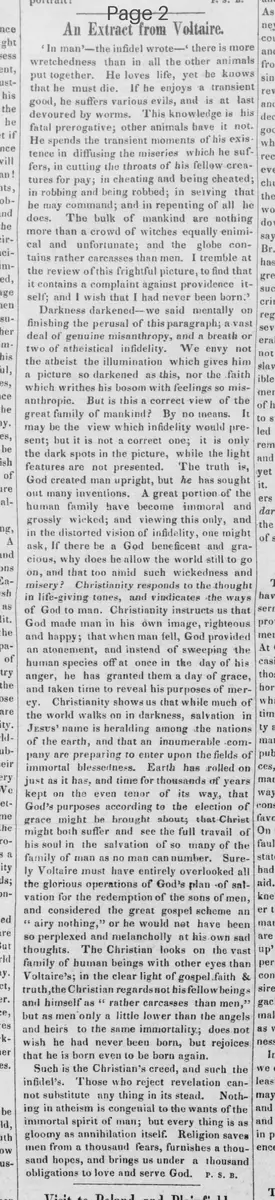
In man's—the infidel wrote—there is more wretchedness than in all the other animals put together. He loves life, yet he knows that he must die. If he enjoys a transient good, he suffers various evils, and is at last devoured by worms. This knowledge is his fatal prerogative; other animals have it not. He spends the transient moments of his existence in diffusing the miseries which he suffers, in cutting the throats of his fellow creatures for pay; in cheating and being cheated; in robbing and being robbed; in serving that he may command; and in repenting of all he does. The bulk of mankind are nothing more than a crowd of wretches equally inimical and unfortunate; and the globe contains rather carcasses than men. I tremble at the review of this frightful picture, to find that it contains a complaint against providence itself; and I wish that I had never been born.
Darkness darkened—we said mentally on finishing the perusal of this paragraph; a vast deal of genuine misanthropy, and a breath or two of atheistical infidelity. We envy not the atheist the illumination which gives him a picture so darkened as this, nor the faith which writhes his bosom with feelings so misanthropic. But is this a correct view of the great family of mankind? By no means. It may be the view which infidelity would present; but it is not a correct one; it is only the dark spots in the picture, while the light features are not presented. The truth is, God created man upright, but he has sought out many inventions. A great portion of the human family have become immoral and grossly wicked; and viewing this only, and in the distorted vision of infidelity, one might ask, If there be a God beneficent and gracious, why does he allow the world still to go on, and that too amid such wickedness and misery? Christianity responds to the thought in life-giving tones, and vindicates the ways of God to man. Christianity instructs us that God made man in his own image, righteous and happy; that when man fell, God provided an atonement, and instead of sweeping the human species off at once in the day of his anger, he has granted them a day of grace, and taken time to reveal his purposes of mercy. Christianity shows us that while much of the world walks on in darkness, salvation in Jesus' name is heralding among the nations of the earth, and that an innumerable company are preparing to enter upon the fields of immortal blessedness. Earth has rolled on just as it has, and time for thousands of years kept on the even tenor of its way, that God's purposes according to the election of grace might be brought about; that Christ might both suffer and see the full travail of his soul in the salvation of so many of the family of man as no man can number. Surely Voltaire must have entirely overlooked all the glorious operations of God's plan of salvation for the redemption of the sons of men, and considered the great gospel scheme an "airy nothing," or he would not have been so perplexed and melancholy at his own sad thoughts. The Christian looks on the vast family of human beings with other eyes than Voltaire's; in the clear light of gospel faith & truth, the Christian regards not his fellow beings and himself as "rather carcasses than men," but as men only a little lower than the angels and heirs to the same immortality; does not wish he had never been born, but rejoices that he is born even to be born again.
Such is the Christian's creed, and such the infidel's. Those who reject revelation cannot substitute any thing in its stead. Nothing in atheism is congenial to the wants of the immortal spirit of man; but every thing is as gloomy as annihilation itself. Religion saves men from a thousand fears, furnishes a thousand hopes, and brings us under a thousand obligations to love and serve God.
P. S. B.
In man's—the infidel wrote—there is more wretchedness than in all the other animals put together. He loves life, yet he knows that he must die. If he enjoys a transient good, he suffers various evils, and is at last devoured by worms. This knowledge is his fatal prerogative; other animals have it not. He spends the transient moments of his existence in diffusing the miseries which he suffers, in cutting the throats of his fellow creatures for pay; in cheating and being cheated; in robbing and being robbed; in serving that he may command; and in repenting of all he does. The bulk of mankind are nothing more than a crowd of wretches equally inimical and unfortunate; and the globe contains rather carcasses than men. I tremble at the review of this frightful picture, to find that it contains a complaint against providence itself; and I wish that I had never been born.
Darkness darkened—we said mentally on finishing the perusal of this paragraph; a vast deal of genuine misanthropy, and a breath or two of atheistical infidelity. We envy not the atheist the illumination which gives him a picture so darkened as this, nor the faith which writhes his bosom with feelings so misanthropic. But is this a correct view of the great family of mankind? By no means. It may be the view which infidelity would present; but it is not a correct one; it is only the dark spots in the picture, while the light features are not presented. The truth is, God created man upright, but he has sought out many inventions. A great portion of the human family have become immoral and grossly wicked; and viewing this only, and in the distorted vision of infidelity, one might ask, If there be a God beneficent and gracious, why does he allow the world still to go on, and that too amid such wickedness and misery? Christianity responds to the thought in life-giving tones, and vindicates the ways of God to man. Christianity instructs us that God made man in his own image, righteous and happy; that when man fell, God provided an atonement, and instead of sweeping the human species off at once in the day of his anger, he has granted them a day of grace, and taken time to reveal his purposes of mercy. Christianity shows us that while much of the world walks on in darkness, salvation in Jesus' name is heralding among the nations of the earth, and that an innumerable company are preparing to enter upon the fields of immortal blessedness. Earth has rolled on just as it has, and time for thousands of years kept on the even tenor of its way, that God's purposes according to the election of grace might be brought about; that Christ might both suffer and see the full travail of his soul in the salvation of so many of the family of man as no man can number. Surely Voltaire must have entirely overlooked all the glorious operations of God's plan of salvation for the redemption of the sons of men, and considered the great gospel scheme an "airy nothing," or he would not have been so perplexed and melancholy at his own sad thoughts. The Christian looks on the vast family of human beings with other eyes than Voltaire's; in the clear light of gospel faith & truth, the Christian regards not his fellow beings and himself as "rather carcasses than men," but as men only a little lower than the angels and heirs to the same immortality; does not wish he had never been born, but rejoices that he is born even to be born again.
Such is the Christian's creed, and such the infidel's. Those who reject revelation cannot substitute any thing in its stead. Nothing in atheism is congenial to the wants of the immortal spirit of man; but every thing is as gloomy as annihilation itself. Religion saves men from a thousand fears, furnishes a thousand hopes, and brings us under a thousand obligations to love and serve God.
P. S. B.
What sub-type of article is it?
Moral Or Religious
What keywords are associated?
Voltaire
Misanthropy
Atheism
Christianity
Salvation
Providence
Atonement
Immortality
What entities or persons were involved?
Voltaire
God
Jesus
Christianity
Editorial Details
Primary Topic
Christian Critique Of Voltaire's Misanthropy And Atheism
Stance / Tone
Defensive Of Christianity, Condemnatory Of Atheism
Key Figures
Voltaire
God
Jesus
Christianity
Key Arguments
Human Wretchedness Stems From Sin, Not Inherent Nature
Christianity Provides Atonement And A Day Of Grace
Atheism Distorts Reality By Ignoring Salvation
True View Sees Humans As Heirs To Immortality Through Faith
Religion Offers Hope And Obligations To Serve God