Thank you for visiting SNEWPapers!
Sign up free
Daily National Intelligencer
Washington, District Of Columbia
What is this article about?
U.S. House of Representatives proceedings on February 22: bills reported on land sales in Jefferson District and military peace establishment; debate and conference request on resolution thanking Gen. Jackson for New Orleans victory; agreement to Senate amendments on treasury notes; disagreement on direct tax amendments; various other bills passed, recommitted, or postponed.
Clipping
OCR Quality
Full Text
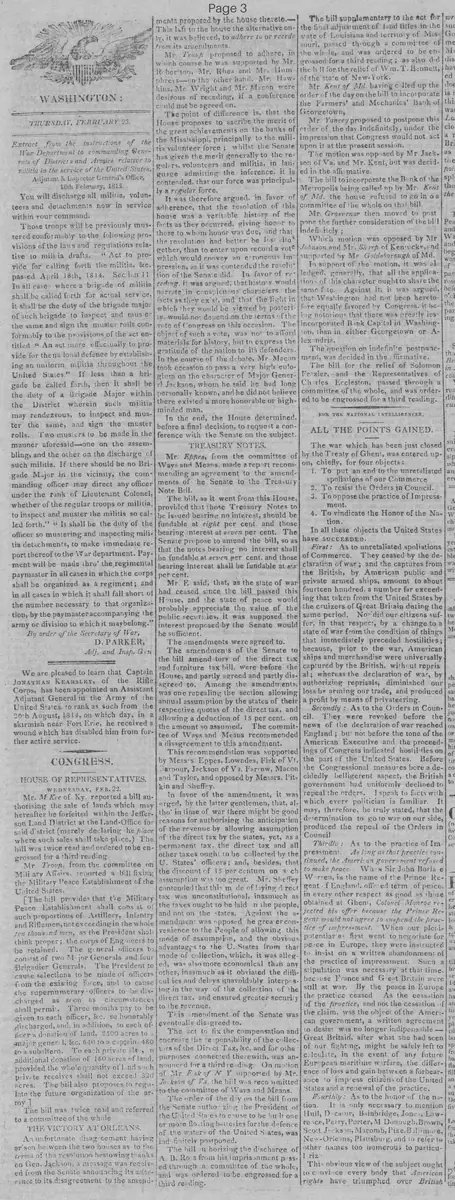
HOUSE OF REPRESENTATIVES.
WEDNESDAY, FEB. 22.
Mr. McKee of Ky. reported a bill authorising the sale of lands which may hereafter be forfeited within the Jefferson Land District at the Land-Office for said district (merely declaring the place where such sales shall take place.) The bill was twice read and ordered to be engrossed for a third reading.
Mr. Troup, from the committee on Military Affairs, reported a bill fixing the Military Peace Establishment of the United States.
[The bill provides that the Military Peace Establishment shall consist of such proportions of Artillery, Infantry and Riflemen, not exceeding in the whole ten thousand men, as the President shall think proper; the corps of Engineers to be retained. The general officers to consist of two Major Generals and four Brigadier Generals. The President to cause selections to be made of officers from the existing force, and to cause the supernumerary officers to be discharged as soon as circumstances shall permit. Three months pay to be given to each officer, &c. so honorably discharged, and, in addition, to each officer a donation of land, 2500 acres to major generals, &c. 640 to a captain 480 to a subaltern. To each private also, an additional donation of 160 acres of land, provided the whole quantity of land such private receives shall not exceed 320 acres. The bill also proposes to regulate the future organization of the army]
The bill was twice read and referred to a committee of the whole
THE VICTORY AT ORLEANS.
An unfortunate disagreement having arisen between the two houses as to the terms of the resolution bestowing thanks on Gen. Jackson, a message was received from the Senate announcing its adherence to its disagreement to the amendments proposed by the house thereto. This left to the house the alternative only, it was believed, to adhere to or recede from its amendments.
Mr. Troup proposed to adhere, in which course he was supported by Mr. Robertson, Mr. Rhea and Mr. Humphreys—on the other hand. Mr. Hawkins, Mr Wright and Mr. Macon were desirous of receding, if a conference could not be agreed on.
The point of difference is, that the House proposes to ascribe the merit of the great achievements on the banks of the Mississippi, principally to the militia volunteer force ; whilst the Senate has given the merit generally to the regulars, volunteers and militia, in language admitting the inference. it is contended, that our force was principally a regular force.
It was therefore argued. in favor of adherence, that the resolution of this house was a veritable history of the facts as they occurred, giving honor to those to whom honor was due, and that the resolution had better be lost altogether, than to enter upon record a vote which would convey an erroneous impression, as it was contended the resolution of the Senate did. In favor of receding. it was argued, that history would narrate in conspicuous characters, the facts as they exist, and that the light in which they would be viewed by posterity, would not depend on the terms of the vote of Congress on this occasion. The object of such a vote, was not to afford materials for history, but to express the gratitude of the nation to its defenders.
In the course of the debate, Mr. Macon took occasion to pass a very high eulogium on the character of Major General Jackson, whom he said he had long personally known, and he did not believe there existed a more honorable or high-minded man.
In the end, the House determined, before a final decision, to request a conference with the Senate on the subject.
TREASURY NOTES
Mr. Eppes, from the committee of Ways and Means, made a report recommending an agreement to the amendments of the Senate to the Treasury Note Bill.
The bill, as it went from this House. provided that those Treasury Notes to be issued bearing no interest, should be fundable at eight per cent. and those bearing interest at seven per cent. The Senate propose to amend the bill, so as that the notes bearing no interest shall be fundable at seven per cent. and those bearing interest shall be fundable at six per cent.
Mr E. said. that, as the state of war had ceased since the bill passed this House, and the state of peace would probably appreciate the value of the public securities, it was supposed the interest proposed by the Senate would be sufficient.
The amendments were agreed to.
The amendments of the Senate to the bill amendatory of the direct tax and furniture tax bill, were before the House, and partly agreed and partly disagreed to. Among the amendments, was one repealing the section allowing annual assumption by the states of their respective quotas of the direct tax, and allowing a deduction of 15 per cent. on the amount so assumed. The committee of Ways and Means recommended a disagreement to this amendment.
This recommendation was supported by Messrs. Eppes, Lowndes, Fisk of Vt. Harper, Jackson of Va. Farrow, Macon and Taylor, and opposed by Messrs. Pitkin and Sheffey.
In favor of the amendment, it was urged, by the latter gentlemen, that, although in time of war there might be good reasons for authorising the anticipation of the revenue by allowing assumption of the direct tax by the states, yet, as a permanent tax, the direct tax and all other taxes ought to be collected by the U. States' officers: and, besides, that the discount of 15 per centum on such assumption was too great. Mr. Sheffey contended that this mode of laying direct tax was unconstitutional, inasmuch as the taxes ought to be laid on the people, and not on the states. Against the amendment was opposed the greater convenience to the People of allowing this mode of assumption, and the obvious advantages to the U. States from that mode of collection, which, it was alleged, was also more economical than any other, inasmuch as it obviated the difficulties and delays unavoidably interposing in the way of the collection of the direct tax, and ensured greater security to the revenue.
This amendment of the Senate was eventually disagreed to.
The act to fix the compensation and increase the responsibility of the collectors of the Direct Tax, &c. and for other purposes connected therewith, was announced for a third reading. On motion of Mr. Fisk of N Y supported by Mr. Jackson of Va. the bill was recommitted to the committee of Ways and Means.
The order of the day on the bill from the Senate authorising the President of the United States to cause to be built one or more floating batteries for the defence of the waters of the United States, was indefinitely postponed.
The bill authorising the discharge of A. B. Ross from his imprisonment passed through a committee of the whole, and was ordered to be engrossed for a third reading.
The bill supplementary to the act for the final adjustment of land titles in the state of Louisiana and territory of Missouri, passed through a committee of the whole, and was ordered to be engrossed for a third reading; as also did the bill for the relief of Wm. T. Bennett, of the state of New-York.
Mr Kent of Md. having called up the order of the day on the bill to incorporate the Farmers' and Mechanics' Bank of Georgetown,
Mr Yancey proposed to postpone this order of the day indefinitely, under the impression that Congress would not act upon it at the present session.
The motion was opposed by Mr. Jackson of Va. and Mr. Kent, but was decided in the affirmative.
The bill to incorporate the Bank of the Metropolis being called up by Mr. Kent of Md. the house refused to go into a committee of the whole on that bill.
Mr. Grosvenor then moved to postpone the further consideration of the bill indefinitely ;
Which motion was opposed by Mr. Johnson and Mr. Sharp of Kentucky, and supported by Mr. Goldsborough of Md.
In support of the motion, it was alleged, generally, that all the applications of this character ought to share the same fate. Against it. it was argued, that Washington had not been heretofore equally favored by Congress. it being notorious that there was greatly less incorporated Bank Capital in Washington, than in either Georgetown or Alexandria.
The question on indefinite postponement, was decided in the affirmative.
The bill for the relief of Solomon Frazier, and the Representatives of Charles Eccleston, passed through a committee of the whole, and was ordered to be engrossed for a third reading.
What sub-type of article is it?
What keywords are associated?
What entities or persons were involved?
Domestic News Details
Event Date
Wednesday, Feb. 22.
Key Persons
Outcome
bills reported, debated, amended, agreed to, disagreed to, passed through committees, ordered engrossed, recommitted, or indefinitely postponed as detailed.
Event Details
The House reported bills on land sales in Jefferson District and military peace establishment (up to 10,000 men, officer reductions, land donations); debated Senate disagreement on thanks resolution for Gen. Jackson's victory at Orleans, emphasizing militia role vs. regulars, requested conference; agreed to Senate amendments lowering interest rates on treasury notes due to peace; disagreed to Senate amendment on state assumption of direct tax quotas; handled various other bills on tax collectors, floating batteries, prisoner discharge, land titles in Louisiana and Missouri, individual relief, and bank incorporations, with several postponed.