Thank you for visiting SNEWPapers!
Sign up free
The New Hampshire Gazette And General Advertiser
Portsmouth, Rockingham County, New Hampshire
What is this article about?
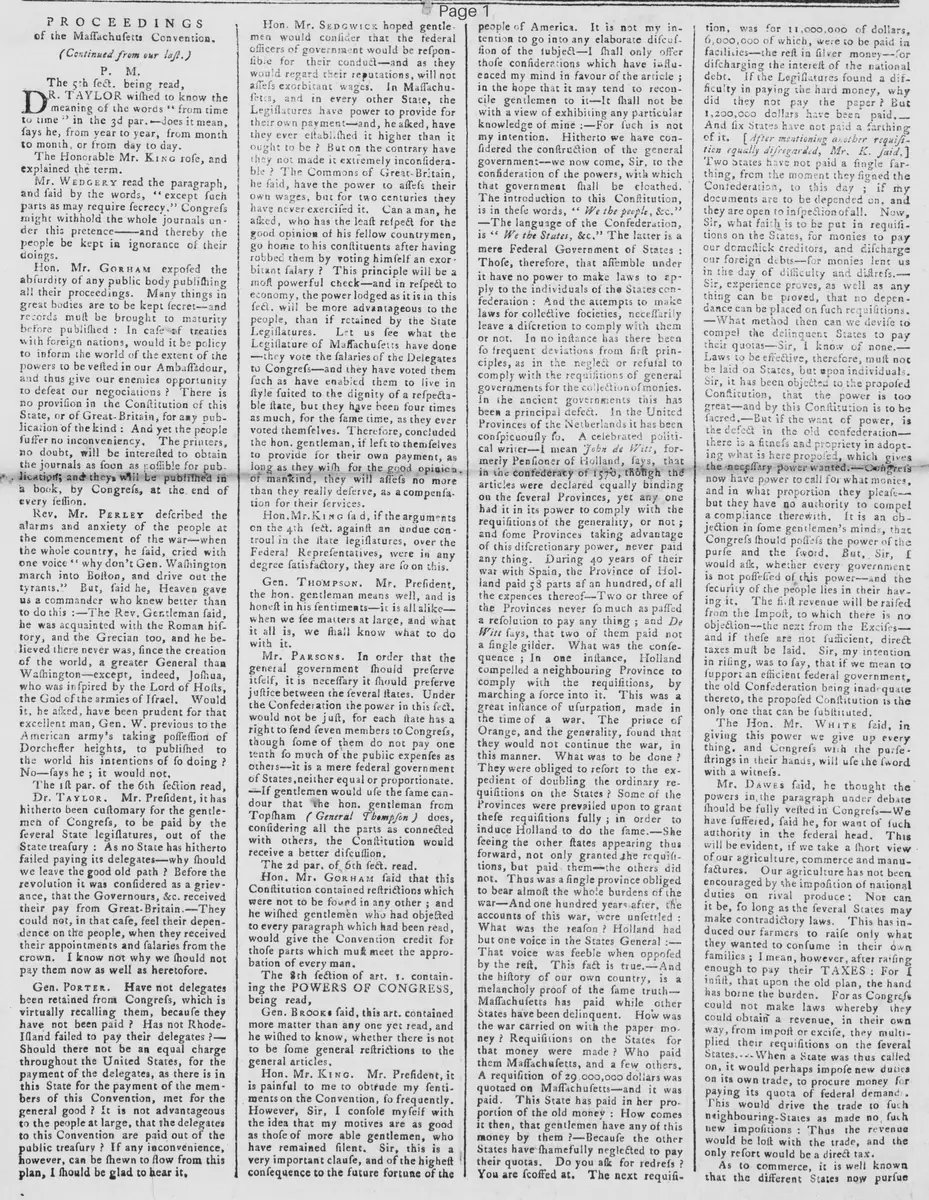
Transcript of afternoon proceedings in the Massachusetts Ratifying Convention, debating constitutional provisions on journal publication, delegate payment by Congress versus states, and granting Congress powers to lay taxes, duties, and regulate commerce for a stronger federal government.
Merged-components note: This is a single continued report on the proceedings of the Massachusetts Convention discussing the U.S. Constitution, spanning multiple components across pages; relabeled from 'story' and 'editorial' to 'domestic_news' as it fits local/national political news.
Clippings
1 of 2
OCR Quality
Full Text
of the Massachusetts Convention.
(Continued from our last.)
P. M.
The 5th day.
The 5th sect. being read,
R. TAYLOR wished to know the
meaning of the words "from time
to time" in the 3d par.—does it mean,
says he, from year to year, from month
to month, or from day to day.
The Honorable Mr. King rose, and
explained the term.
Mr. WEDGERY read the paragraph,
and said by the words,
"except such
parts as may require secrecy." Congress
might withhold the whole journals un-
der this pretence—
and thereby the
people be kept in ignorance of their
doings.
Hon. Mr. GORHAM exposed
the absurdity of any public body publishing
all their proceedings. Many things in
great bodies are to be kept secret—and
records must be brought to maturity
before published: In case of treaties
with foreign nations, would it be policy
to inform the world of the extent of the
powers to be vested in our Ambassador,
and thus give our enemies opportunity
to defeat our negociations? There is
no provision in the Constitution of this
State, or of Great-Britain, for any pub-
lication of the kind: And yet the people
suffer no inconveniency. The printers,
no doubt, will be interested to obtain
the journals as soon as possible for pub.
lication; and they will be published in
a book, by Congress, at the end of
every session.
Rev. Mr. PARSONS described the
alarms and anxiety of the people at
the commencement of the war—when
the whole country, he said, cried with
one voice "why don't Gen. WASHINGTON
march into Boston, and drive out the
tyrants." But, said he, Heaven gave
us a commander who knew better than
to do this:—The Rev. Gentleman said.
he was acquainted with the Roman his-
tory, and the Grecian too, and he be-
lieved there never was, since the creation
of the world, a greater General than
WASHINGTON—except, indeed, JOSHUA,
who was inspired by the Lord of Hosts,
the God of the armies of Israel. Would
it, he asked, have been prudent for that
excellent man, Gen. W. previous to the
American army's taking possession of
Dorchester heights, to publish to
the world his intentions of so doing?
No—says he: it would not.
The 1st par. of the 6th section read,
Dr. TAYLOR. Mr. President, it has
hitherto been customary for the gentle-
men of Congress, to be paid by the
several State legislatures, out of the
State treasury: As no State has hitherto
failed paying its delegates—why should
we leave the good old path? Before the
revolution it was considered as a griev-
ance, that the Governours, &c. received
their pay from Great-Britain.—They
could not, in that case, feel their depen-
dence on the people, when they received
their appointments and salaries from the
crown. I know not why we should not
pay them now as well as heretofore.
Gen. PORTER. Have not delegates
been retained from Congress, which is
virtually recalling them, because they
have not been paid? Has not Rhode-
Island failed to pay their delegates?—
Should there not be an equal charge
throughout the United States, for the
payment of the delegates, as there is in
this State for the payment of the mem-
bers of this Convention, met for the
general good? It is not advantageous
to the people at large, that the delegates
to this Convention are paid out of the
public treasury? If any inconvenience,
however, can be shewn to flow from this
plan, I should be glad to hear it.
Hon. Mr. SEDGWICK hoped gentle.
men would consider that the federal
officers of government would be respon-
sible for their conduct—and as they
would regard their reputations, will not
assess exorbitant wages. In Massachu-
setts, and in every other State, the
Legislatures have power to provide for
their own payment—and, he asked, have
they ever established it higher than it
ought to be? But on the contrary have
they not made it extremely inconsidera.
ble? The Commons of Great-Britain,
he said, have the power to assess their
own wages, but for two centuries they
have never exercised it. Can a man, he
asked, who has the least respect for the
good opinion of his fellow countrymen,
go home to his constituents after having
robbed them by voting himself an exor-
bitant salary? This principle will be a
most powerful check—and in respect to
economy, the power lodged as it is in this
sect. will be more advantageous to the
people, than if retained by the State
Legislatures.
Let us see what the
Legislature of Massachusetts have done
—they vote the salaries of the Delegates
to Congress—and they have voted them
such as have enabled them to live in
style suited to the dignity of a respecta-
ble state, but they have been four times
as much, for the same time, as they ever
voted themselves. Therefore, concluded
the hon. gentleman, if left to themselves
to provide for their own payment, as
long as they wish for the good opinion
of mankind, they will ask no more
than they really deserve, as a compenfa-
tion for their services.
Hon. Mr. KING said, if the arguments
on the 4th sect. against an undue con-
troul in the state legislatures, over the
Federal Representatives, were in any
degree satisfactory, they are so on this.
Gen. THOMPSON. Mr. President,
the hon. gentleman means well, and is
honest in his sentiments—it is all alike—
when we see matters at large, and what
it all is, we shall know what to do
with it.
Mr. PARSONS. In order that the
general government should preserve
itself, it is necessary it should preserve
justice between the several states. Under
the Confederation the power in this sect.
would not be just, for each state has a
right to send seven members to Congress,
though some of them do not pay one
tenth so much of the public expences as
others—it is a mere federal government
of States, neither equal or proportionate.
If gentlemen would use the same can-
dour that the hon. gentleman from
Topsham (General THOMPSON) does,
considering all the parts as connected
with others, the Constitution would
receive a better discussion.
The 2d par. of 6th sect. read.
Hon. Mr. GORHAM said that this
Constitution contained restrictions which
were not to be found in any other; and
he wished gentlemen who had objected
to every paragraph which had been read,
would give the Convention credit for
those parts which must meet the appro-
bation of every man.
The 5th section of art. I. contain-
ing the POWERS OF CONGRESS,
being read,
Gen. BROOKE said, this art. contained
more matter than any one yet read, and
he wished to know, whether there is not
to be some general restrictions to the
general articles.
Hon. Mr. KING. Mr. President, it
is painful to me to obtrude my senti-
ments on the Convention, so frequently.
However. Sir, I console myself with
the idea that my motives are as good
as those of more able gentlemen, who
have remained silent. Sir, this is a
very important clause, and of the highest
consequence to the future fortune of the
people of America. It is not my in-
tention to go into any elaborate discus.
sion of the subject—I shall only offer
those considerations which have jaflu-
eaced my mind in favour of the article;
in the hope that it may tend to recon-
cile gentlemen to it—It shall not be
with a view of exhibiting any particular
knowledge of mine:—For such is not
my intention. Hitherto we have con-
sidered the construction of the general
government—we now come, Sir, to the
consideration of the powers, with which
that government shall be cloathed.
The introduction to this Constitution,
is in these words, "We the people, &c."
—The language of the Confederation,
is "We the States, &c." The latter is a
mere Federal Government of States:
Those, therefore. that assemble under
it have no power to make laws to ap-
ply to the individuals of the States con-
federation: And the attempts to make
laws for collective societies, necessarily
leave a discretion to comply with them
or not. In no instance has there been
so frequent deviations from first prin-
ciples, as in the neglect or refusal to
comply with the requisitions of general
governments for the collection of monies.
In the ancient governments this has
been a principal defect. In the United
Provinces of the Netherlands it has been
conspicuously so. A celebrated politi-
cal writer—I mean John de Witt, for-
merly Pensioner of Holland, says. that
in the confederacy of 1570, though the
articles were declared equally binding
on the several Provinces, yet any one
had it in its power to comply with the
requisitions of the generality, or not;
and some Provinces taking advantage
of this discretionary power, never paid
any thing. During 40 years of their
war with Spain. the Province of Hol-
land paid 78 parts of an hundred, of all
the expences thereof—Two or three of
the Provinces never so much as passed
a resolution to pay any thing; and De
Witt says, that two of them paid not
a single guilder. What was the conse-
quence; In one instance, Holland
compelled a neighbouring Province to
comply with the requisitions, by
marching a force into it. This was a
great instance of usurpation, made in
the time of a war. The prince of
Orange, and the generality, found that
they would not continue the war, in
this manner. What was to be done?
They were obliged to resort to the ex-
pedient of doubling the ordinary re-
quisitions on the States? Some of the
Provinces were prevailed upon to grant
these requisitions fully; in order to
induce Holland to do the same.—She
seeing the other states appearing thus
forward, not only granted the requisi-
tions, but paid them—the others did
not. Thus was a single province obliged
to bear almost the whole burdens of the
war—And one hundred years after, the
accounts of this war. were unsettled:
What was the reason? Holland had
but one voice in the States General:—
That voice was feeble when opposed
by the rest. This fact is true.—And
the history of our own country, is a
melancholy proof of the same truth—
Massachusetts has paid while other
States have been delinquent. How was
the war carried on with the paper mo-
ney? Requisitions on the States for
that money were made? Who paid
them Massachusetts, and a few others.
A requisition of 29,000,000 dollars was
quotaed on Massachusetts—and it was
paid. This State has paid in her pro-
portion of the old money: How comes
it then, that gentlemen have any of this
money by them? Because the other
States have shamefully neglected to pay
their quotas. Do you ask for redress?
You are scoffed at. The next requisi-
tion, was for 11,000,000 of dollars,
6,000,000 of which, were to be paid in
specie—the rest in silver money—for
discharging the interest of the national
debt, If the Legislatures found a dif-
ficulty in paying the hard money, why
did they not pay the paper? But
1,200,000 dollars have been paid...
And six States have not paid a farthing
of it. After mentioning another requisi-
tion equally disregarded, Mr. K. said,
Two States have not paid a single far-
thing, from the moment they signed the
Confederation, to this day; if my
documents are to be depended on. and
they are open to inspection of all. Now,
Sir, what faith is to be put in requisi-
tions on the States, for monies to pay
our domestick creditors, and discharge
our foreign debts—for monies lent us
in the day of difficulty and distress.—
Sir, experience proves, as well as any
thing can be proved, that no depen-
dance can be placed on such requisitions.
What method then can we devise to
compel the delinquent States to pay
their quotas—Sir. I know of none.—
Laws to be effective. therefore, must not
be laid on States, but upon individuals.
Sir, it has been objected to the proposed
Constitution, that the power is too
great—and by this Constitution is to be
sacred,—But if the want of power, is
the defect in the old confederation—
there is a fitness and propriety in adopt-
ing what is here proposed, which gives
the necessary power wanted.—Congress
now have power to call for what monies,
and in what proportion they please—
but they have no authority to compel
a compliance therewith. It is an ob-
jection in some gentlemen's minds, that
Congress should possess the power of the
purse and the sword. But,. Sir, I
would ask, whether every government
is not possessed of this power—and the
security of the people lies in their hav-
ing it. The first revenue will be raised
from the Impost, to which there is no
objection—the next from the Excises—
and if these are not sufficient, direct
taxes must be laid. Sir, my intention
in rising, was to say, that if we mean to
support an efficient federal government,
the old Confederation being inadequate
thereto, the proposed Constitution is the
only one that can be substituted.
The Hon. Mr. WHITE said, in
giving this power we give up every
thing, and Congress with the purse-
strings in their hands, will use the sword
with a witness.
Mr. DAWES said, he thought the
powers in,the paragraph under debate
should be fully vested in Congress—We
have suffered, said he, for want of such
authority in the federal head. This
will be evident, if we take a short view
of our agriculture, commerce and manu-
factures. Our agriculture has not been
encouraged by the imposition of national
duties on rival produce: Nor can
it be, so long as the several States may
make contradictory laws. This has in-
duced our farmers to raise only what
they wanted to consume in their own
families; I mean, however, after raising
enough to pay their TAXES: For I
insist, that upon the old plan, the land
has borne the burden. For as Congress
could not make laws whereby they
could obtain a revenue, in their own
way, from impost or excise, they multi-
plied their requisitions on the several
States... When a State was thus called
on, it would perhaps impose new duties
on its own trade, to procure money for
paying its quota of federal demand.
This would drive the trade to such
neighbouring-States as made no, such
new impositions: Thus the revenue
would be lost with the trade, and the
only resort would be a direct tax.
As to commerce. it is well known
that the different States now pursue
different system of duties in regard to each other. By this, and for want of general laws of prohibition through the Union, we have not secured even our own domestic traffic, that passes from State to State. This is contrary to the policy of every nation on earth. Some nations have no other commerce. The great and flourishing empire of China has but little commerce beyond her own territories; and no country is better circumstanced than we for an exclusive traffic from State to State: Yet even in this we are rivalled by foreigners—by those foreigners to whom we are least indebted. A vessel from Roseway or Halifax finds as hearty a welcome with its fish and whale bone at the southern ports, as though it was built, navigated and freighted from Salem or Boston,— And this must be the case, until we have laws comprehending and embracing alike all the States in the Union. But it is not only our coasting trade, our whole commerce is going to ruin. Congress has not had power to make even a trade law, which shall confine the importation of foreign goods to the ships of the producing or the consuming country: If we had such a law, we should not go to England for the goods of other nations; nor would British vessels be the carriers of American produce from our sister States. In the States southward of the Delaware, it is agreed, that three fourths of the produce are exported, and three fourths of the returns are made in British bottoms. It is said, that for exporting lumber one half the property goes to the carrier, and of the produce in general, it has been computed, that when it is shipped for London from a southern State, to the value of one million of dollars. the British merchant draws from that sum three hundred thousand dollars, under the names of freight and charges. This is money which belongs to the New-England States. because we can furnish the ships as well as, and much better, than the British. Our sister States are willing we should receive these benefits, and that they should be secured to us by national laws; but until that is done, their private merchants will, no doubt, for the sake of long credit, or some other such temporary advantage, prefer the ships of foreigners: And yet we have suffered these ignominious burthens, rather than trust our own representatives with power to help us; and we call ourselves free and independent States: We are independent of each other, but we are slaves to Europe. We have no uniformity in duties, imposts, excises or prohibitions. Congress has no authority to withhold advantages from foreigners, in order to obtain advantages from them. By the 6th of the old articles, Congress may enter into treaties and alliances under certain provisos, but Congress cannot pledge. that a single State shall not render the whole treaty of commerce a nullity. Our manufactures are another great subject. which has received no encouragement by national duties on foreign manufactures, and they never can by any authority in the old Confederation.— It has been said, that no country can produce manufactures until it be over-stocked with inhabitants. It is true, the United States have employ, except in the winter. for their citizens in agriculture—the most respectable employment under heaven: But it is now to be remembered, that since the old Confederation there is a great emigration of foreign artisans hither, some of whom are left here by the armies of the last war, and others, who have more lately sought the new world, from hopes of mending their condition—these will not change their employments. Besides this, the very face of our country leads to manufactures. Our numerous falls of water, and places for mills, where paper, flour, gun-powder, iron works, and numerous other articles are prepared, these will save us immense sums of money, that otherwise would go to Europe.— The question is, have these been encouraged? Has Congress been able, by national laws, to prevent the importation of such foreign commodities as are made from such raw materials as we ourselves raise. It is alleged, that the citizens of the United States have contracted debts within the last three years, with the subjects of Great-Britain, for the amount of near six million dollars, and that consequently our lands are mortgaged for that sum. So Corsica was once mortgaged to the Genoese merchants.
sold to a foreign power. If we wish to encourage our own commerce, to raise the value of our own lands, we must give Congress the powers in question. The Hon. Gentleman from Norton last speaking, says, that if Congress have the power of laying and collecting taxes, they will use the power of the sword. I hold the reverse to be true. The doctrine of requisitions or of demands upon a whole State, implies such a power: For surely a whole State, a whole community, can be compelled only by an army; but taxes upon an individual implies only the use of a collector of taxes, That Congress, however, will not apply to the power of direct taxation, unless in cases of emergency, is plain; because, as thirty thousand inhabitants will elect a representative, eight tenths of which electors perhaps are yeomen, and holders of farms, it will be their own faults if they are not represented by such men as will never permit the land to be injured by unnecessary taxes.
(To be continued.)
What sub-type of article is it?
What keywords are associated?
What entities or persons were involved?
Where did it happen?
Domestic News Details
Primary Location
Massachusetts
Key Persons
Event Details
Debate in the Massachusetts Convention on sections of the proposed US Constitution, including interpretation of 'from time to time' for journal publication, concerns over secrecy, payment of congressional delegates by federal versus state governments, and granting Congress powers to lay taxes, duties, imposts, excises, and regulate commerce to strengthen the federal government over the weak Confederation.