Thank you for visiting SNEWPapers!
Sign up free
Story
September 20, 1889
The Times
Owosso, Shiawassee County, Michigan
What is this article about?
Scientific explanation of summer heat: Earth's northern hemisphere tilts toward sun for direct rays and longer days, despite greater distance; hottest weather lags solstice by a month as heat accumulates; parallels daily temperature peaks.
Clipping
OCR Quality
98%
Excellent
Full Text
The Summer Heat.
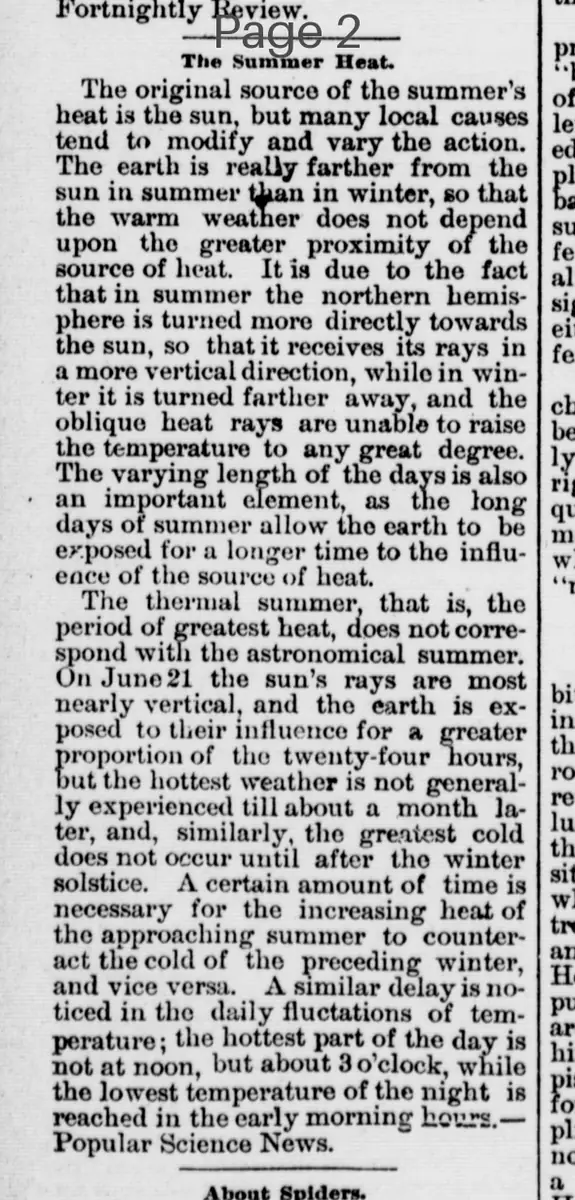
The original source of the summer's heat is the sun, but many local causes tend to modify and vary the action. The earth is really farther from the sun in summer than in winter, so that the warm weather does not depend upon the greater proximity of the source of heat. It is due to the fact that in summer the northern hemisphere is turned more directly towards the sun, so that it receives its rays in a more vertical direction, while in winter it is turned farther away, and the oblique heat rays are unable to raise the temperature to any great degree.
The varying length of the days is also an important element, as the long days of summer allow the earth to be exposed for a longer time to the influence of the source of heat.
The thermal summer, that is, the period of greatest heat, does not correspond with the astronomical summer. On June 21 the sun's rays are most nearly vertical, and the earth is exposed to their influence for a greater proportion of the twenty-four hours, but the hottest weather is not generally experienced till about a month later, and, similarly, the greatest cold does not occur until after the winter solstice. A certain amount of time is necessary for the increasing heat of the approaching summer to counteract the cold of the preceding winter, and vice versa. A similar delay is noticed in the daily fluctuations of temperature; the hottest part of the day is not at noon, but about 3 o'clock, while the lowest temperature of the night is reached in the early morning hours.—Popular Science News
The original source of the summer's heat is the sun, but many local causes tend to modify and vary the action. The earth is really farther from the sun in summer than in winter, so that the warm weather does not depend upon the greater proximity of the source of heat. It is due to the fact that in summer the northern hemisphere is turned more directly towards the sun, so that it receives its rays in a more vertical direction, while in winter it is turned farther away, and the oblique heat rays are unable to raise the temperature to any great degree.
The varying length of the days is also an important element, as the long days of summer allow the earth to be exposed for a longer time to the influence of the source of heat.
The thermal summer, that is, the period of greatest heat, does not correspond with the astronomical summer. On June 21 the sun's rays are most nearly vertical, and the earth is exposed to their influence for a greater proportion of the twenty-four hours, but the hottest weather is not generally experienced till about a month later, and, similarly, the greatest cold does not occur until after the winter solstice. A certain amount of time is necessary for the increasing heat of the approaching summer to counteract the cold of the preceding winter, and vice versa. A similar delay is noticed in the daily fluctuations of temperature; the hottest part of the day is not at noon, but about 3 o'clock, while the lowest temperature of the night is reached in the early morning hours.—Popular Science News
What sub-type of article is it?
Curiosity
What themes does it cover?
Nature
What keywords are associated?
Summer Heat
Sun Rays
Earth Tilt
Solstice Lag
Thermal Summer
Story Details
Story Details
Explanation of summer heat sources: sun's vertical rays on tilted northern hemisphere, longer days; thermal summer lags astronomical by a month due to heat buildup; similar daily temperature delays.