Thank you for visiting SNEWPapers!
Sign up free
Story
September 28, 1878
The Democratic Advocate
Westminster, Carroll County, Maryland
What is this article about?
Article on the record-large 1878 U.S. wheat crop urges farmers not to sell too early to avoid price drops and speculation; emphasizes proper soil management and seed over blaming climate for failures. By H. M. Engle in Ohio Farmer.
Clipping
OCR Quality
95%
Excellent
Full Text
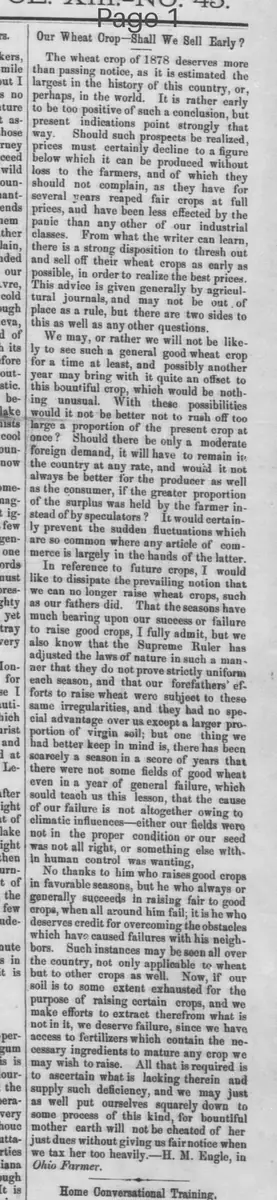
Our Wheat Crop-Shall We Sell Early ?
The wheat crop of 1878 deserves more than passing notice, as it is estimated the largest in the history of this country, or perhaps, in the world. It is rather early to be too positive of such a conclusion, but present indications point strongly that way.
Should such prospects be realized, prices must certainly decline to a figure below which it can be produced without loss to the farmers, and of which they should not complain, as they have for several years reaped fair crops at full prices, and have been less affected by the panic than any other of our industrial classes. From what the writer can learn, there is a strong disposition to thresh out and sell off their wheat crops as early as possible, in order to realize the best prices. This advice is given generally by agricultural journals, and may not be out of place as a rule, but there are two sides to this as well as any other questions.
We may, or rather we will not be likely to see such a general good wheat crop for a time at least, and possibly another year may bring with it quite an offset to this bountiful crop, which would be nothing unusual. With these possibilities would it not be better not to rush off too large a proportion of the present crop at once? Should there be only a moderate foreign demand, it will have to remain in the country at any rate, and would it not always be better for the producer as well as the consumer, if the greater proportion of the surplus was held by the farmer instead of by speculators? It would certainly prevent the sudden fluctuations which are so common where any article of commerce is largely in the hands of the latter.
In reference to future crops, I would like to dissipate the prevailing notion that we can no longer raise wheat crops, such as our fathers did. That the seasons have much bearing upon our success or failure to raise good crops, I fully admit, but we also know that the Supreme Ruler has adjusted the laws of nature in such a manner that they do not prove strictly uniform each season, and that our forefathers' efforts to raise wheat were subject to these same irregularities, and they had no special advantage over us except a larger proportion of virgin soil; but one thing we had better keep in mind is, there has been scarcely a season in a score of years that there were not some fields of good wheat even in a year of general failure, which should teach us this lesson, that the cause of our failure is not altogether owing to climatic influences--either our fields were not in the proper condition or our seed was not all right, or something else within human control was wanting,
No thanks to him who raises good crops in favorable seasons, but he who always or generally succeeds in raising fair to good crops, when all around him fail; it is he who deserves credit for overcoming the obstacles which have caused failures with his neighbors. Such instances may be seen all over the country, not only applicable to wheat but to other crops as well. Now, if our soil is to some extent exhausted for the purpose of raising certain crops, and we make efforts to extract therefrom what is not in it, we deserve failure, since we have access to fertilizers which contain the necessary ingredients to mature any crop we may wish to raise. All that is required is to ascertain what is lacking therein and supply such deficiency, and we may just as well put ourselves squarely down to some process of this kind, for bountiful mother earth will not be cheated of her just dues without giving us fair notice when we tax her too heavily.-H. M. Engle, in Ohio Farmer.
The wheat crop of 1878 deserves more than passing notice, as it is estimated the largest in the history of this country, or perhaps, in the world. It is rather early to be too positive of such a conclusion, but present indications point strongly that way.
Should such prospects be realized, prices must certainly decline to a figure below which it can be produced without loss to the farmers, and of which they should not complain, as they have for several years reaped fair crops at full prices, and have been less affected by the panic than any other of our industrial classes. From what the writer can learn, there is a strong disposition to thresh out and sell off their wheat crops as early as possible, in order to realize the best prices. This advice is given generally by agricultural journals, and may not be out of place as a rule, but there are two sides to this as well as any other questions.
We may, or rather we will not be likely to see such a general good wheat crop for a time at least, and possibly another year may bring with it quite an offset to this bountiful crop, which would be nothing unusual. With these possibilities would it not be better not to rush off too large a proportion of the present crop at once? Should there be only a moderate foreign demand, it will have to remain in the country at any rate, and would it not always be better for the producer as well as the consumer, if the greater proportion of the surplus was held by the farmer instead of by speculators? It would certainly prevent the sudden fluctuations which are so common where any article of commerce is largely in the hands of the latter.
In reference to future crops, I would like to dissipate the prevailing notion that we can no longer raise wheat crops, such as our fathers did. That the seasons have much bearing upon our success or failure to raise good crops, I fully admit, but we also know that the Supreme Ruler has adjusted the laws of nature in such a manner that they do not prove strictly uniform each season, and that our forefathers' efforts to raise wheat were subject to these same irregularities, and they had no special advantage over us except a larger proportion of virgin soil; but one thing we had better keep in mind is, there has been scarcely a season in a score of years that there were not some fields of good wheat even in a year of general failure, which should teach us this lesson, that the cause of our failure is not altogether owing to climatic influences--either our fields were not in the proper condition or our seed was not all right, or something else within human control was wanting,
No thanks to him who raises good crops in favorable seasons, but he who always or generally succeeds in raising fair to good crops, when all around him fail; it is he who deserves credit for overcoming the obstacles which have caused failures with his neighbors. Such instances may be seen all over the country, not only applicable to wheat but to other crops as well. Now, if our soil is to some extent exhausted for the purpose of raising certain crops, and we make efforts to extract therefrom what is not in it, we deserve failure, since we have access to fertilizers which contain the necessary ingredients to mature any crop we may wish to raise. All that is required is to ascertain what is lacking therein and supply such deficiency, and we may just as well put ourselves squarely down to some process of this kind, for bountiful mother earth will not be cheated of her just dues without giving us fair notice when we tax her too heavily.-H. M. Engle, in Ohio Farmer.
What sub-type of article is it?
Agricultural Essay
Farming Advice
What keywords are associated?
Wheat Crop 1878
Selling Strategy
Farming Practices
Speculation
Soil Management
Fertilizers
What entities or persons were involved?
H. M. Engle
Where did it happen?
United States
Story Details
Key Persons
H. M. Engle
Location
United States
Event Date
1878
Story Details
Discusses the massive 1878 wheat crop, advises holding surplus to avoid speculation-driven price fluctuations, counters idea that climate prevents good yields by stressing proper field preparation, seed quality, and fertilizers for consistent success.