Thank you for visiting SNEWPapers!
Sign up free
The New Hampshire Gazette
Portsmouth, Rockingham County, New Hampshire
What is this article about?
The House Committee on Post Office issues a report defending Postmaster General William T. Barry against Senate allegations of improper loans from contractor James Reeside and favoritism to bidder Richard C. Stockton. It also justifies bounties paid to officers for apprehending mail depredators, citing precedents since 1805.
Merged-components note: These two sequential components form a single coherent article on the Post Office Report, with the text flowing directly from the end of the first ('His reply is dated the') to the beginning of the second ('21st of January').
Clipping
OCR Quality
Full Text
TUESDAY, APRIL 28, 1835.
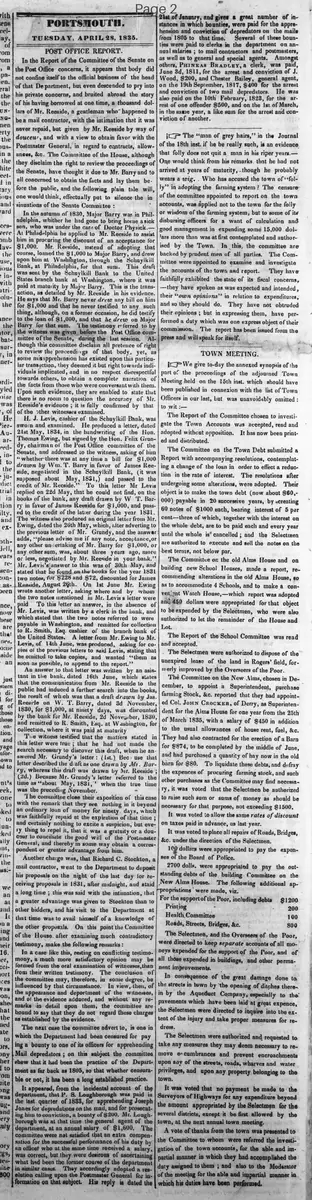
POST OFFICE REPORT.
In the Report of the Committee of the Senate on the Post Office concerns, it appears that body did not confine itself to the official business of the head of that Department, but even descended to pry into his private concerns, and bruited abroad the story of his having borrowed at one time, a thousand dollars of Mr. Reeside, a gentleman who happened to be a mail contractor, with the intimation that it was never repaid, but given by Mr. Reeside by way of douceur, and with a view to obtain favor with the Postmaster General, in regard to contracts, allowances, &c. The Committee of the House, although they disclaim the right to review the proceedings of the Senate, have thought it due to Mr. Barry and to all concerned to obtain the facts and lay them before the public, and the following plain tale will, one would think, effectually put to silence the insinuations of the Senate Committee:
In the autumn of 1830, Major Barry was in Philadelphia, whither he had gone to bring home a sick son, who was under the care of Doctor Physick.— At Philadelphia he applied to Mr. Reeside to assist him in procuring the discount of an acceptance for $1,000. Mr. Reeside, instead of adopting that course, loaned the $1,000 to Major Barry, and drew upon him at Washington, through the Schuylkill Bank, at Philadelphia, for that sum. This draft was sent by the Schuylkill Bank to the United States branch bank at Washington, where it was paid at maturity by Major Barry. This is the transaction, as detailed by Mr. Reeside in his evidence. He says that Mr. Barry never drew any bill on him for $1,000 and that he never testified to any such thing, although, on a former occasion, he did testify to the loan of $1,000, and that he drew on Major Barry for that sum. The testimony referred to by the witness was given before the Post Office committee of the Senate, during the last session. Although this committee disclaim all pretence of right to review the proceedings of that body, yet, as some misapprehension has existed upon this particular transaction, they deemed it but right towards individuals implicated, and in no respect disrespectful towards others, to obtain a complete narration of the facts from those who were conversant with them. Upon such evidence, they are enabled to state that there is no room to question the accuracy of Mr. Reeside's evidence; it is fully confirmed by that of the other witnesses examined.
H. J. Lewis, cashier of the Schuylkill Bank, was sworn and examined. He produced a letter, dated 21st May, 1834, in the handwriting of the Hon. Thomas Ewing, but signed by the Hon. Felix Grundy, chairman of the Post Office committee of the Senate, and addressed to the witness, asking of him "whether there was at any time a bill for $1,000 drawn by Wm. T. Barry in favor of James Reeside, negotiated in the Schuylkill Bank, (it was supposed about May, 1831,) and passed to the credit of Mr. Reeside." To this letter Mr. Lewis replied on 22d May, that he could not find, on the books of the bank, any draft drawn by W T. Barry in favor of James Reeside for $1,000, and passed to the credit of the latter during the year 1831.
The witness also produced an original letter from Mr. Ewing, dated the 26th May, which, after adverting to the previous letter of Mr. Grundy, and the answer adds, please advise me if any note, acceptance, or any other undertaking of Mr. Barry for $1,000, or any other sum, was, about three years ago, more or less, negotiated by Mr. Reeside in your bank."
Mr. Lewis's answer to this was of 30th May, and stated that he found on the books for the year 1831 two notes, for $228 and $72, discounted for James Reeside, August 29th. On 1st June Mr. Ewing wrote another letter, asking where and by whom the two notes mentioned in Mr. Lewis's letter were paid To this letter an answer, in the absence of Mr. Lewis, was written by a clerk in the bank, and which stated that the two notes referred to were payable in Washington, and remitted for collection to R. Smith, Esq. cashier of the branch bank of the United States. A letter from Mr. Ewing to Mr. Lewis, of 14th June, was produced, asking for copies of the previous letters to said Lewis, stating that he omitted to take copies, and wanted "them as soon as possible, to append to the report.'"
An answer to that letter was written by an assistant in the bank, dated 16th June, which states that the communication from Mr. Reeside to the public had induced a further search into the books, the result of which was that a draft drawn by Jas. Reeside on W. T. Barry, dated 3d November, 1830, for $1,000, at ninety days, was discounted by the bank for Mr. Reeside. 2d November, 1830. and remitted to R. Smith, Esq. at Washington, for collection, where it was paid at maturity
The witness testified that the matters stated in this letter were true; that he had not made the search necessary to discover this draft, when he answered Mr. Grundy's letter: (1st.) Because that letter described the draft as one drawn by Mr. Barry, whereas this draft was drawn by Mr. Reeside; (2d.) Because Mr. Grundy's letter referred to the time as "about May, 1831, when the true time was the preceding November.
The committee close their exposition of this case with the remark that they see nothing in it beyond an ordinary loan of money for ninety days, which was faithfully repaid at the expiration of that time; and certainly nothing to excite a suspicion, but every thing to repel it, that it was a gratuity or a douceur to conciliate the good will of the Postmaster General, and thereby in some way obtain a correspondent or greater advantage from him.
Another charge was, that Richard C. Stockton, a mail contractor, went to the Department to deposit his proposals on the night of the last day for receiving proposals in 1831, after midnight, and staid a long time; this was said with the intimation, that a greater advantage was given to Stockton than to other bidders, and his visit to the Department at that time was to avail himself of a knowledge of the other proposals. On this point the Committee of the House, after examining much contradictory testimony, make the following remarks:
In a case like this, resting on conflicting testimony, a much more satisfactory opinion may be formed from the oral examination of witnesses, than from their written testimony. The conclusion of the committee may, therefore, in some degree, be influenced by that circumstance. In view, then, of the appearance and deportment of the witnesses, and of the evidence adduced, and without any remarks in detail upon them, the committee are bound to say that they do not regard these charges as established by the evidence.
The next case the committee advert to, is one in which the Department had been censured for paying a bounty to one of its officers for apprehending Mail depredators; on this subject the committee shew that it had been the practice of the Department as far back as 1805, so that whether censurable or not, it has been a long established practice.
It appeared, from the incidental account of the department, that P. S. Loughborough was paid in the last quarter of 1833, for apprehending Joseph Jones for depredations on the mail, and for prosecuting him to conviction, a bounty of $200. Mr. Loughborough was at that time the general agent of the department, at an annual salary of $1,600. The committee were not satisfied that an extra compensation for the successful performance of his duty by an officer who at the same time received a salary, was correct, but they were desirous of ascertaining what had been the former course of the department in similar cases. They accordingly adopted a resolution calling upon the Postmaster General for information on that subject. His reply is dated the
21st of January, and gives a great number of instances in which bounties, were paid for the apprehension and conviction of depredators on the mails from 1805 to that time. Several of these bounties were paid to clerks in the department on annual salaries; to mail contractors and postmasters. as well as to general and special agents. Amongst others, Phineas Bradley, a clerk, was paid, June 3d, 1811, for the arrest and conviction of J. Wood, $200, and Chester Bailey, general agent, on the 19th September, 1817, $400 for the arrest and conviction of two mail depredators. He was also paid on the 10th February, 1823, for the arrest of one offender $500, and on the 1st of March, in the same year, a like sum for the arrest and conviction of another.
What sub-type of article is it?
What keywords are associated?
What entities or persons were involved?
Where did it happen?
Domestic News Details
Primary Location
Washington
Event Date
April 28, 1835
Key Persons
Outcome
house committee clears barry of improper loan allegations, finds no evidence of favoritism to stockton, and defends bounties as established practice since 1805 with multiple precedents cited.
Event Details
House Post Office Committee report refutes Senate claims of Postmaster General Barry receiving an unrepaid $1,000 loan as a bribe from contractor Reeside in 1830, detailing it as a legitimate 90-day loan repaid via bank draft. Dismisses late-night proposal deposit by Stockton as unproven favoritism. Justifies $200 bounty to agent Loughborough for mail depredator arrest, noting similar payments to salaried officials since 1805.