Thank you for visiting SNEWPapers!
Sign up free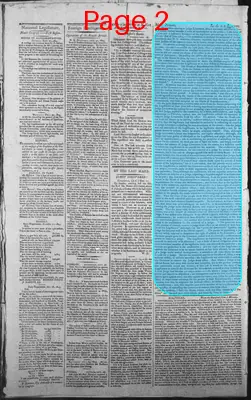
Letter to Editor
January 14, 1806
The New Hampshire Gazette
Portsmouth, Rockingham County, New Hampshire
What is this article about?
Summary of New Hampshire legislative proceedings in June and December 1805 concerning Judge Arthur Livermore's absence from superior court duties, including committee reports, votes on salary and removal address, and debates on constitutional authority for judicial removal.
Clipping
OCR Quality
98%
Excellent
Full Text
Messrs. Printers,
For the N.H. Gazette:
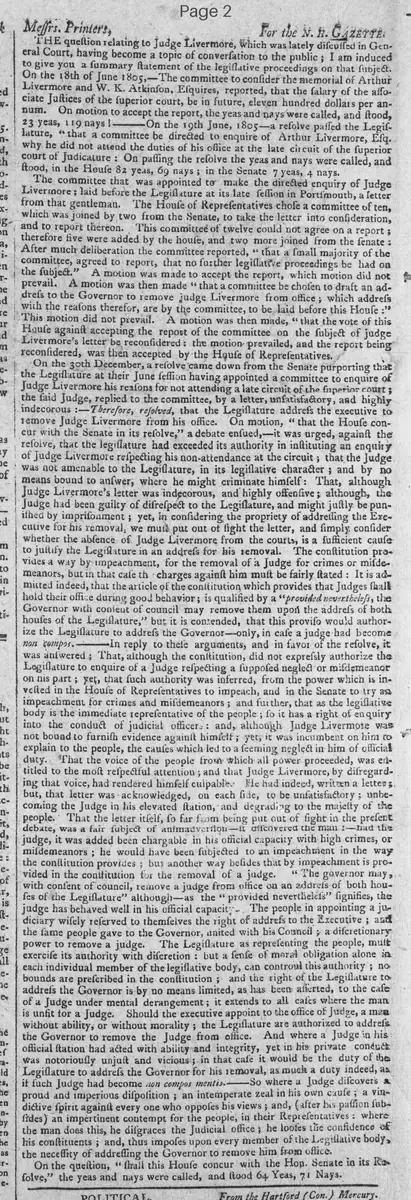
THE question relating to Judge Livermore, which was lately discussed in General Court, having become a topic of conversation to the public; I am induced to give you a summary statement of the legislative proceedings on that subject.
On the 18th of June 1805, -- The committee to consider the memorial of Arthur Livermore and W. K. Atkinson, Esquires, reported, that the salary of the associate Justices of the superior court, be in future, eleven hundred dollars per annum. On motion to accept the report, the yeas and nays were called, and stood, 23 yeas, 119 nays! -- On the 19th June, 1805 -- a resolve passed the Legislature, "that a committee be directed to enquire of Arthur Livermore, Esq. why he did not attend the duties of his office at the late circuit of the superior court of Judicature:" On passing the resolve the yeas and nays were called, and stood, in the House 82 yeas, 69 nays; in the Senate 7 yeas, 4 nays.
The committee that was appointed to make the directed enquiry of Judge Livermore; laid before the Legislature at its late session in Portsmouth, a letter from that gentleman. The House of Representatives chose a committee of ten, which was joined by two from the Senate, to take the letter into consideration, and to report thereon. This committee of twelve could not agree on a report; therefore five were added by the house, and two more joined from the senate:
After much deliberation the committee reported, "that a small majority of the committee, agreed to report, that no further legislative proceedings be had on the subject." A motion was made to accept the report, which motion did not prevail. A motion was then made "that a committee be chosen to draft an address to the Governor to remove judge Livermore from office; which address with the reasons therefor, are by the committee, to be laid before this House:"
This motion did not prevail. A motion was then made, "that the vote of this House against accepting the report of the committee on the subject of judge Livermore's letter be reconsidered: the motion prevailed, and the report being reconsidered, was then accepted by the House of Representatives.
On the 30th December, a resolve came down from the Senate purporting that the Legislature at their June session having appointed a committee to enquire of Judge Livermore his reasons for not attending a late circuit of the superior court; the said Judge, replied to the committee, by a letter, unsatisfactory, and highly indecorous: -- Therefore, resolved, that the Legislature address the executive to remove Judge Livermore from his office. On motion, "that the House concur with the Senate in its resolve," a debate ensued, -- it was urged, against the resolve, that the legislature had exceeded its authority in instituting an enquiry of Judge Livermore respecting his non-attendance at the circuit; that the Judge was not amenable to the Legislature, in its legislative character; and by no means bound to answer; where he might criminate himself: That, although Judge Livermore's letter was indecorous, and highly offensive; although, the Judge had been guilty of disrespect to the Legislature, and might justly be punished by imprisonment; yet, in considering the propriety of addressing the Executive for his removal, we must put out of sight the letter, and simply consider whether the absence of Judge Livermore from the courts, is a sufficient cause to justify the Legislature in an address for his removal. The constitution provides a way by impeachment, for the removal of a Judge for crimes or misdemeanors, but in that case the charges against him must be fairly stated: It is admitted indeed, that the article of the constitution which provides that Judges shall hold their office during good behavior; is qualified by a "provided nevertheless, the Governor with consent of council may remove them upon the address of both houses of the Legislature," but it is contended, that this proviso would authorize the Legislature to address the Governor -- only, in case a judge had become non compos. -- In reply to these arguments, and in favor of the resolve, it was answered; That, although the constitution, did not expressly authorize the Legislature to enquire of a Judge respecting a supposed neglect or misdemeanor on his part; yet, that such authority was inferred, from the power which is invested in the House of Representatives to impeach, and in the Senate to try an impeachment for crimes and misdemeanors; and further, that as the legislative body is the immediate representative of the people; so it has a right of enquiry into the conduct of judicial officers: and, although Judge Livermore was not bound to furnish evidence against himself; yet, it was incumbent on him to explain to the people, the causes which led to a seeming neglect in him of official duty. That the voice of the people from which all power proceeded, was entitled to the most respectful attention; and that Judge Livermore, by disregarding that voice, had rendered himself culpable. He had indeed, written a letter; but, that letter was acknowledged, on each side, to be unsatisfactory; unbecoming the Judge in his elevated station, and degrading to the majesty of the people. ' That the letter itself, so far from being put out of sight in the present debate, was a fair subject of animadversion -- it discovered the man! -- had the judge, it was added been chargeable in his official capacity with high crimes, or misdemeanors; he would have been subjected to an impeachment in the way the constitution provides; but another way besides that by impeachment is provided in the constitution for the removal of a judge. " The governor may, with consent of council, remove a judge from office on an address of both houses of the Legislature" although -- as the " provided nevertheless" signifies, the judge has behaved well in his official capacity --. The people in appointing a judiciary wisely reserved to themselves the right of address to the Executive; and the same people gave to the Governor, united with his Council; a discretionary power to remove a judge. The Legislature as representing the people, must exercise its authority with discretion: but a sense of moral obligation alone in each individual member of the legislative body, can controul this authority; no bounds are prescribed in the constitution; and the right of the Legislature to address the Governor is by no means limited, as has been asserted, to the case of a Judge under mental derangement; it extends to all cases where the man is unfit for a Judge. Should the executive appoint to the office of Judge, a man without ability, or without morality; the Legislature are authorized to address the Governor to remove the Judge from office. And where a Judge in his official station had acted with ability and integrity, yet in his private conduct was notoriously unjust and vicious; in that case it would be the duty of the Legislature to address the Governor for his removal, as much a duty indeed, as if such Judge had become non compos mentis. -- So where a Judge discovers a proud and imperious disposition; an intemperate zeal in his own cause; a vindictive spirit against every one who opposes his views; and, (after his passion subsides) an impertinent contempt for the people, in their Representatives: where the man does this, he disgraces the Judicial office; he loses the confidence of his constituents; and, thus imposes upon every member of the Legislative body, the necessity of addressing the Governor to remove him from office.
On the question, " shall this House concur with the Hon. Senate in its Resolve," the yeas and nays were called, and stood 64 Yeas, 71 Nays.
For the N.H. Gazette:
THE question relating to Judge Livermore, which was lately discussed in General Court, having become a topic of conversation to the public; I am induced to give you a summary statement of the legislative proceedings on that subject.
On the 18th of June 1805, -- The committee to consider the memorial of Arthur Livermore and W. K. Atkinson, Esquires, reported, that the salary of the associate Justices of the superior court, be in future, eleven hundred dollars per annum. On motion to accept the report, the yeas and nays were called, and stood, 23 yeas, 119 nays! -- On the 19th June, 1805 -- a resolve passed the Legislature, "that a committee be directed to enquire of Arthur Livermore, Esq. why he did not attend the duties of his office at the late circuit of the superior court of Judicature:" On passing the resolve the yeas and nays were called, and stood, in the House 82 yeas, 69 nays; in the Senate 7 yeas, 4 nays.
The committee that was appointed to make the directed enquiry of Judge Livermore; laid before the Legislature at its late session in Portsmouth, a letter from that gentleman. The House of Representatives chose a committee of ten, which was joined by two from the Senate, to take the letter into consideration, and to report thereon. This committee of twelve could not agree on a report; therefore five were added by the house, and two more joined from the senate:
After much deliberation the committee reported, "that a small majority of the committee, agreed to report, that no further legislative proceedings be had on the subject." A motion was made to accept the report, which motion did not prevail. A motion was then made "that a committee be chosen to draft an address to the Governor to remove judge Livermore from office; which address with the reasons therefor, are by the committee, to be laid before this House:"
This motion did not prevail. A motion was then made, "that the vote of this House against accepting the report of the committee on the subject of judge Livermore's letter be reconsidered: the motion prevailed, and the report being reconsidered, was then accepted by the House of Representatives.
On the 30th December, a resolve came down from the Senate purporting that the Legislature at their June session having appointed a committee to enquire of Judge Livermore his reasons for not attending a late circuit of the superior court; the said Judge, replied to the committee, by a letter, unsatisfactory, and highly indecorous: -- Therefore, resolved, that the Legislature address the executive to remove Judge Livermore from his office. On motion, "that the House concur with the Senate in its resolve," a debate ensued, -- it was urged, against the resolve, that the legislature had exceeded its authority in instituting an enquiry of Judge Livermore respecting his non-attendance at the circuit; that the Judge was not amenable to the Legislature, in its legislative character; and by no means bound to answer; where he might criminate himself: That, although Judge Livermore's letter was indecorous, and highly offensive; although, the Judge had been guilty of disrespect to the Legislature, and might justly be punished by imprisonment; yet, in considering the propriety of addressing the Executive for his removal, we must put out of sight the letter, and simply consider whether the absence of Judge Livermore from the courts, is a sufficient cause to justify the Legislature in an address for his removal. The constitution provides a way by impeachment, for the removal of a Judge for crimes or misdemeanors, but in that case the charges against him must be fairly stated: It is admitted indeed, that the article of the constitution which provides that Judges shall hold their office during good behavior; is qualified by a "provided nevertheless, the Governor with consent of council may remove them upon the address of both houses of the Legislature," but it is contended, that this proviso would authorize the Legislature to address the Governor -- only, in case a judge had become non compos. -- In reply to these arguments, and in favor of the resolve, it was answered; That, although the constitution, did not expressly authorize the Legislature to enquire of a Judge respecting a supposed neglect or misdemeanor on his part; yet, that such authority was inferred, from the power which is invested in the House of Representatives to impeach, and in the Senate to try an impeachment for crimes and misdemeanors; and further, that as the legislative body is the immediate representative of the people; so it has a right of enquiry into the conduct of judicial officers: and, although Judge Livermore was not bound to furnish evidence against himself; yet, it was incumbent on him to explain to the people, the causes which led to a seeming neglect in him of official duty. That the voice of the people from which all power proceeded, was entitled to the most respectful attention; and that Judge Livermore, by disregarding that voice, had rendered himself culpable. He had indeed, written a letter; but, that letter was acknowledged, on each side, to be unsatisfactory; unbecoming the Judge in his elevated station, and degrading to the majesty of the people. ' That the letter itself, so far from being put out of sight in the present debate, was a fair subject of animadversion -- it discovered the man! -- had the judge, it was added been chargeable in his official capacity with high crimes, or misdemeanors; he would have been subjected to an impeachment in the way the constitution provides; but another way besides that by impeachment is provided in the constitution for the removal of a judge. " The governor may, with consent of council, remove a judge from office on an address of both houses of the Legislature" although -- as the " provided nevertheless" signifies, the judge has behaved well in his official capacity --. The people in appointing a judiciary wisely reserved to themselves the right of address to the Executive; and the same people gave to the Governor, united with his Council; a discretionary power to remove a judge. The Legislature as representing the people, must exercise its authority with discretion: but a sense of moral obligation alone in each individual member of the legislative body, can controul this authority; no bounds are prescribed in the constitution; and the right of the Legislature to address the Governor is by no means limited, as has been asserted, to the case of a Judge under mental derangement; it extends to all cases where the man is unfit for a Judge. Should the executive appoint to the office of Judge, a man without ability, or without morality; the Legislature are authorized to address the Governor to remove the Judge from office. And where a Judge in his official station had acted with ability and integrity, yet in his private conduct was notoriously unjust and vicious; in that case it would be the duty of the Legislature to address the Governor for his removal, as much a duty indeed, as if such Judge had become non compos mentis. -- So where a Judge discovers a proud and imperious disposition; an intemperate zeal in his own cause; a vindictive spirit against every one who opposes his views; and, (after his passion subsides) an impertinent contempt for the people, in their Representatives: where the man does this, he disgraces the Judicial office; he loses the confidence of his constituents; and, thus imposes upon every member of the Legislative body, the necessity of addressing the Governor to remove him from office.
On the question, " shall this House concur with the Hon. Senate in its Resolve," the yeas and nays were called, and stood 64 Yeas, 71 Nays.
What sub-type of article is it?
Informative
Political
What themes does it cover?
Politics
Constitutional Rights
What keywords are associated?
Judge Livermore
Legislative Proceedings
Judicial Removal
New Hampshire
Constitutional Debate
1805
Superior Court
Governor Address
What entities or persons were involved?
Messrs. Printers
Letter to Editor Details
Recipient
Messrs. Printers
Main Argument
provides a detailed summary of legislative votes and debates in 1805 on inquiring into judge arthur livermore's court absence and potential removal from office, highlighting constitutional arguments on legislative authority and judicial tenure.
Notable Details
Yeas And Nays Votes On Salary Report: 23 Yeas, 119 Nays
Resolve To Inquire Of Judge Livermore: House 82 Yeas, 69 Nays; Senate 7 Yeas, 4 Nays
Debate On Concurrence With Senate Resolve: 64 Yeas, 71 Nays
Arguments On Impeachment Vs. Address For Removal
Judge's Letter Deemed Unsatisfactory And Indecorous