Thank you for visiting SNEWPapers!
Sign up free
Richmond Palladium
Richmond, Wayne County, Indiana
What is this article about?
Laurie Todd's letter reflects on the joys of winter country life versus urban turmoil, extolling simplicity and gratitude. He reminisces about New York customs forty years prior, contrasting frugal marriages, modest furnishings, and social gatherings with modern extravagance and waste, advising early marriage for happiness.
Merged-components note: These two components form a single continuous letter from Laurie Todd, with sequential reading order and coherent narrative flow on life forty years ago.
Clipping
OCR Quality
Full Text
From the New York Mirror.
How they did things forty years since.
LETTER FROM LAURIE TODD.
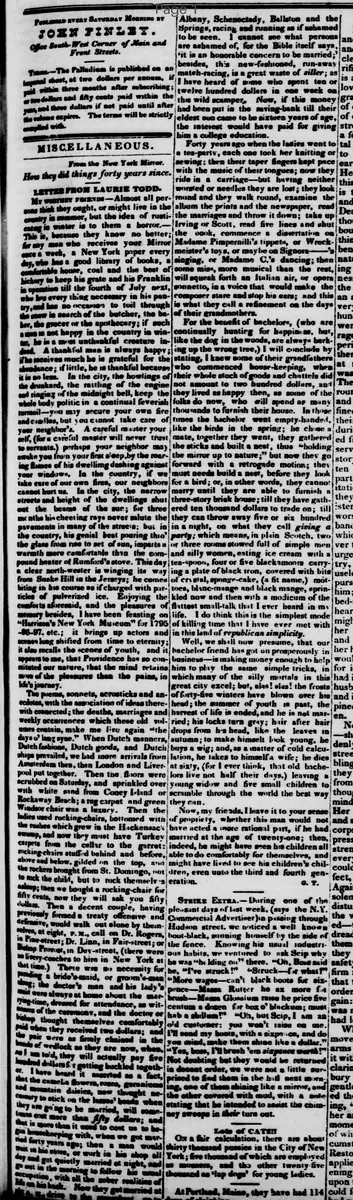
Mr. Weemsy Sir--Almost all persons think they ought, or might live in the country in summer, but the idea of rusticating in winter is to them a horror. This is, because they know no better; for any man who receives your Mirror each week, a New York paper every day, who has a good library of books, a comfortable house, coal and the best of hickory to keep his grate and his Franklin in operation till the fourth of July next, who begs every thing necessary in his pantry, and has no occasion to toil through the snow in search of the butcher, the baker, the grocer or the apothecary: if such a man is not happy in the country in winter, he is a most unthankful creature.
A thankful man is always happy: if he receives much he is grateful for the abundance; if little, he is thankful because it is no less. In the city, the bowlings of the drunkard, the rumbling of the engine and ringing of the midnight bell, keep the whole body politic in a continual feverish turmoil--you may secure your own fire and candles, but you cannot take care of your neighbor's. A careful man yourself, (for a careful man will never trust to servants.) perhaps your neighbor may awake you from your first sleep, by the roaring flames of his dwelling dashing against your windows. In the country, if we take care of our own fires, our neighbors cannot hurt us. In the city, the narrow streets and height of the dwellings shut out the beams of the sun; for three months his cheering rays never salute the pavements in many of the streets: but in the country, his genial heat pouring through the glass from rise to set of sun, imparts a warmth more comfortable than the compound heater of Rumford's stove. This day a clear north-wester is winging its way from Snake Hill in the Jerseys; he comes biting in his course as if charged with particles of pulverized ice. Enjoying the comforts aforesaid, and the pleasures of memory besides, I have been feasting on "Harrison's New York Museum" for 1795-96-97. etc.; it brings up actors and scenes long shifted from time to eternity: it also recalls the scenes of youth, and it appears to me, that Providence has so constituted our nature, that the mind retains more of the pleasures than the pains, in life's journey.
The poems, sonnets, acrosticks and anecdotes, with the association of ideas therewith connected: the deaths, marriages and weekly occurrences which these old volumes contain, make me live again "the days o' lang syne." When Dutch manners, Dutch fashions, Dutch goods, and Dutch ships prevailed, we had more arrivals from Amsterdam then, than London and Liverpool put together. Then the floors were scrubbed on Saturday, and sprinkled over with white sand from Coney Island or Rockaway Beach; a rug carpet and green Windsor chair was a luxury. Then the ladies used rocking-chairs, bottomed with the rushes which grew in the Hackensack swamp, and now they must have Turkey carpets from the cellar to the garret: rocking-chairs stuffed behind and before, above and below, gilded on the top, and the rockers brought from St. Domingo, not to mock the child, but to rock themselves asleep; then we bought a rocking-chair for fifty cents, now they will ask you fifty dollars. Then a decent couple, having previously formed a treaty offensive and defensive, would walk out alone by themselves, at eight p. m., call on Dr. Rogers, in Pine-street; Dr. Linn, in Fair-street; or Bishop Provost, in Dey-street, (there were no livery-coaches to hire in New York at that time.) There was no necessity for parading a bride's-maid, or groom's-man along; the doctor's man and his lady maid were always at home about the marrying-time, dressed for attendance, as witnesses of the ceremony, and the doctor or bishop thought themselves comfortably paid when they received two dollars; and the pair were as firmly chained in the bonds of wedlock as they are now, when, as I am told, they will actually pay five hundred dollars for getting buckled together. I have heard it asserted as a fact, that the camellia, flowers, roses, geranium and mountain daisies, now thought so necessary to stick on the lasses' breasts when they are going to be married, times cost more than it used to cost to get a housekeeping with, when that was married forty years ago; then we would wait in his store, or man day and get quietly married, and go out in the morning to follow occupation, with all the realities of life.
Albany, Schenectady, Ballston and the Springs, racing and running as if ashamed to be seen, I cannot see what persons are ashamed of, for the Bible itself says, "it is an honorable concern to be married;" besides, this new-fashioned, run-away match-racing, is a great waste of siller; as I have heard of some who spent ten or twelve hundred dollars in one week on this wild scamper. Now, if this money had been put in the savings-bank till their eldest son came to be sixteen years of age, the interest would have paid for giving him a college education.
Forty years ago when the ladies went to a tea-party, each one took her knitting or sewing: then their taper fingers kept pace with the music of their tongues; now they ride in a carriage--but having neither worsted or needles they are lost: they look round and they walk round, examine the album the prints and the newspaper, read the marriages and throw it down; take up Irving or Scott, read five lines and shut the book, commence a dissertation on Madame Pimpernelli's tippets, or Wreck-meister's toys, or may be on Signora-o'-singing, or Madame C.'s dancing: then some miss, more musical than the rest, will squeak forth an Italian air, or opera gondetto, in a voice that would make the composer stare and stop his ears: and this is what they call a refinement on the days of their grandmothers.
For the benefit of bachelors, (who are continually hunting for happiness, but, like the dog in the woods, are always barking up the wrong tree,) I will conclude by stating, I knew some of their grandfathers who commenced house-keeping, when their whole stock of goods and chattels did not amount to two hundred dollars, and they lived as happy then, as some of the folks do now, who will spend as many thousands to furnish their house. In those times the bachelor went empty-handed, like the birds in the spring: he chose a mate, together they went, they gathered the sticks and built a nest, thus "holding the mirror up to nature:" but now they go forward with a retrograde motion: they must needs build a nest, before they look for a bird; or, in other words, they cannot marry until they are able to furnish a three-story brick house; till they have gathered ten thousand dollars to trade on: till they can throw away five or six hundred in a night, on what they call giving a party; which means, in plain Scotch, two or three rooms stowed full of simple men and silly women, eating ice cream with a tea-spoon, four or five blackamoors carrying a plate of black iron, covered with bits of crystal, sponge-cake, (a fit name,) mottos, blanc-mange and black mange, sprinkled now and then with a modicum of the flattest small-talk that I ever heard in my life. I do think this is the simplest mode of killing time that I have ever met with in this land of republican simplicity.
Well, we shall now presume, that our bachelor friend has got on prosperously in business is making money enough to help him to play the same simple tricks, in which many of the silly mortals in this great city excel; but, alas! alas! the frosts of forty-five winters have blown over his head; the summer of youth is past, the harvest of life is ended, and he is not married: his locks turn gray: hair after hair drops from his head, like the leaves in autumn; to make himself look young, he buys a wig; and, as a matter of cold calculation, he takes to himself a wife: he dies at sixty. (for I ever think, that old bachelors live not half their days.) leaving a young widow and five small children to scramble through the world the best way they can.
Now, my friends, I leave it to your sense of propriety, whether this man would not have acted a more rational part, if he had married at the age of twenty-one; then, indeed, he might have seen his children all able to do comfortably for themselves, and might have lived to see his children's children, even unto the third and fourth generation.
G. T.
What sub-type of article is it?
What themes does it cover?
What keywords are associated?
What entities or persons were involved?
Literary Details
Title
Letter From Laurie Todd
Author
G. T.
Subject
Reflections On Country Life In Winter And Customs Of Marriage And Society Forty Years Ago
Key Lines