Thank you for visiting SNEWPapers!
Sign up free
Litchfield Enquirer
Litchfield, Litchfield County, Connecticut
What is this article about?
Biographical sketch of Samuel J. Mills, born 1783 in Torringford, CT, who became the 'Father of Foreign Missions in America.' Details his religious conversion, education at Williams and Yale, role in sparking the foreign missionary movement, formation of the American Board of Commissioners for Foreign Missions in 1810, and establishment of a mission school in Cornwall, CT.
Clipping
OCR Quality
Full Text
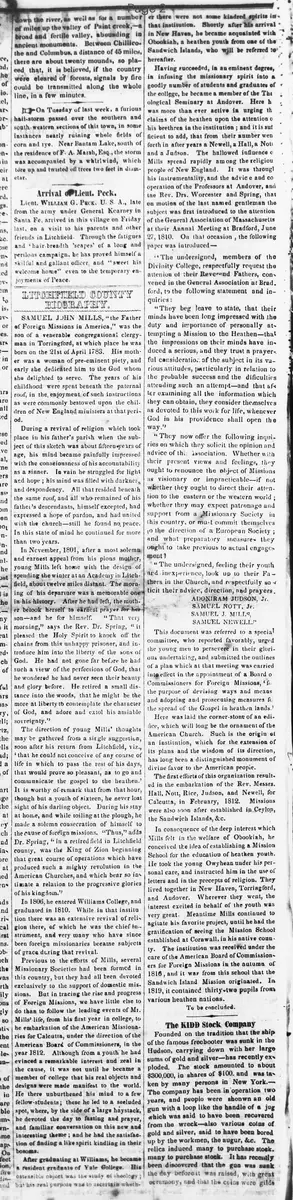
SAMUEL J. MILLS, "the Father of Foreign Missions in America," was the son of a venerable congregational clergyman in Torringford, at which place he was born on the 21st of April 1783. His mother was a woman of pre-eminent piety, and early she dedicated him to the God whom she delighted to serve. The years of his childhood were spent beneath the paternal roof, in the enjoyment of such instructions as were commonly bestowed upon the children of New England ministers at that period.
During a revival of religion which took place in his father's parish when the subject of this sketch was about fifteen years of age, his mind became painfully impressed with the consciousness of his accountability as a sinner. In vain he struggled for light and hope; his mind was filled with darkness and despondency. All that resided beneath the same roof, and all who remained of his father's descendants, himself excepted, had expressed a hope of pardon, and had united with the church—still he found no peace. In this state of mind he continued for more than two years.
In November, 1801, after a most solemn and earnest appeal from his pious mother, young Mills left home with the design of spending the winter at an Academy in Litchfield, about twelve miles distant. The morning of his departure was a memorable one in his history. After he had left, the mother betook herself to earnest prayer for her son—and he for himself. "That very morning," says the Rev. Dr. Spring, "it pleased the Holy Spirit to knock off the chains from this unhappy prisoner, and introduce him into the liberty of the sons of God. He had not gone far before he had such a view of the perfections of God, that he wondered he had never seen their beauty and glory before. He retired a small distance into the woods, that he might be the more at liberty to contemplate the character of God, and adore and extol his amiable sovereignty."
The direction of young Mills' thoughts may be gathered from a single suggestion soon after his return from Litchfield, viz. 'that he could not conceive of any course of life in which to pass the rest of his days, that would prove so pleasant, as to go and communicate the gospel to the heathen.' It is worthy of remark that from that hour though but a youth of sixteen, he never lost sight of his darling object. During his stay at home, and while toiling at the plough, he made a solemn consecration of himself to the cause of foreign missions. "Thus," adds Dr. Spring, "in a retired field in Litchfield county, was the King of Zion beginning that great course of operations which have produced such a mighty revolution in the American Churches, and which bear so intimate a relation to the progressive glories of his kingdom."
In 1806, he entered Williams College, and graduated in 1810. While in that institution there was an extensive revival of religion there, of which he was the chief instrument, and very many who have since been foreign missionaries became subjects of grace during that revival.
Previous to the efforts of Mills, several Missionary Societies had been formed in this country, but they had all been devoted exclusively to the support of domestic missions. But in tracing the rise and progress of Foreign Missions, we have little else to do than to follow the leading events of S. J. Mills' life, from his first year in college, to the embarkation of the American Missionaries for Calcutta, under the direction of the American Board of Commissioners, in the year 1812. Although from a youth he had evinced a remarkable interest and zeal in the cause, it was not until he became a member of college that his real objects and designs were made manifest to the world. He there unburdened his mind to a few fellow-students: these he led to a secluded spot, where, by the side of a large haystack, he devoted the day to fasting and prayer, and familiar conversation on this new and interesting theme; and he had the satisfaction of finding a like spirit kindling in their bosoms;
After graduating at Williams, he became a resident graduate of Yale College. His ostensible object was the study of theology; but his real purpose was to ascertain whether there were not some kindred spirits in that institution. Shortly after his arrival in New Haven, he became acquainted with Obookiah, a heathen youth from one of the Sandwich Islands, who will be referred to hereafter. Having succeeded, in an eminent degree, in infusing the missionary spirit into a goodly number of students and graduates of the college, he became a member of the Theological Seminary at Andover. Here he was more than ever active in urging the claims of the heathen upon the attention of his brethren in the institution; and it is sufficient to add, that from their number went forth in after years a Newell, a Hall, a Nott and a Judson. The hallowed influence of Mills spread rapidly among the religious people of New England. It was through his instrumentality, and the advice and co-operation of the Professors at Andover, and the Rev. Drs. Worcester and Spring, that on motion of the last named gentleman the subject was first introduced to the attention of the General Association of Massachusetts at their Annual Meeting at Bradford, June 27, 1810. On that occasion, the following paper was introduced—
The undersigned, members of the Divinity College, respectfully request the attention of their Reverend Fathers, convened in the General Association at Bradford, to the following statement and inquiries:
"They beg leave to state, that their minds have been long impressed with the duty and importance of personally attempting a Mission to the Heathen—that the impressions on their minds have induced a serious, and they trust a prayerful consideration of the subject in its various attitudes, particularly in relation to the probable success and the difficulties attending such an attempt—and that after examining all the information which they can obtain, they consider themselves as devoted to this work for life, whenever God in his providence shall open the way."
"They now offer the following inquiries on which they solicit the opinion and advice of this association. Whether with their present views and feelings, they ought to renounce the object of Missions as visionary or impracticable—if not whether they ought to direct their attention to the eastern or the western world: whether they may expect patronage and support from a Missionary Society in this country, or must commit themselves to the direction of a European Society; and what preparatory measures they ought to take previous to actual engagement?
"The undersigned, feeling their youth and inexperience, look up to their Fathers in the Church, and respectfully solicit their advice, direction, and prayers.
ADONIRAM JUDSON, Jr.
SAMUEL NOTT, Jr.
SAMUEL J. MILLS.
SAMUEL NEWELL"
This document was referred to a special committee, who reported favorably, urged the young men to persevere in their glorious undertaking, and submitted the outlines of a plan which at that meeting was carried into effect in the appointment of a Board of Commissioners for Foreign Missions, for the purpose of devising ways and means and adopting and prosecuting measures for the spread of the Gospel in heathen lands.'
Here was laid the corner-stone of an edifice, which will long be the ornament of the American Church. Such is the origin of an institution, which for the extension of its plans and the wisdom of its direction, has long been a distinguished monument of divine favor to the American people.
The first efforts of this organization resulted in the embarkation of the Rev. Messrs. Hall, Nott, Rice, Judson, and Newell, for Calcutta, in February, 1812. Missions were also soon after established in Ceylon, the Sandwich Islands, &c.
In consequence of the deep interest which Mills felt in the welfare of Obookiah, he conceived the idea of establishing a Mission School for the education of heathen youth. He took the young Owyhean under his personal care, and instructed him in the use of letters and in the precepts of religion. They lived together in New Haven, Torringford, and Andover. Wherever they went, the interest excited in behalf of the youth was very great. Meantime Mills continued to agitate his favorite project, until he had the gratification of seeing the Mission School established at Cornwall, in his native county. The institution was received under the care of the American Board of Commissioners for Foreign Missions in the autumn of 1816, and it was from this school that the Sandwich Island Mission originated. In 1819, it contained thirty-two pupils from various heathen nations.
To be continued.
What sub-type of article is it?
What themes does it cover?
What keywords are associated?
What entities or persons were involved?
Where did it happen?
Story Details
Key Persons
Location
Litchfield County, Connecticut; Torringford; Litchfield; Williams College; Yale College, New Haven; Andover Theological Seminary; Bradford, Massachusetts
Event Date
Born April 21, 1783; Conversion November 1801; College 1806 1810; Association Meeting June 27, 1810; Embarkation February 1812; School Established Autumn 1816
Story Details
Samuel J. Mills, inspired by religious revival and maternal piety, converts in 1801 and dedicates life to foreign missions. At Williams College, he sparks a revival and haystack prayer meeting. He influences Yale and Andover students, leading to the 1810 formation of the American Board of Commissioners for Foreign Missions. Mills helps establish missions to Calcutta in 1812 and a mission school in Cornwall, CT, in 1816 for heathen youth education.