Thank you for visiting SNEWPapers!
Sign up free
Daily State Sentinel
Indianapolis, Marion County, Indiana
What is this article about?
A speech attributed to or for C. L. Vallandigham defends the Civil War as a fight to suppress Southern rebellion and restore the Union, not abolish slavery. It criticizes Lincoln's administration mildly, opposes emancipation and arming negroes, rejects compromise, and urges patriotic unity against secret societies in Washington County, Indiana.
Clipping
OCR Quality
Full Text
For C. L. Vallandigham.
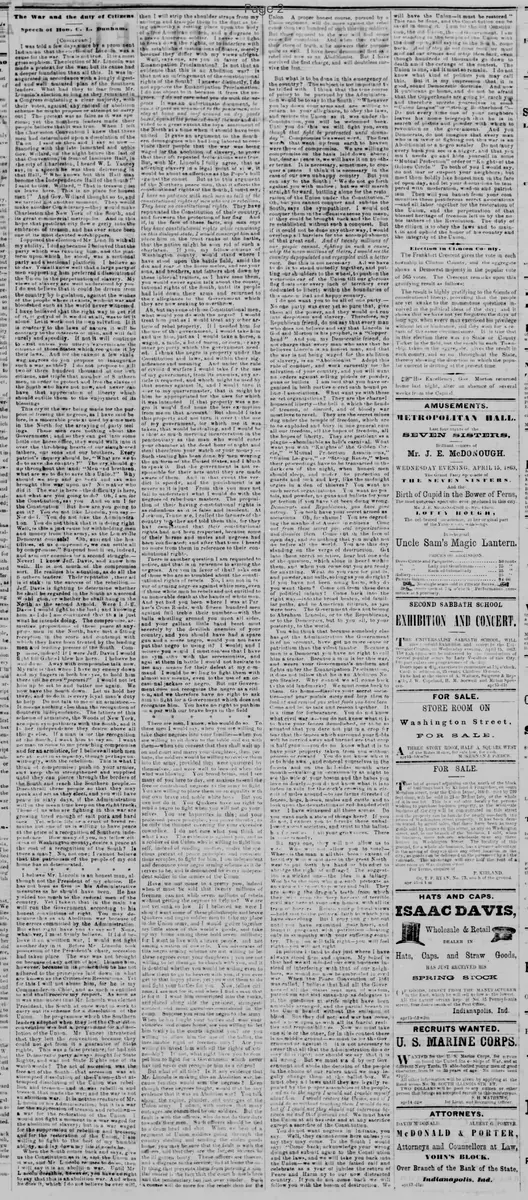
I was told a few days since by a prominent Indianian that the election of Lincoln was a gross sophism. The election of Mr. Lincoln was cause for the war. This is not true. It is a most made a pretext for the war; but its cause had a deeper foundation than all this. It was inaugurated in accordance with a long digested and well matured plan of the Southern leaders. What had they to fear from Mr. Lincoln's election so long as they remained in a Congress containing a clear majority, with their votes, against any radical or abolition scheme he might propose or attempt to carry out! The pretext was as false as it was specious; yet the Southern leaders made their people believe that it was true.
When I left the Charleston Convention I knew that these men had determined upon a dissolution of the Union. I said to them and I say so now—Standing with the late lamented and noble Gov. Willard, on the night before the last of that Convention, in front of Institute Hall, in the city of Charleston, I heard W. L. Yancey say, in a speech he was then delivering in that Hall, "Who knows but this Hall may become the Independence Hall of the South!" I said to Gov. Willard, "That is treason; let us leave here. This is no place for honest men!" And Gov. Willard thought so too, and we tarried not another moment. They would make another Confederacy—they would make Charleston the New York of the South, and its great commercial metropolis. And in this hope that pestilent city flew eagerly into the embraces of treason, and has ever since been one of its most devoted worshippers.
I opposed the election of Mr. Lincoln with all my ability. I did so because I believed that the party which was running him, and the platform upon which he stood, was a sectional party and a sectional platform. I believe so to day. You all know well that a large party of men supporting him preferred a dissolution of the Union to the perpetuation of slavery. My views of slavery are well understood by you. I do not believe that it could be driven from the country by legislation, against the wishes of the people where it exists, without war and bloodshed such as the world never witnessed. I have believed that the right way to get rid of it, if get rid of it we did at all, was to let it alone. Let it work out its own salvation. If it is contrary to the laws of nature it will be contrary to the interests of man, and will fall surely and speedily. If not it will continue to exist unless you utterly exterminate the citizens of those States which recognize it by their laws. And for the sake of a few skulking negroes do you propose to inaugurate such a war as this? I do not propose to kill two or three hundred thousand of our own citizens, and triple that number of Southern men, in order to protect and free the slaves of the South who have not now, and never can have that appreciation of liberty which should entitle them to the enjoyment of its blessings.
This cry of the war being made for the purpose of freeing the negroes, as I have said before, is a miserable pretext used by some men in the North for the arraying of party feelings. These men care nothing about the Government; and so they can get into some little one horse office, they would walk into it over the throbbing hearts of our slaughtered fathers, our sons and our brothers. Every patriot's inquiry should be, "What are we to do to save the country?" The cry should go up throughout the land: "Men and brethren, what are we to do to save this Union?" Why should we stop and go back and ask who brought this war upon us? No matter who did it. The war is here—the difficulty is here, and what are you going to do? Oh, I am for the Constitution, say you. And so am I for the Constitution. But how are you going to get it? You do not like Lincoln, you say—Nor do I. You do not like the Administration. You do not think that it is doing right. Well, is this a just cause for withholding men and money from the army, as the Louisville Democrat counsels? Oh, suspend the hostilities, let us compromise, we can settle all by compromise. "Suspend hostilities, indeed, and arm our enemies for a second struggle.—Never! I know Jeff. Davis, and know him well. He is not much of the compromise sort. He realizes his situation, as do all the Southern leaders. Their reputation, their all is at stake in the success of the rebellion.—Jeff. Davis is fighting to determine whether he shall be regarded in the South as a second Washington, or whether he shall hang in the North as the second Arnold. Were I Jeff. Davis I would fight to the last; and knowing him as I do I am convinced that this is just what he intends doing. The compromise, armistice propositions of these peace at any price men in the North, have met a fitting reception in the scorn and contempt with which they have been treated by the leading men and leading presses of the South. Compromise, indeed! If I were Jeff. Davis I would fight till Gabriel blew his horn. I believe he will do so. Away with compromise talk now. My rule is that when I have my enemy down and my fingers in both his eyes, to hold him there till he cries "peccavi!" I would not let him up to set to and batter me again. We now have the South down. Let us hold her there, and to do it is every loyal man's duty to help. Do not talk to me of an armistice.—It means nothing else than the recognition of Southern independence. The fathers of this scheme of armistice, the Woods of New York, are open sympathizers with the South, and it is her independence they desire above all things else. If a man is for the recognition of the South, I want him to say so. I want no man to come to me preaching compromise and for an armistice, for I believe all such men are at heart sympathizers, though perhaps unwittingly, with the rebellion. This is what I think of compromise: push on your armies, and keep them strengthened and supplied until they can pierce through the borders of the South and reach the Southern people.—Disenthral these people so that they may speak and act as they elect, and you will have peace in sixty days, if the Administration will in the mean time keep on the right track.
Those of us who are fighting in this war are growing tired enough of salt pork and hard tack. Yet while life or a crust of bread remains not one of us is willing to have peace at the price of a recognition of Southern independence. How many of you, my fellow citizens of Washington county, desire a peace at the cost of a recognition of the South? Is there a man? No, not one; I cannot believe that the patriotism of the people of my old home has so deteriorated.
I believe Mr. Lincoln is an honest man, although not the President of my choice. He has not been as firm in his Administrative measures as he should have been. He has yielded too much to the radical men of the country. Yet I take it that in the main he will run the Government according to his honest convictions of right. You may denounce this as an Abolition war because of the errors committed by the Administration. But what right have you to say so? None, whatever, I most firmly believe. If I did believe it an abolition war, I would not fight another day in it. Before Mr. Lincoln took possession of the President's chair, secession had taken place. The war was not brought on because of any action of his. I blame him, however, because in its prosecution he has not adhered to the principles laid down in what are known as the Crittenden Resolutions. Yet for this I will not abuse him, for he is my Commander-in-Chief, and as such is entitled to and shall receive my respect. As soon as it was announced that Mr. Lincoln was elected President, the South at once went to work to carry out its scheme for a dissolution of the Union. The programme which the Southern leaders adopted when they left the Charleston convention was but a programme for a dissolution of the Union. Mr. Yancey threatened that they left the convention because they could not get from it a guarantee of State rights. This was a false pretence; for had not the Democratic party always fought for State Rights, and was not State Rights one of its watchwords? The act of secession was the free act of the South—that secession was an attempted dissolution of the Union—that attempted dissolution of the Union was rebellion and treason—and it was rebellion and treason that made the war; and the war is not an abolition war. It is not the creature of Mr. Lincoln or his Administration; but it is a war for the suppression of treason and rebellion—war for the restoration of the Union. I would not fight a moment in a war waged for the abolition of slavery; but in a war waged for the suppression of rebellion and treason, and for the restoration of the Union, I am willing to fight to the best of my humble ability, and lay down my life if needs be.
When the South comes back and says, give us the Constitution as it is, and the Union as it was, and Mr. Lincoln refuses to do so, then I will say it is an abolition war. Until Mr. Lincoln does this, however, you have no right to say that this is an abolition war. And when he does it, which I do not believe he ever will, then I will strip the shoulder straps from my uniform and trample them in the dust as being unworthy a resting place upon the body of a free American citizen, and a disgrace to a brave American soldier. I never will fight to break down the rights, or to interfere with the established institutions of States, merely because they differ with my views of right.
Well, say one, are you in favor of the Emancipation Proclamation? Is not that an evidence that this is an Abolition war? Is that not an infringement of the constitutional rights of the South? I answer distinctly. I do not approve the Emancipation Proclamation. I do not object to it because it frees the negroes. I do not care what you do with the negroes. It was an unfortunate document, because it gave an argument to the peace men, who stay at home and loll around on dry goods boxes, against the prosecution of the war and divided to a great extent the loyal sentiment of the North at a time when it should have been united. It gave an argument to the Southern demagogues who had long labored to convince their people that the war was being waged for the abolition of slavery, to prove that their oft repeated declarations were true. But, with Mr. Lincoln I fully agree, that as affecting slavery in a legal point of view, it would be about as effective as the Pope's bull against the comet. But as to this argument of the Northern peace men, that it affects the constitutional rights of the South, I must say, I have no patience with such men as talk of the constitutional rights of men who are in rebellion. They have no constitutional rights. They have repudiated the Constitution of their country, and forsworn the protection of her flag. And if, in the face of these facts, any man says they have constitutional rights while remaining in this disloyal state, I would conscript him and place him in the front ranks of the battle, that the nation might be soon rid of such a charlatan. If you, my fellow citizens of Washington county, would stand where I have stood upon the battle field, amid the din and roar of the fierce melee, and see your sons, and brothers, and fathers shot down by these infernal traitors, as I have seen them, you would never again talk about the constitutional rights of the South, until its people had laid down their arms and returned to their allegiance to the Government which they are now seeking to overthrow.
Ah, but says one of these Constitutional men, what would you do with the negro? I would treat him just as I would treat any other article of rebel property. If I needed him for the use of the government, I would take him and use him, just as I would take a horse, a wagon, a mule, a lot of bacon, or corn, any other property which the government needed. I think the negro is property under the Constitution and laws, and within their significance and meaning. And under the rule of civilized warfare I would take for the use of my government, from its enemies, any article it required, and which might be used by that enemy against it, and I would turn it over to my quartermaster, that it might by him be appropriated for the uses for which it was intended. If that property was a negro it would find none the less exemption from me on that account. But should I take this property and not turn it over to the use of my government, for which use it was taken, that would be stealing, and I would be a thief as much meriting incarceration in the penitentiary as the man who would enter your chamber at the dead hour of night and steal therefrom your watch or your money—Such stealing has been done by men wearing the uniform of the United States, and I blush to speak it. But the government is not responsible for their acts until they are made aware of them. And in that event the verdict is speedy, and the punishment is as severe as it is just. From this you may not fail to understand what I would do with the negroes of rebellious masters. The proposition of their having constitutional rights is as ridiculous as it is false and insolent. At Jackson, Tennessee, I called the farmers of the country together and told them this, for they had complained that their constitutional rights had not been respected, because some of their horses and mules and negroes had been confiscated; and after that time I heard no more from them in reference to their constitutional rights.
There is another question I am requested to notice, and that is in reference to arming the negroes. Are you in favor of that? asks one of those who are so troubled about the constitutional rights of rebels. No. I am not in favor of arming negroes against white men, even if those white men be rebels and not entitled to an honorable death at the hands of white men. And yet had you been where I was at Parker's Cross Roads, with fifteen hundred men against full treble their number—with the balls whistling around you upon all sides, and your gallant little band beset most severely by the devilish enemies of your country, and you should have had a spare gun and a spare negro, would you not have put that negro to using it? I would; and I believe you would. I must confess that I have no sympathy with the secessionists, and against them in battle I would not hesitate to use any means for their defeat at my command. I would be willing to fight them with almost any means, even to the use of an occasional jackass or negro. But our Government does not recognize the negro as a citizen, and we therefore have no right to ask him to fight for a Government which does not recognize him. You have no right to put him on a par with our brave boys in the field. There are men, I know, who would do so. To these men I would say, when you are willing to take these negroes into your families—when you are willing to sit down to the table and eat with them—when you consent that they shall wait upon and court and marry your daughters, then, perhaps, the soldiers would be willing to receive them into the army, provided they were quartered by themselves, and were well to leeward when the wind was blowing. You broad brims, and I see many of you here to day, are anxious to send the free or contraband negroes to the army to fight. You are willing to place them on an equality with our own brave and noble white boys. But you cannot do it. You Quakers have no right to send a negro to fight when you will not go yourselves. You are hypocrites in this; and your professed peace principles, you prove thereby, to be only the thinnest covering for your excessive cowardice. I do not care what you think of what I say. The evidence is against you, and as a soldier of the Union who is willing to fight himself, instead of sending another, under the specious pretext of peace principles and conscientious scruples, to fight for him, I am independent and denounce your negro arming scheme as it deserves to be, and is denounced by every independent soldier in the armies of the Union.
Have we not come to a pretty pass, indeed, when it must be said that twenty millions of freemen cannot whip seven millions of rebels without getting the negroes to help us? We are not yet sunk so low. If I believed we were I should want some of these philanthropic and brave Quakers and negro soldier men to take my place in the Union army, and I would gather together my little store of this world's goods, and take up my home among these bold seven millions; for I want to live with a brave people, and not among a nation of cowards. You advocates of this negro arming scheme are not willing to let these negroes court your daughters; you are not willing to let them go to church with you, and it is doubtful whether you would be willing even to allow them to go to heaven with you, if you ever get to that happy place, yet you want them to do and fight your battles for you. Now, fellow citizens, I am not for it, and when I find a man that is for it I want him conscripted into the ranks, and placed alongside the greasiest, strongest, scented, and most garrulous contraband in the camp. Suppose you send the negro to the army. When he has fought your battles and won your victories and comes home are you willing to let him testify in the courts against you? are you willing to allow him the use of the ballot, the inestimable right of freemen only? Are you willing to invest him with all the rights of citizenship? If not, what right have you to compel him to fight for a Government which never has and never can recognize him as a citizen?
But what of all this? Is it any evidence that Mr. Lincoln is making this an Abolition war, because fanatics would arm the negroes? Even though these negroes fought, would that be any evidence that it was an Abolition war? You talk about the rapine, plunder, and outrages of the Union army. I admit, with sorrow, that many outrages are committed by our soldiers. But the fault is with the officers, who do not do their duty towards their men. Such officers should be tied to a drum head and shot. When we hear of a regiment of Union soldiers going through the country stealing and sending the stolen goods home, you may be sure that the fault is with the officers and that they are the largest sharers in the ill gotten booty. These officers are thieves and a disgrace to the service, to say nothing of the only thing that prevents them from pursuing a similar course is the fact that the courts are here and the penitentiary but just over yonder. Such a course will do more for the rebels than for the Union. A proper honest course, pursued by a Union regiment will do more against the rebel cause than two hundred of such thieving soldiers. But those opposed to the war will find some cause for complaint. And when they exhaust their store of truth, a lie answers their purpose quite as well. I have been denounced first as a rebel and now as an Abolitionist. But I have survived the first charge, and will doubtless survive the last.
But what is to be done in this emergency of the country? The subject is too important to be trifled with. I think that the true course of policy to be pursued by the Administration would be to say to the South: "Whenever you lay down your arms and are willing to return to your allegiance, to obey the laws, and restore the Union as it was under the Constitution, you will be welcomed back. Until you do this we will fight you, even though that fight be protracted until doomsday." Compromise is a sweet word. The first words that went up from earth to heaven were those of compromise. We are willing to compromise on the basis laid down above; but, dear as peace is, we will have it on no other terms. It is necessary, sometimes, to conquer a peace. I think it is necessary in the case of our own unhappy country. But you can say to the South: We do not go forth against you with malice; but we will march straight forward, battling alone for the restoration of the Union under the Constitution. Oh, but you cannot conquer and subdue the South, says the sympathizer. I would not conquer them in the offensive sense you mean, if they could be brought back and the Union re-established without such a conquest. But if it could not be done any other way, I would overleap all barriers for the accomplishment of that great end. And if twenty millions of our people cannot, fighting in such a cause, whip the seven millions of theirs, I would see the country depopulated and repeopled with a better race. But this is not necessary. All we have to do is to stand unitedly together, and putting our shoulders to the wheel, to push on the victorious car of the Union till our glorious flag floats over every inch of territory ever dedicated to liberty within the boundaries of this once-united and happy country.
I do not want you to be all of one party.—No one party was ever yet so pure that, give them all the power, and they would not run into despotism and slavery. Therefore, my Republican friend, do not say that every man who does not believe and say that Lincoln is God and Morton is his prophet, is a "Copperhead." And you, my Democratic friend, do not charge that every man who says that he believes Lincoln is an honest man, and that the war is not being waged for the abolition of slavery, is an "Abolitionist." Adopt this rule of conduct, and work earnestly for the salvation of your country, and you will want no orders against selling pistols or powder, guns or bullets. I am told that you have organized in both parties secret oath bound political associations. What want we with these secret organizations? They are the charnel houses of liberty—the hell in which the fiends of treason, of discord, and of bloody war most love to revel. They are the secret mines dug under the temple of freedom, which are to be exploded and bury in one general ruin all our freedom, all the hopes of freedom, all the hopes of liberty. They are pestilent as a plague—abominable as hell's carnival. What want you with Knights of the Golden Circle, "Mutual Protection Associations," "Union Leagues," or "Strong Bands," when their proceedings have to be transacted in the darkness of the night, when honest men should sleep, and under the protection of guards and lock and key, like the midnight orgies in a den of thieves? You want no such secret organizations. You want no pistols, and powder, no guns and bullets for your protection if you have not been doing wrong. Democrats and Republicans, you have gone astray. You both have your secret armed associations. Oh, for shame! You are degrading the manhood of American citizens. Come out from these secret political organizations and dissolve them. Come out in the face of open day, and do nothing that you might not do before all the world. You are this day standing on the verge of destruction. Get into these secret societies, hear but one side of the question, which alone is heard within them, and when you come out you are ready for anything. What do you care for pistols, and powder, and balls, so long as you do right? If you have not been doing harm, why do you want them? Come out from these dens of political infamy! Come back into the right way—into the broad beaten, old familiar paths, and be American citizens, as you were born. The Government does not belong to Abraham Lincoln, or to the Republicans, or to the Democrats, but to you all, to your posterity, to the world.
You who think that because somebody else has got the Administration the Government is of no account, have got no more sense or patriotism than the vilest fanatic. Because a man is a Democrat you have no right to call him a traitor. Because a man is for this war, and wears your Government's uniform and fights under the Emancipation Proclamation, it does not follow that he is an Abolition Negro Stealer. Why cannot we all come back to the old landmarks? We must come back to them. Go home—dissolve your secret societies—put your pistols away and keep them to look at and remind you what fools you have been. Come and let us talk and reason together. It is a time for forbearance. You do not know what civil war is—you do not know what it is to have your fences demolished, or to be so situated that you dare not put in a crop for fear that the fences which surround your fields will be carried away and burned ere that crop is half grown—you do not know what it is to have your property taken from you without process or reward. You do not know what it is to hide away, and conceal yourselves in the forests and on the hill side month after month—skulking in occasionally at night to see the wife of your bosom and the babes you love so dearly—you do not know what it is to listen in vain for the cock's crowing in a circuit of miles around—to see farms divested of fences, hogs, horses, mules and cattle, and to look upon the devastations of red-handed civil war. I have witnessed all these scenes. Do you want such a state of things here? If you do not, I exhort you to forsake these unhallowed secret societies, and trust to the ballot-box for redress of all your grievances. There is a remedy.
But says one, 'they will not allow us to vote.'—Who will not allow you to vote?—Where is the man in all this broad extent of territory who would dare in the great North west to put forth his hand or his edict to abridge the right of suffrage? The suggestion is a wicked one—the idea is a fallacy. Woe be to the men who use such pretexts as an excuse to stop their ears or top their mouths with pistols and ball. They are sowing the dragon's teeth from which they will reap the fiery harvest of terrible civil war here at your own doors with all its train of horrors.
Reveal your real views—hold fast to the political faith to which you have ever clung. But I pray you go not out until you have examined your heart, and found it pregnant with patriotism—beating only in sympathy with your suffering country. Then you will talk right—you will feel right—you will act right.
In politics I stand to day just where I have always stood firm and square. My belief is that had we all minded our own business instead of interfering with that of our neighbors, we would not now be embroiled in civil war. When the Peace Convention of 1861 was called, I believe that had all the Governors of all the states sent men of wisdom, patriotism and statesmanship as delegates to it, the questions at strife might have been amicably arranged, and the partial breach in the Union healed without the emission of blood. But they did not; and war has come, and is upon us with all its fearful realities and responsibilities. Now we must take one side or the other, for in this contest there is no middle ground—we must be for the Government or against it. It is not necessary to swear that all that the Administration does or may do is right; nor should we say that it is all wrong. But we must stand by our Government and abide the decision of the people in the choice of our rulers until we may legally change them at the ballot box. We must obey all laws until they are legally repealed by the proper assemblies of the people. And as to the negro I would not trouble myself about him. I would restore the Union, and if I could do so without touching them I would do so; but if I could not they should not intervene between me and that glorious end. We must have the Union at all hazards and at any sacrifice except a sacrifice of the Constitution.
You do not want negroes in Indiana, you say. Well, they cannot come here unless you say they may come. To the South I would say: "Come back; acknowledge your wrong doings and submit again to the Constitution and the laws, and we will take you back into the Union—we will kill the fatted calf and celebrate as a year of jubilee the return of Peace and Harmony to our now distracted country. If you do not come back we will follow you with the besom of destruction. We will have the Union—it must be restored."
This can be done, and the Constitution can be saved in doing it. I am for the old Constitution, the old Union, the old Government. I am for standing in the temple of the Union with the door wide open and saying to the South, come back. And if they do not come back we must send out our armies and whip them back, even though hundreds of thousands go down to death amid the carnage of the contest. The Union is one, and it must so remain. I do not know what kind of politics you may call this. But it is my impression that it is good, sound Democratic doctrine. And now Republicans go home, and do not be afraid that the Copperheads are going to catch you and therefore secrete yourselves in some "Union League" or "strong Brotherhood"—Do not every time one of your neighbors leaves his home telegraph that he is in search of pistols and powder with which to revolutionize the government. And you Democrats, do not imagine that every man who is in favor of fighting out this war is an Abolitionist or a negro stealer. Do not fancy every bush you see is a nigger, and that you must needs go and hide yourself in some "Mutual Protection" order or "Knight of the Golden Circle." To both of you I would say, do not fear or suspect your neighbors; but meet them boldly like honest men in the face of open day, and let your discussions be tempered with moderation, wisdom and patriotism. Then will you banish from your communities these pestiferous secret associations—and all labor together for the restoration of the Union, and the perpetuation of that blessed heritage of freedom left us by the noble fathers of the Revolution. The duty of the citizen is to obey the laws and to maintain and uphold the honor of his country and the integrity of the Union.
What sub-type of article is it?
What themes does it cover?
What keywords are associated?
What entities or persons were involved?
Where did it happen?
Story Details
Key Persons
Location
Washington County, Indiana; Charleston, South Carolina
Event Date
1861 1863
Story Details
Speaker recounts experiences at Charleston Convention, opposes Lincoln's election as sectional, argues war caused by Southern secession plot not abolition, criticizes Emancipation Proclamation and arming negroes, rejects compromise with rebels, urges unity, dissolution of secret societies, and support for Union restoration under Constitution.