Thank you for visiting SNEWPapers!
Sign up free
Editorial
April 11, 1843
The New Hampshire Gazette
Portsmouth, Rockingham County, New Hampshire
What is this article about?
An editorial criticizes the Democratic party's support for reducing Portsmouth's school appropriation from $6000 to $5000, arguing it harms public education vital for the poor and middling classes. It highlights minimal tax savings, compares favorably to higher spending in nearby towns, and urges reconsideration to avoid cutting teacher salaries.
Clipping
OCR Quality
95%
Excellent
Full Text
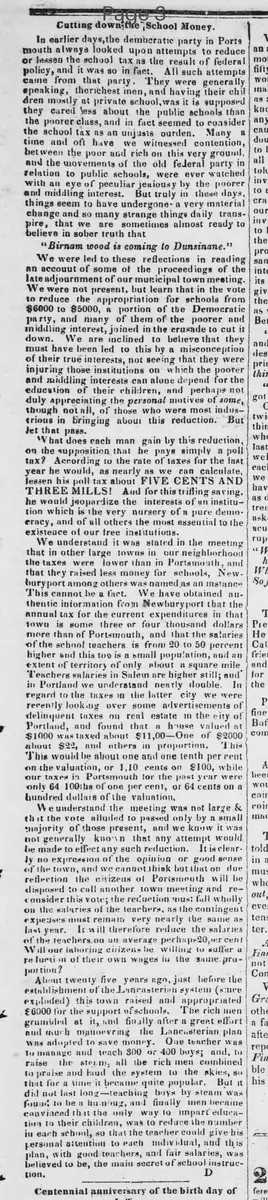
Cutting down the "School Money."
In earlier days, the democratic party in Portsmouth always looked upon attempts to reduce or lessen the school tax as the result of federal policy, and it was so in fact. All such attempts came from that party. They were generally 'speaking,' their children at private school, and it is supposed they cared less about the public schools than the poorer class, and in fact seemed to consider the school tax as an unjust burden. Many time and oft have we witnessed contention, between the poor and rich on this very ground. And the movements of the old federal party in relation to public schools, were ever watched with an eye of peculiar jealousy by the poorer and middling interest. But truly in these days, things seem to have undergone a very material change and so many strange things daily transpire, that we are sometimes almost ready to believe in sober truth that
"Birnam wood is coming to Dunsinane,"
We were led to these reflections in reading an account of some of the proceedings of the late adjournment of our municipal town meeting. We were not present, but learn that in the vote to reduce the appropriation for schools from $6000 to $5000, a portion of the Democratic party, and many of them of the poorer and middling interest, joined in the crusade to cut it down. We are inclined to believe that they must have been led to this by a misconception of their true interests, not seeing that they were injuring those institutions on which the poorer and middling interests can alone depend for the education of their children, and perhaps not duly appreciating the personal motives of some, though not all, of those who were most industrious in bringing about this reduction. But let that pass.
What does each man gain by this reduction, on the supposition that he pays simply a poll tax? According to the rate of taxes for the last year he would, as nearly as we can calculate, lessen his poll tax about FIVE CENTS AND THREE MILLS! And for this trifling saving, he would jeopardize the interests of an institution which is the very nursery of a pure democracy, and of all others the most essential to the existence of our free institutions.
We understand it was stated in the meeting that in other large towns in our neighborhood the taxes were lower than in Portsmouth, and that they raised less money for schools, Newburyport among others was named as an instance. This cannot be a fact. We have obtained authentic information from Newburyport that the annual tax for the current expenditures in that town is some three or four thousand dollars more than of Portsmouth, and that the salaries of the school teachers is from 20 to 50 percent higher and this too is a small population, and an extent of territory of only about a square mile. Teachers salaries in Salem are higher still; and in Portland we understand nearly double. In regard to the taxes in the latter city we were recently looking over some advertisements of delinquent taxes on real estate in the city of Portland, and found that a house valued at $1000 was taxed about $11.00—One of $2000 about $22, and others in proportion. This would be about one and one tenth per cent on the valuation, or 1.10 cents on $100, while our taxes in Portsmouth for the past year were only 64/100ths of one per cent, or 64 cents on a hundred dollars of the valuation.
We understand the meeting was not large & that the vote alluded to passed only by a small majority of those present, and we know it was not generally known that any attempt would be made to effect any such reduction. It is clearly no expression of the opinion or good sense of the town, and we cannot think but that on due reflection the citizens of Portsmouth will be disposed to call another town meeting and reconsider this vote; the reduction was to fall wholly on the salaries of the teachers, as the contingent expenses must remain very nearly the same as last year. It will therefore reduce the salaries of the teachers on an average perhaps 20 per cent. Will our laboring citizens be willing to suffer a reduction of their own wages in the same proportion?
About twenty five years ago, just before the establishment of the Lancasterian system (since exploded) this town raised and appropriated $6000 for the support of schools. The rich men grumbled at it, and finally after a great effort and much manoeuvring the Lancasterian plan was adopted to save money. One teacher was to manage and teach 300 or 400 boys; and, to raise the steam, all the rich men combined to praise and laud the system to the skies, so that for a time it became quite popular. But it did not last long—teaching boys by steam was found to be a humbug, and finally men became convinced that the only way to impart education to their children, was to reduce the number in each school, so that the teacher could give his personal attention to each individual, and this plan, with good teachers, and fair salaries, was believed to be, the main secret of school instruction.
In earlier days, the democratic party in Portsmouth always looked upon attempts to reduce or lessen the school tax as the result of federal policy, and it was so in fact. All such attempts came from that party. They were generally 'speaking,' their children at private school, and it is supposed they cared less about the public schools than the poorer class, and in fact seemed to consider the school tax as an unjust burden. Many time and oft have we witnessed contention, between the poor and rich on this very ground. And the movements of the old federal party in relation to public schools, were ever watched with an eye of peculiar jealousy by the poorer and middling interest. But truly in these days, things seem to have undergone a very material change and so many strange things daily transpire, that we are sometimes almost ready to believe in sober truth that
"Birnam wood is coming to Dunsinane,"
We were led to these reflections in reading an account of some of the proceedings of the late adjournment of our municipal town meeting. We were not present, but learn that in the vote to reduce the appropriation for schools from $6000 to $5000, a portion of the Democratic party, and many of them of the poorer and middling interest, joined in the crusade to cut it down. We are inclined to believe that they must have been led to this by a misconception of their true interests, not seeing that they were injuring those institutions on which the poorer and middling interests can alone depend for the education of their children, and perhaps not duly appreciating the personal motives of some, though not all, of those who were most industrious in bringing about this reduction. But let that pass.
What does each man gain by this reduction, on the supposition that he pays simply a poll tax? According to the rate of taxes for the last year he would, as nearly as we can calculate, lessen his poll tax about FIVE CENTS AND THREE MILLS! And for this trifling saving, he would jeopardize the interests of an institution which is the very nursery of a pure democracy, and of all others the most essential to the existence of our free institutions.
We understand it was stated in the meeting that in other large towns in our neighborhood the taxes were lower than in Portsmouth, and that they raised less money for schools, Newburyport among others was named as an instance. This cannot be a fact. We have obtained authentic information from Newburyport that the annual tax for the current expenditures in that town is some three or four thousand dollars more than of Portsmouth, and that the salaries of the school teachers is from 20 to 50 percent higher and this too is a small population, and an extent of territory of only about a square mile. Teachers salaries in Salem are higher still; and in Portland we understand nearly double. In regard to the taxes in the latter city we were recently looking over some advertisements of delinquent taxes on real estate in the city of Portland, and found that a house valued at $1000 was taxed about $11.00—One of $2000 about $22, and others in proportion. This would be about one and one tenth per cent on the valuation, or 1.10 cents on $100, while our taxes in Portsmouth for the past year were only 64/100ths of one per cent, or 64 cents on a hundred dollars of the valuation.
We understand the meeting was not large & that the vote alluded to passed only by a small majority of those present, and we know it was not generally known that any attempt would be made to effect any such reduction. It is clearly no expression of the opinion or good sense of the town, and we cannot think but that on due reflection the citizens of Portsmouth will be disposed to call another town meeting and reconsider this vote; the reduction was to fall wholly on the salaries of the teachers, as the contingent expenses must remain very nearly the same as last year. It will therefore reduce the salaries of the teachers on an average perhaps 20 per cent. Will our laboring citizens be willing to suffer a reduction of their own wages in the same proportion?
About twenty five years ago, just before the establishment of the Lancasterian system (since exploded) this town raised and appropriated $6000 for the support of schools. The rich men grumbled at it, and finally after a great effort and much manoeuvring the Lancasterian plan was adopted to save money. One teacher was to manage and teach 300 or 400 boys; and, to raise the steam, all the rich men combined to praise and laud the system to the skies, so that for a time it became quite popular. But it did not last long—teaching boys by steam was found to be a humbug, and finally men became convinced that the only way to impart education to their children, was to reduce the number in each school, so that the teacher could give his personal attention to each individual, and this plan, with good teachers, and fair salaries, was believed to be, the main secret of school instruction.
What sub-type of article is it?
Education
Taxation
What keywords are associated?
School Funding
Public Education
Tax Reduction
Teacher Salaries
Portsmouth Schools
Democratic Party
Education Policy
What entities or persons were involved?
Democratic Party
Federal Party
Portsmouth
Newburyport
Salem
Portland
Editorial Details
Primary Topic
Opposition To Reduction In School Funding
Stance / Tone
Strongly Supportive Of Public School Funding
Key Figures
Democratic Party
Federal Party
Portsmouth
Newburyport
Salem
Portland
Key Arguments
Democratic Support For School Tax Reduction Betrays Poorer Interests
Reduction Saves Only About Five Cents Per Poll Tax Payer
Public Schools Essential For Democracy And Poor Children's Education
Newburyport Spends More On Schools With Higher Teacher Salaries
Portsmouth Taxes Lower Than Neighboring Cities Like Portland
Vote Not Representative; Urge Reconsideration To Avoid Teacher Salary Cuts
Historical Failure Of Cost Saving Lancasterian System Proves Need For Adequate Funding