Thank you for visiting SNEWPapers!
Sign up free
Literary
April 27, 1833
The Northern Star, And Farmers' And Mechanics' Advocate
Warren, Bristol County, Rhode Island
What is this article about?
A reflective prose essay marveling at the immense speeds and scales of celestial bodies, from planets like Saturn and Jupiter to comets and stars, emphasizing the vast, unending motion of the universe since creation.
Clipping
OCR Quality
95%
Excellent
Full Text
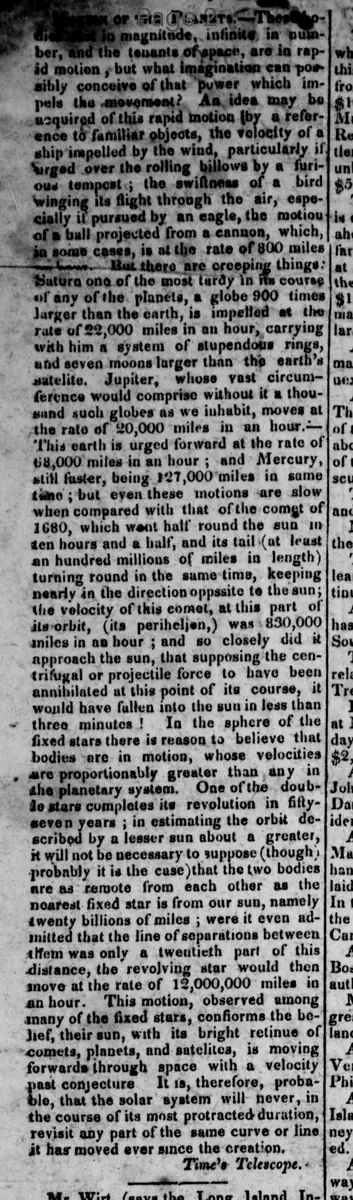
in magnitude, infinite in number, and the tenants of space, are in rapid motion, but what imagination can possibly conceive of that power which impels the movement? An idea may be acquired of this rapid motion by a reference to familiar objects, the velocity of a ship impelled by the wind, particularly if surged over the rolling billows by a furious tempest; the swiftness of a bird winging its flight through the air, especially if pursued by an eagle, the motion of a ball projected from a cannon, which, in some cases, is at the rate of 800 miles an hour. But there are creeping things: Saturn one of the most tardy in its course of any of the planets, a globe 900 times larger than the earth, is impelled at the rate of 22,000 miles in an hour, carrying with him a system of stupendous rings, and seven moons larger than the earth's satellite. Jupiter, whose vast circumference would comprise without it a thousand such globes as we inhabit, moves at the rate of 20,000 miles in an hour. This earth is urged forward at the rate of 68,000 miles in an hour; and Mercury, still faster, being 127,000 miles in same time; but even these motions are slow when compared with that of the comet of 1680, which went half round the sun in ten hours and a half, and its tail (at least an hundred millions of miles in length) turning round in the same time, keeping nearly in the direction opposite to the sun; the velocity of this comet, at this part of its orbit, (its perihelion,) was 830,000 miles in an hour; and so closely did it approach the sun, that supposing the centrifugal or projectile force to have been annihilated at this point of its course, it would have fallen into the sun in less than three minutes! In the sphere of the fixed stars there is reason to believe that bodies are in motion, whose velocities are proportionably greater than any in the planetary system. One of the double stars completes its revolution in fifty-seven years; in estimating the orbit described by a lesser sun about a greater, it will not be necessary to suppose (though probably it is the case) that the two bodies are as remote from each other as the nearest fixed star is from our sun, namely twenty billions of miles; were it even admitted that the line of separation between them was only a twentieth part of this distance, the revolving star would then move at the rate of 12,000,000 miles in an hour. This motion, observed among many of the fixed stars, confirms the belief, their sun, with its bright retinue of comets, planets, and satellites, is moving forwards through space with a velocity past conjecture It is, therefore, probable, that the solar system will never, in the course of its most protracted duration, revisit any part of the same curve or line it has moved ever since the creation.
Time's Telescope.
Time's Telescope.
What sub-type of article is it?
Essay
What themes does it cover?
Nature
What keywords are associated?
Celestial Motion
Planets
Comets
Stars
Universe
Astronomy
Literary Details
Title
Time's Telescope
Subject
On The Rapid Motions And Vast Scales Of Celestial Bodies
Form / Style
Prose Reflection On Astronomy And Cosmic Motion
Key Lines
Saturn One Of The Most Tardy In Its Course Of Any Of The Planets, A Globe 900 Times Larger Than The Earth, Is Impelled At The Rate Of 22,000 Miles In An Hour
The Velocity Of This Comet, At This Part Of Its Orbit, (Its Perihelion,) Was 830,000 Miles In An Hour
The Solar System Will Never, In The Course Of Its Most Protracted Duration, Revisit Any Part Of The Same Curve Or Line It Has Moved Ever Since The Creation.