Thank you for visiting SNEWPapers!
Sign up free
The Grangeville Globe
Grangeville, Idaho County, Idaho
What is this article about?
Gorizia, dubbed the 'Nice of Austria' for its climate, links to French Bourbons via remains of Charles X, Duke of Angouleme, and Duc de Chambord in a Franciscan convent. Historically under Austrian rule since the 10th century, it is an archbishop's seat and center for Hebrew book printing.
Clipping
OCR Quality
Full Text
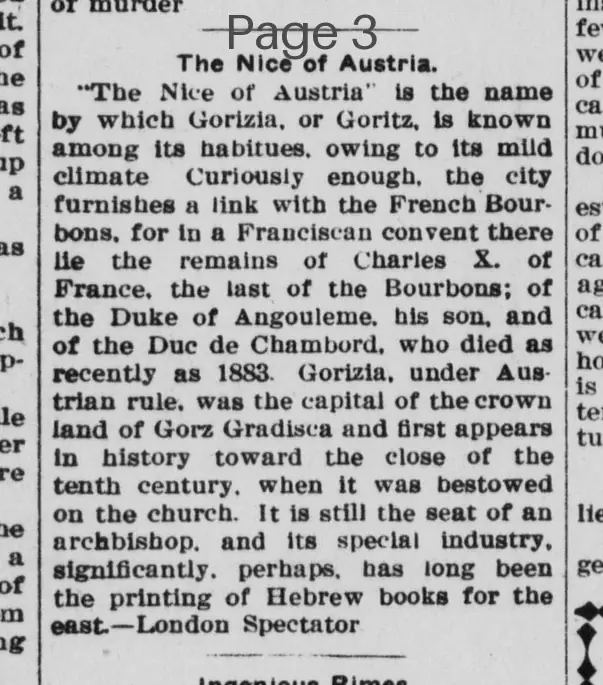
“…The Nice of Austria” is the name by which Gorizia, or Goritz, is known among its habitues, owing to its mild climate. Curiously enough, the city furnishes a link with the French Bourbons, for in a Franciscan convent there lie the remains of Charles X. of France, the last of the Bourbons; of the Duke of Angouleme, his son, and of the Duc de Chambord, who died as recently as 1883. Gorizia, under Austrian rule, was the capital of the crown land of Gorz Gradisca and first appears in history toward the close of the tenth century, when it was bestowed on the church. It is still the seat of an archbishop, and its special industry, significantly, perhaps, has long been the printing of Hebrew books for the east.—London Spectator.
What sub-type of article is it?
What keywords are associated?
What entities or persons were involved?
Where did it happen?
Foreign News Details
Primary Location
Gorizia
Key Persons
Event Details
Gorizia, known as the Nice of Austria due to its mild climate, contains the remains of Charles X. of France, the last of the Bourbons, his son the Duke of Angouleme, and the Duc de Chambord who died in 1883, in a Franciscan convent. Under Austrian rule, it was the capital of the crown land of Gorz Gradisca, first appearing in history toward the close of the tenth century when bestowed on the church. It remains the seat of an archbishop and has long been known for printing Hebrew books for the east.