Thank you for visiting SNEWPapers!
Sign up free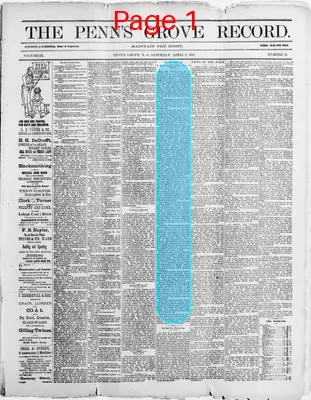
The Penn's Grove Record
Penns Grove, Salem County, New Jersey
What is this article about?
Historical overview of mirrors' origins, from ancient metal versions in Egypt, Rome, and Peru to glass mirrors invented in medieval Europe, with Venice's Murano monopoly using tin-quicksilver amalgam for production success by the 17th century.
Clipping

OCR Quality
Full Text
A Brief Chapter on the Origin of
Mirrors.
Any solid substance that can be
polished will, to a certain extent, answer for a mirror; and metallic "looking-
glasses" are frequently mentioned
in the Old Testament. Such looking-
glasses were made of mixed metal,
chiefly of copper, and were susceptible
of a lustre which Sir G. Wilkinson
says has been partially restored in
some of those discovered at Thebes,
though buried in the earth for many
centuries. They were round or oval,
and inserted in handles of metal, wood
or stone, whose form and ornamentation varied with the tastes of their
owners.
In the catacombs of ancient Rome,
mirrors have been found which appear
to be made of a mixture of bronze
and lead and tin, while others are of a
peculiar kind of stone supposed to be
vitrified lava.
Pliny mentions the rage for silver
mirrors as an evidence of Roman extravagance, and says every Roman girl
wanted one. Plutarch says that Demosthenes had a looking-glass-probably of silver and sufficiently large to
reflect his entire person-before which
he was accustomed to rehearse his
orations and arrange his gestures.
There were two serious objections
to metallic mirrors-their weight and
the fact that they were liable to distort the features of those looking into
them. The latter was, of course,
offensive to ancient beaux and belles,
and led to the substitution of metal of
obsidian, a black stone, "sometimes
transparent"-to quote again from
Pliny-"but of so dull a transparency
that, as a mirror, it renders the shadow
rather than the image of an object."
When the Spaniards discovered
America they found mirrors made of a
substance which they called the Inca's
stone, because it was used by the Peruvian princes for ornamental purposes. It was a sort of pyrites, susceptible of a high degree of polish and
excellently well-calculated for mirrors.
As the ancients were familiar with
glass, it seems strange that they were
not acquainted with mirrors made
therefrom. True, Aristotle, some 400
years B. C., wrote: "Glass and crystal
must be lined with a sheet of metal in
order to give back the image presented
to them." But most authors regard
glass mirrors a modern invention.
The first mention of glass mirrors-
after their present form-occurs in a
work on optics written by an English monk, Johannes Peckham, in 1219.
In it he speaks of glass mirrors, covered on the back with lead, that reflect no image if the lead is scraped
off.
And another careful investigator thinks the invention cannot date
from a period earlier than the middle
of the thirteenth century, because in
France, during the fourteenth century,
glass mirrors were scarce, while those
of metal were abundant.
The crusades, which did so much to
acquaint Western with the industries
and civilization of Eastern Europe,
was the direct cause of the introduction of the manufacture of glass into
Venice. For a long time, this was the
only place where glass was manufactured, and thither every country, desiring articles of glass, was compelled
to go or send. Venetian glass rapidly became famous, and its sale the
source of an immense revenue to the
Republic.
Naturally, Venice was anxious to secure to herself for the future so valuable a monopoly; and to this end,
through the "Council of the Ten," she
ordered the glass-makers to leave the
city proper, and establish themselves
at Murano, on an island a little distance northeast from Venice. Moreover, it was proclaimed that if a
workman should export anything that
might enable other countries to enter
into competition with Venice so far as
the making of glass was concerned-
his property would be confiscated and
himself liable to be put to death.
At Murano, glass mirrors were first
made after the manner suggested by
Aristotle-by placing a metallic sheet
back of the glass. The experiment did
not prove satisfactory, and metal mirrors remained in vogue till the beginning of the sixteenth century, when
two glass-makers of Murano discovered the method of making mirrors
which had for several years prevailed
in Germany.
The German process was as follows:
Melted lead or tin was blown with a
pipe into a hollow ball of glass, while
hot, thereby entirely coating its interior. When the glass had cooled, it
was cut into small, round mirrors.
The two Muranese improved on this
method by substituting an amalgam of
tin and quicksilver in place of the
metals used by the Germans. Then
they petitioned the "Council of the
Ten" that the right to manufacture
these mirrors be granted them exclusively for twenty-five years. The desired privilege was granted them for
twenty years.
Wonderful success attended the enterprise, and, when the twenty years
had expired, hundreds engaged in it.
Indeed, so numerous were the mirror
makers, the Venetian Government separated them from the other glass-
makers, and established a distinct company for their benefit.
Gradually, the manufacture of glass
mirrors advanced toward perfection,
and no one did more in this direction
than Liberale Motta, who flourished at
Murano about 1680, and "made them
of a size previously unattainable."
What sub-type of article is it?
What themes does it cover?
What keywords are associated?
What entities or persons were involved?
Where did it happen?
Story Details
Key Persons
Location
Thebes, Ancient Rome, Venice, Murano, Peru, Germany
Event Date
Ancient Times To 1680
Story Details
The article traces the history of mirrors from ancient metallic versions made of copper, bronze, and obsidian, used by Egyptians, Romans, and Incas, to the invention of glass mirrors in the 13th century, with Venice and Murano becoming centers of production through secretive methods involving tin and quicksilver amalgam, leading to large-scale manufacturing by the 17th century.