Thank you for visiting SNEWPapers!
Sign up free
Story
July 12, 1957
Toledo Union Journal
Toledo, Lucas County, Ohio
What is this article about?
AFL-CIO's George Meany presses Senate to pass civil rights bill amid southern filibuster, backing voting rights enforcement without jury-trial amendments. UAW's Walter Reuther seeks filibuster rule reform for majority rule. (178 chars)
Clipping
OCR Quality
100%
Excellent
Full Text
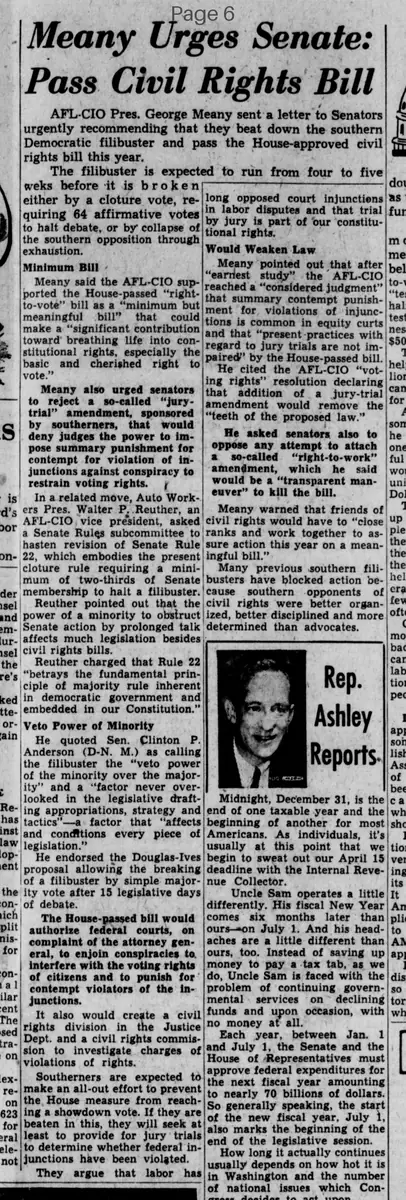
Meany
Urges Senate:
Pass Civil Rights' Bill
AFL-CIO Pres. George Meany sent a letter to Senators urgently recommending that they beat down the southern Democratic filibuster and pass the House-approved civil rights bill this year.
The filibuster is expected to last weeks before it is broken either by a cloture vote, requiring 64 affirmative votes to halt debate, or by collapse of the southern opposition through exhaustion.
Minimum Bill
Meany said the AFL-CIO supported the House-passed "right-to-vote" bill as a "minimum but meaningful bill" that could make a "significant contribution toward breathing life into constitutional rights, especially the basic and cherished right to vote."
Meany also urged senators to reject a so-called "jury-trial" amendment, sponsored by southerners, that would deny judges the power to impose summary punishment for contempt for violation of injunctions against conspiracy to restrain voting rights.
In a related move. Auto Workers Pres. Walter P. Reuther, an AFL-CIO, vice president, asked a Senate Rules subcommittee to hasten revision of Senate Rule 22, which embodies the present cloture rule requiring a minimum of two-thirds of Senate membership to halt a filibuster.
Reuther pointed out that the power of a minority to obstruct Senate action by prolonged talk affects much legislation besides civil rights bills.
Reuther charged that Rule 22 "betrays the fundamental principle of majority rule inherent in democratic government and embedded in our Constitution."
Veto Power of Minority
He quoted Sen. Clinton P. Anderson (D-N.M.) as calling the filibuster the "veto power of the minority over the majority" and a "factor never overlooked in the legislative drafting appropriations, strategy and tactics"--a factor that "affects and conditions every piece of legislation."
He endorsed the Douglas-Ives proposal allowing the breaking of a filibuster by simple majority vote after 15 legislative days of debate.
The House-passed bill would authorize federal courts, on complaint of the attorney general, to enjoin conspiracies to interfere with the voting rights of citizens and to punish for contempt violators of the injunctions.
It also would create a civil rights division in the Justice Dept. and a civil rights commission to investigate charges of violations of rights.
Southerners are expected to make an all-out effort to prevent the House measure from reaching a showdown vote. If they are beaten in this, they will seek at least to provide for jury trials to determine whether federal injunctions have been violated.
They argue that labor has long opposed court injunctions in labor disputes and that trial by jury is part of our constitutional rights.
Would Weaken Law
Meany pointed out that after "earnest study" the AFL-CIO reached a "considered judgment" that summary contempt punishment for violations of injunctions is common in equity courts and that "present practices with regard to jury trials are not impaired" by the House-passed bill.
He cited the AFL-CIO "voting rights" resolution declaring that addition of a jury-trial amendment would remove the "teeth of the proposed law."
He asked senators also to oppose any attempt to attach a so-called "right-to-work" amendment, which he said would be a "transparent maneuver" to kill the bill.
Meany warned that friends of civil rights would have to "close ranks and work together to assure action this year on a meaningful bill."
Many previous southern filibusters have blocked action because southern opponents of civil rights were better organized, better disciplined and more determined than advocates.
Urges Senate:
Pass Civil Rights' Bill
AFL-CIO Pres. George Meany sent a letter to Senators urgently recommending that they beat down the southern Democratic filibuster and pass the House-approved civil rights bill this year.
The filibuster is expected to last weeks before it is broken either by a cloture vote, requiring 64 affirmative votes to halt debate, or by collapse of the southern opposition through exhaustion.
Minimum Bill
Meany said the AFL-CIO supported the House-passed "right-to-vote" bill as a "minimum but meaningful bill" that could make a "significant contribution toward breathing life into constitutional rights, especially the basic and cherished right to vote."
Meany also urged senators to reject a so-called "jury-trial" amendment, sponsored by southerners, that would deny judges the power to impose summary punishment for contempt for violation of injunctions against conspiracy to restrain voting rights.
In a related move. Auto Workers Pres. Walter P. Reuther, an AFL-CIO, vice president, asked a Senate Rules subcommittee to hasten revision of Senate Rule 22, which embodies the present cloture rule requiring a minimum of two-thirds of Senate membership to halt a filibuster.
Reuther pointed out that the power of a minority to obstruct Senate action by prolonged talk affects much legislation besides civil rights bills.
Reuther charged that Rule 22 "betrays the fundamental principle of majority rule inherent in democratic government and embedded in our Constitution."
Veto Power of Minority
He quoted Sen. Clinton P. Anderson (D-N.M.) as calling the filibuster the "veto power of the minority over the majority" and a "factor never overlooked in the legislative drafting appropriations, strategy and tactics"--a factor that "affects and conditions every piece of legislation."
He endorsed the Douglas-Ives proposal allowing the breaking of a filibuster by simple majority vote after 15 legislative days of debate.
The House-passed bill would authorize federal courts, on complaint of the attorney general, to enjoin conspiracies to interfere with the voting rights of citizens and to punish for contempt violators of the injunctions.
It also would create a civil rights division in the Justice Dept. and a civil rights commission to investigate charges of violations of rights.
Southerners are expected to make an all-out effort to prevent the House measure from reaching a showdown vote. If they are beaten in this, they will seek at least to provide for jury trials to determine whether federal injunctions have been violated.
They argue that labor has long opposed court injunctions in labor disputes and that trial by jury is part of our constitutional rights.
Would Weaken Law
Meany pointed out that after "earnest study" the AFL-CIO reached a "considered judgment" that summary contempt punishment for violations of injunctions is common in equity courts and that "present practices with regard to jury trials are not impaired" by the House-passed bill.
He cited the AFL-CIO "voting rights" resolution declaring that addition of a jury-trial amendment would remove the "teeth of the proposed law."
He asked senators also to oppose any attempt to attach a so-called "right-to-work" amendment, which he said would be a "transparent maneuver" to kill the bill.
Meany warned that friends of civil rights would have to "close ranks and work together to assure action this year on a meaningful bill."
Many previous southern filibusters have blocked action because southern opponents of civil rights were better organized, better disciplined and more determined than advocates.
What sub-type of article is it?
Historical Event
What themes does it cover?
Justice
Moral Virtue
What keywords are associated?
Civil Rights Bill
Filibuster
Voting Rights
Senate Rule 22
Jury Trial Amendment
What entities or persons were involved?
George Meany
Walter P. Reuther
Clinton P. Anderson
Where did it happen?
Senate
Story Details
Key Persons
George Meany
Walter P. Reuther
Clinton P. Anderson
Location
Senate
Story Details
AFL-CIO President George Meany urges senators to end the southern filibuster and pass the House-approved civil rights bill, supporting its right-to-vote provisions and opposing jury-trial and right-to-work amendments. UAW President Walter Reuther calls for revising Senate Rule 22 to allow majority cloture after 15 days.