Thank you for visiting SNEWPapers!
Sign up free
Alexandria Daily Gazette, Commercial & Political
Alexandria, Virginia
What is this article about?
Diplomatic correspondence in 1808 between US envoys Armstrong and Pinkney and British Foreign Secretary Canning regarding revocation of British Orders in Council in exchange for lifting the US embargo, amid tensions with France; Britain refuses without French concessions.
Merged-components note: Merged continuation of foreign diplomatic correspondence across pages 2 and 3.
Clippings
1 of 2
OCR Quality
Full Text
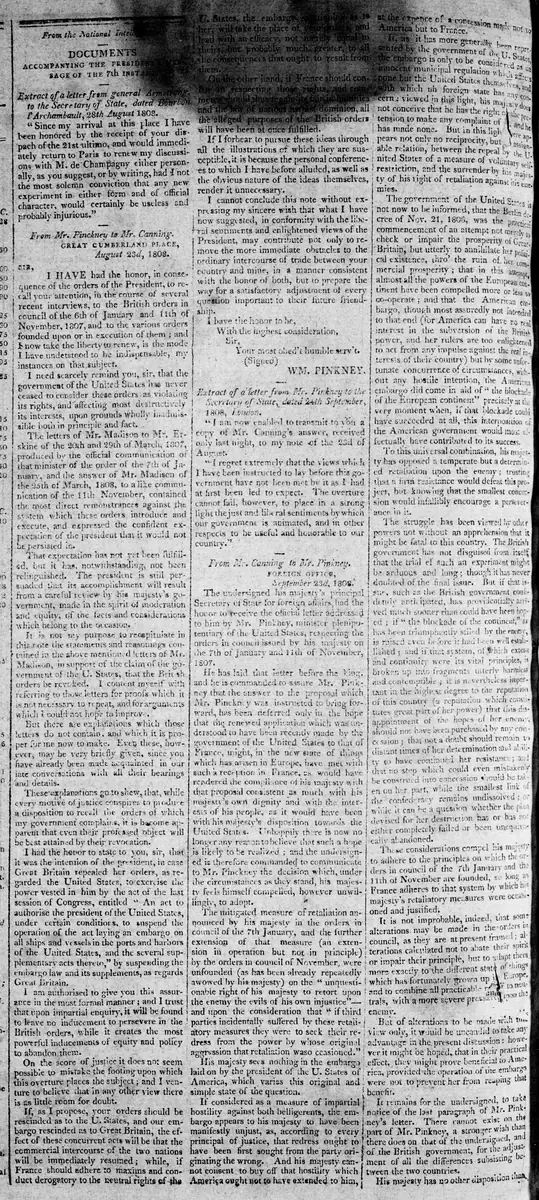
Extract of a letter from General Armstrong to the Secretary of State, dated Bourbon l'Archambault, 28th August 1808.
"Since my arrival at this place I have been honored by the receipt of your dispatches of the 21st ultimo, and would immediately return to Paris to renew my discussions with M. de Champagny either personally, as you suggest, or by writing, had I not the most solemn conviction that any new experiment in either form and of official character, would certainly be useless and probably injurious."
From Mr. Pinckney to Mr. Canning.
GREAT CUMBERLAND PLACE,
August 23d, 1808.
SIR,
I HAVE had the honor, in consequence of the orders of the President, to recall your attention, in the course of several recent interviews, to the British orders in council of the 6th of January and 11th of November, 1807, and to the various orders founded upon or in execution of them; and I now take the liberty to renew, in the mode I have understood to be indispensable, my instances on that subject.
I need scarcely remind you, sir, that the government of the United States has never ceased to consider these orders as violating its rights, and affecting most destructively its interests, upon grounds wholly inadmissible both in principle and fact.
The letters of Mr. Madison to Mr. Erskine of the 20th and 29th of March, 1807, produced by the official communication of that minister of the order of the 7th of January, and the answer of Mr. Madison of the 25th of March, 1808, to a like communication of the 11th November, contained the most direct remonstrances against the system which these orders introduce and execute, and expressed the confident expectation of the president that it would not be persisted in.
That expectation has not yet been fulfilled, but it has, notwithstanding, not been relinquished. The president is still persuaded that its accomplishment will result from a careful review by his majesty's government, made in the spirit of moderation and equity, of the facts and considerations which belong to the occasion.
It is not my purpose to recapitulate in this note the statements and reasonings contained in the above mentioned letters of Mr. Madison, in support of the claim of the government of the U. States, that the British orders be revoked. I content myself with referring to those letters for proofs which it is not necessary to repeat, and for arguments which I could not hope to improve.
But there are explanations which those letters do not contain, and which it is proper for me now to make. Even these, however, may be very briefly given, since you have already been made acquainted in our late conversations with all their bearings and details.
These explanations go to show, that, while every motive of justice conspires to produce a disposition to recall the orders of which my government complains, it is become apparent that even their professed object will be best attained by their revocation.
I had the honor to state to you, sir, that it was the intention of the president, in case Great Britain repealed her orders, as regarded the United States, to exercise the power vested in him by the act of the last session of Congress, entitled "An act to authorize the president of the United States, under certain conditions, to suspend the operation of the act laying an embargo on all ships and vessels in the ports and harbors of the United States, and the several supplementary acts thereto," by suspending the embargo law and its supplements, as regards Great Britain.
I am authorised to give you this assurance in the most formal manner; and I trust that upon impartial enquiry, it will be found to leave no inducement to persevere in the British orders, while it creates the most powerful inducements of equity and policy to abandon them.
On the score of justice it does not seem possible to mistake the footing upon which this overture places the subject; and I venture to believe that in any other view there is as little room for doubt.
If, as I propose, your orders should be rescinded as to the U. States, and our embargo rescinded as to Great Britain, the effect of these concurrent acts will be that the commercial intercourse of the two nations will be immediately resumed; while, if France should adhere to maxims and conduct derogatory to the neutral rights of the United States,
If I forbear to pursue these ideas through all the illustrations of which they are susceptible, it is because the personal conferences to which I have before alluded, as well as the obvious nature of the ideas themselves, render it unnecessary.
I cannot conclude this note without expressing my sincere wish that what I have now suggested, in conformity with the liberal sentiments and enlightened views of the President, may contribute not only to remove the more immediate obstacles to the ordinary intercourse of trade between your country and mine, in a manner consistent with the honor of both, but to prepare the way for a satisfactory adjustment of every question important to their future friendship.
I have the honor to be,
With the highest consideration,
SIR,
Your most obedient humble servant,
-(Signed)
WM. PINKNEY.
Extract of a letter from Mr. Pinkney to the Secretary of State, dated 23d September, 1808, London.
"I am now enabled to transmit to you a copy of Mr. Canning's answer, received only last night, to my note of the 23d of August.
I regret extremely that the views which I have been instructed to lay before that government have not been met by it as I had at first been led to expect. The overture cannot fail, however, to place in a strong light the just and liberal sentiments by which our government is animated, and in other respects to be useful and honorable to our country."
From Mr. Canning to Mr. Pinkney.
FOREIGN OFFICE,
September 23d, 1808.
The undersigned, his majesty's principal Secretary of State for foreign affairs, has had the honor to receive the official letter addressed to him by Mr. Pinkney, minister plenipotentiary of the United States, respecting the orders in council issued by his majesty on the 7th of January and 11th of November, 1807.
He has laid that letter before the King, and he is commanded to assure Mr. Pinkney that the answer to the proposal which Mr. Pinkney was instructed to bring forward, has been deferred only in the hope that the renewed application which was understood to have been recently made by the government of the United States to that of France, might, in the new state of things which has arisen in Europe, have met with such a reception in France, as would have rendered the compliance of his majesty with that proposal consistent as much with his majesty's own dignity and with the interests of his people, as it would have been with his majesty's disposition towards the United States. Unfortunately there is now no longer any reason to believe that such a hope is likely to be realized; and the undersigned is therefore commanded to communicate to Mr. Pinkney the decision which, under the circumstances as they stand, his majesty feels himself compelled, however unwillingly, to adopt.
The mitigated measure of retaliation announced by his majesty in the orders in council of the 7th January, and the further extension of that measure (an extension in operation but not in principle) by the orders in council of November, were unfounded (as has been already repeatedly avowed by his majesty) on the "unquestionable right of his majesty to retort upon the enemy the evils of his own injustice"-- and upon the consideration that "if third parties incidentally suffered by these retaliatory measures they were to seek their redress from the power by whose original aggression that retaliation was occasioned."
His majesty sees nothing in the embargo laid on by the president of the U. States of America, which varies this original and simple state of the question.
If considered as a measure of impartial hostility against both belligerents, the embargo appears to his majesty to have been manifestly unjust, as, according to every principle of justice, that redress ought to have been first sought from the party originating the wrong. And his majesty cannot consent to buy off that hostility which America ought not to have extended to him,
at the expense of a concession made not to America but to France.
As it has more generally been represented by the government of the U. States, the embargo is only to be considered as an innocent municipal regulation which affects none but the United States themselves, and with which no foreign state has any concern; viewed in this light, his majesty does not conceive that he has the right or the pretension to make any complaint of it, and he has made none. But in this light there appears not only no reciprocity, but no assignable relation, between the repeal by the United States of a measure of voluntary self-restriction, and the surrender by his majesty of his right of retaliation against his enemies.
The government of the United States is not now to be informed, that the Berlin decree of Nov. 21, 1806, was the practical commencement of an attempt not merely to check or impair the prosperity of Great Britain, but utterly to annihilate her political existence, thro' the ruin of her commercial prosperity; that in this attempt, almost all the powers of the European continent have been compelled more or less to co-operate; and that the American embargo, though most assuredly not intended to that end (for America can have no real interest in the subversion of the British power, and her rulers are too enlightened to act from any impulse against the real interests of their country) but by some unfortunate concurrence of circumstances, without any hostile intention, the American embargo did come in aid of "the blockade of the European continent" precisely at the very moment when, if that blockade could have succeeded at all, this interposition of the American government would most effectually have contributed to its success.
To this universal combination, his majesty has opposed a temperate but a determined retaliation upon the enemy; trusting that a firm resistance would defeat this project, but knowing that the smallest concession would infallibly encourage a perseverance in it.
The struggle has been viewed by other powers not without an apprehension that it might be fatal to this country. The British government has not disguised from itself that the trial of such an experiment might be arduous and long: though it has never doubted of the final issue. But if that issue, such as the British government confidently anticipated, has providentially arrived much sooner than could have been hoped; if "the blockade of the continent," as it has been triumphantly stiled by the enemy, is raised even before it had been well established: and if that system, of which extent and continuity were its vital principles, is broken up into fragments utterly harmless and contemptible; it is nevertheless important in the highest degree to the reputation of this country (a reputation which constitutes great part of her power) that this disappointment of the hopes of her enemy should not have been purchased by any concession; that not a doubt should remain to distant times of her determination and ability to have continued her resistance; and that no step which could even mistakenly be construed into concession should be taken on her part, while the smallest link of the confederacy remains undissolved; or while it can be a question whether the plan devised for her destruction has or has not either completely failed or been unequivocally abandoned.
These considerations compel his majesty to adhere to the principles on which the orders in council of the 7th January and the 11th of November are founded, so long as France adheres to that system by which his majesty's retaliatory measures were occasioned and justified:
It is not improbable, indeed, that some alterations may be made in the orders in council, as they are at present framed; alterations calculated not to abate their spirit or impair their principle, but to adapt them more exactly to the different state of things which has fortunately grown up in Europe, and to combine all practicable relief to neutral commerce with the most effectual resistance to the enemy.
But of alterations to be made with such a view only, it would be uncandid to take any advantage in the present discussion: however it might be hoped, that in their practical effect, they might prove beneficial to America, provided the operation of the embargo were not to prevent her from reaping that benefit.
It remains for the undersigned, to take notice of the last paragraph of Mr. Pinkney's letter. There cannot exist on the part of Mr. Pinkney, a stronger wish than there does on that of the undersigned, and of the British government, for the adjustment of all the differences subsisting between the two countries.
His majesty has no other disposition than to concur cordially in every just and reasonable proposition which can tend to that desirable end.
cultivate the most friendly intercourse with the U. S.
Mr. Pinkney would be one of the last to imagine that the prosperity of America is essentially the prosperity of this. The prosperity of any other country, is necessary or serviceable to Great Britain, and the strength and power of Great Britain, are not for herself only, but for the world. When those adjustments shall take place, to which, though unfortunately not practicable at this moment, nor under the conditions prescribed by Mr. Pinkney, the undersigned, nevertheless, confidently looks forward; it will perhaps be no insecure pledge, for the continuance of the good understanding between the two countries, that they will have learnt duly to appreciate each other's friendship; and that will not hereafter be imputed to G. Britain, either on the one hand that she envies American industry as prejudicial to British commerce, or, on the other hand, that she is compelled to court an intercourse with America, as absolutely necessary to her own existence.
His majesty would not hesitate to contribute, in any manner in his power, to restore to the commerce of the U. States, its wonted activity; and if it were possible to make any sacrifice for the repeal of the embargo, without appearing to deprecate it as a measure of hostility, he would gladly have facilitated its removal as a measure of inconvenient restriction upon the American people.
The undersigned, is commanded, in conclusion, to observe, that nothing is said in Mr. Pinckney's letter, of any intention to repeal the proclamation by which the ships of war of Great Britain are interdicted from all those rights of hospitality in the ports of the U States, which are freely allowed to the ships of his majesty's enemies.
The continuance of an interdiction which, under such circumstances, amounts so nearly to direct hostility, after the willingness professed, and the attempt made by his majesty, to remove the cause on which that measure had been originally founded, would afford but an inauspicious omen for the commencement of a system of mutual conciliation; and the omission of any notice of that measure in the proposal which Mr. Pinkney has been instructed to bring forward, would have been of itself a material defect in the overture of the president.
But the undersigned is commanded no further to dwell upon this subject than for the purpose of assuring Mr. Pinkney, that on this and every other point in discussion between the two governments, his majesty earnestly desires the restoration of a perfect good understanding, and that his majesty would decline no measure for the attainment of that object, which should be compatible with his own honor and just rights, and with the interests of his people.
The undersigned requests Mr. Pinkney will accept the assurances of his high consideration.
(Signed)
GEORGE CANNING.
To be continued.
What sub-type of article is it?
What keywords are associated?
What entities or persons were involved?
Where did it happen?
Foreign News Details
Primary Location
London
Event Date
August September 1808
Key Persons
Outcome
britain refuses to repeal orders in council without french concessions on berlin decree and related measures; possible future alterations to orders but adherence to principles; no resolution on us embargo or british warship port access.
Event Details
US diplomat William Pinkney presses British Foreign Secretary George Canning on August 23, 1808, to revoke the Orders in Council of January 7 and November 11, 1807, offering in return to suspend the US embargo against Britain if France continues violations of neutral rights. General Armstrong reports from France on stalled talks with Champagny. Canning responds on September 23, 1808, deferring due to hopes on US-France talks but ultimately refusing, viewing the embargo as aiding France's continental system; insists on maintaining retaliation until France abandons her system, while expressing desire for future adjustments and good relations.