Thank you for visiting SNEWPapers!
Sign up free
Delaware Journal
Wilmington, New Castle County, Delaware
What is this article about?
The Russian campaign in eastern Europe ended unfavorably, with Count Wittgenstein's army retreating from October 17 to November 10 amid severe weather and Turkish attacks by Grand Vizier Mahomet Ali, suffering immense losses and abandoning most gains except Kalafat and isolated Varna. This Turkish triumph under Sultan Mahmoud baffles Russian ambitions, potentially leading to European intervention or favorable peace.
Clipping
OCR Quality
Full Text
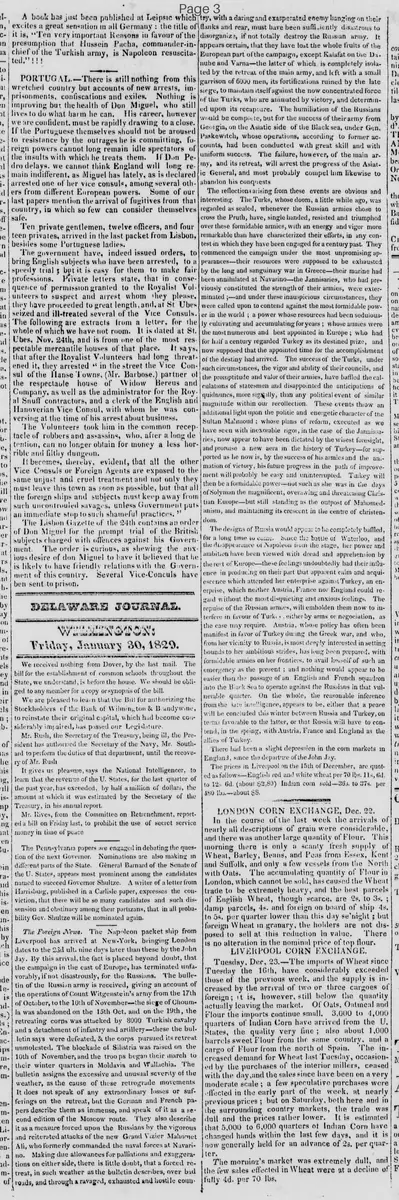
The reflections arising from these events are obvious and interesting. The Turks, whose doom, a little while ago, was regarded as sealed, whenever the Russian armies chose to cross the Pruth, have, single handed, resisted and triumphed over these formidable armies, with an energy and vigor more remarkable than have characterized their efforts, in any contest in which they have been engaged for a century past. They commenced the campaign under the most unpromising appearances—their resources were supposed to be exhausted by the long and sanguinary war in Greece—their marine had been annihilated at Navarino—the Janissaries, who had previously constituted the strength of their armies, were exterminated;—and under these inauspicious circumstances, they were called upon to contend against the most formidable power in the world; a power whose resources had been sedulously cultivating and accumulating for years; whose armies were the most numerous and best appointed in Europe; who had for half a century regarded Turkey as its destined prize, and now supposed that the appointed time for the accomplishment of the destiny had arrived. The success of the Turks, under such circumstances, the vigor and ability of their councils, and the promptitude and valor of their armies, have baffled the calculations of statesmen and disappointed the anticipations of quidnuncs, more signally, than any political event of similar magnitude within our recollection. These events throw an additional light upon the politic and energetic character of the Sultan Mahmoud; whose plans of reform, executed as we have seen with inexorable rigor, in the case of the Janissaries, now appear to have been dictated by the wisest foresight, and promise a new era in the history of Turkey—for supported as he now is, by the success of his armies and the animation of victory, his future progress in the path of improvement will probably be easy and uninterrupted. Turkey will then be a formidable power—not such as she was in the days of Solyman the magnificent, overawing and threatening Christian Europe—but still standing as the outpost of Mahomedanism, and maintaining its crescent in the centre of christendom.
The designs of Russia would appear to be completely baffled, for a long time to come. Since the battle of Waterloo, and the disappearance of Napoleon from the stage, her power and ambition have been viewed with dread and apprehension by the rest of Europe—these feelings undoubtedly had their influence in producing on their part that apparent calm and acquiescence which attended her enterprise against Turkey, an enterprise, which neither Austria, France nor England could regard without the most disquieting and anxious feelings. The repulse of the Russian armies, will embolden them now to interfere in favour of Turkey, either by arms or negociation, as the case may require. Austria, whose policy has often been manifest in favor of Turkey during the Greek war, and who, from her vicinity to Russia, is most deeply interested in setting bounds to her ambitious strides, has long been prepared, with formidable armies on her frontiers, to avail herself of such an emergency as the present; and nothing would appear to be easier than the passage of an English and French squadron into the Black Sea to operate against the Russians in that vulnerable quarter. On the whole, the reasonable inference from the late intelligence, appears to be, either that a peace will be concluded this winter between Russia and Turkey, on terms favorable to the latter, or that Russia will have to contend, in the spring, with Austria, France and England as the allies of Turkey.
What sub-type of article is it?
What keywords are associated?
What entities or persons were involved?
Where did it happen?
Foreign News Details
Primary Location
East Of Europe
Event Date
17th Of October To The 10th Of November
Key Persons
Outcome
russian army retreat with immense losses described as a second moscow rout; abandonment of sieges at choumla and silistria; loss of campaign fruits except kalafat and isolated varna with 6000 men garrison; potential abandonment of asiatic conquests by paskewitch; turkish triumph and possible european intervention or favorable peace
Event Details
The Russian campaign terminated unfavorably; Count Wittgenstein's army abandoned siege of Choumla on 15th Oct., repelled Turkish attack on 19th, raised blockade of Silistria on 10th Nov., and marched to winter quarters in Moldavia and Wallachia due to severe weather; German and French papers report immense losses from attacks by Grand Vizier Mahomet Ali; Varna isolated and threatened; Asiatic army under Paskewitch successful but likely halted; Turkish success under Sultan Mahmoud baffles Russia, potentially leading to peace or allied opposition from Austria, France, England.