Thank you for visiting SNEWPapers!
Sign up free
The Newport Gazette
Newport, Newport County, Rhode Island
What is this article about?
British General Sir William Howe's dispatch details the landing at Elk River, victory at Brandywine Creek on September 11, 1777, skirmishes including Paoli, and advance to occupy Philadelphia by October 26, 1777, against Washington's forces.
Merged-components note: This is a continuation of the detailed narrative report from the London Gazette Extraordinary on General Howe's military operations in America; merging the split components across pages 2 and 3.
Clippings
1 of 2
OCR Quality
Full Text
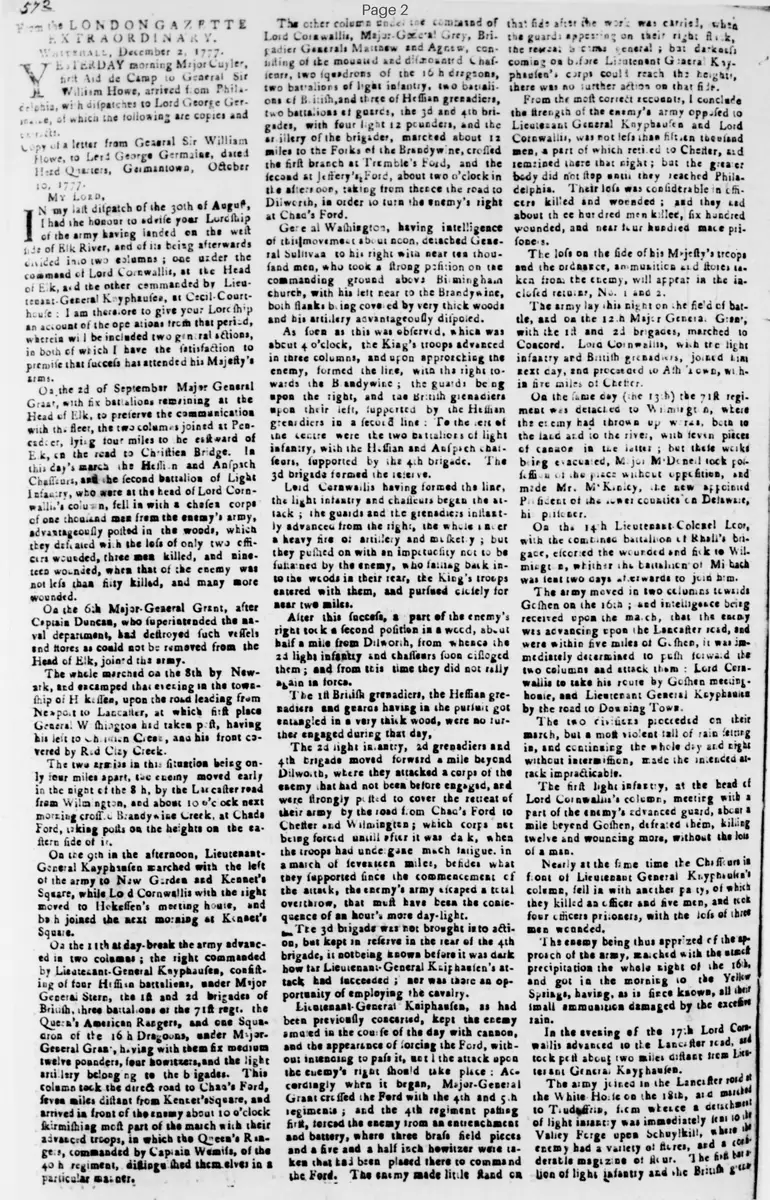
EXTRAORDINARY.
Whitehall, December 2, 1777.
YESTERDAY morning Major Cuyler, his Aide de Camp to General Sir William Howe, arrived from Philadelphia, with dispatches to Lord George Germaine, of which the following are copies and extracts.
Copy of a letter from General Sir William Howe, to Lord George Germaine, dated
Head Quarters,
Germantown,
October
10, 1777.
My Lord,
In my last dispatch of the 30th of August, I had the honour to advise your Lordship of the army having landed on the west side of Elk River, and of its being afterwards divided into two columns: one under the command of Lord Cornwallis, at the Head of Elk, and the other commanded by Lieutenant-General Knyphausen, at Cecil-Court-house: I am therefore to give your Lordship an account of the operations from that period, wherein will be included two general actions, in both of which I have the satisfaction to premise that success has attended his Majesty's arms.
On the 2d of September Major General Grant, with six battalions remaining at the Head of Elk, to preserve the communication with the fleet, the two columns joined at Penncader, lying four miles to the eastward of Elk, on the road to Christian Bridge. In this day's march the Hessian and Anspach Chasseurs, and the second battalion of Light Infantry, who were at the head of Lord Cornwallis's column, fell in with a chosen corps of one thousand men from the enemy's army, advantageously posted in the woods, which they defeated with the loss of only two officers wounded, three men killed, and nineteen wounded, when that of the enemy was not less than fifty killed, and many more wounded.
On the 6th Major-General Grant, after Captain Duncan, who superintended the naval department, had destroyed such vessels and stores as could not be removed from the Head of Elk, joined the army.
The whole marched on the 8th by Newark, and encamped that evening in the township of Kennett, upon the road leading from Newport to Lancaster, at which first place General Washington had taken post, having his left towards Brandywine Creek, and his front covered by Red Clay Creek.
The two armies in this situation being only four miles apart, the enemy moved early in the night of the 8th, by the Lancaster road from Wilmington, and about 10 o'clock next morning crossed Brandywine Creek, at Chads Ford, taking posts on the heights on the eastern side of it.
On the 9th in the afternoon, Lieutenant-General Knyphausen marched with the left of the army to New Garden and Kennett's Square, while Lord Cornwallis with the right moved to Kennett's meeting-house, and both joined the next morning at Kennett's Square.
On the 11th at day-break the army advanced in two columns: the right commanded by Lieutenant-General Knyphausen, consisting of four Hessian battalions, under Major General Stern, the 1st and 2d brigades of British, three battalions of the 71st regt. the Queen's American Rangers, and one Squadron of the 16th Dragoons, under Major-General Grant, having with them six medium twelve pounders, four howitzers, and the light artillery belonging to the brigades. This column took the direct road to Chads Ford, seven miles distant from Kennett's Square, and arrived in front of the enemy about 10 o'clock skirmishing most part of the march with their advanced troops, in which the Queen's Rangers, commanded by Captain Wemyss, of the 40th regiment, distinguished themselves in a particular manner.
The other column under the command of Lord Cornwallis, Major-General Grey, Brigadier Generals Matthew and Agnew, consisting of the mounted and dismounted Chasseurs, two squadrons of the 16th dragoons, two battalions of light infantry, two brigades of British, and three of Hessian grenadiers, two battalions of guards, the 3d and 4th brigades, with four light 12-pounders, and the artillery of the brigades, marched about 12 miles to the Forks of the Brandywine, crossed the first branch at Tremble's Ford, and the second at Jeffery's Ford, about two o'clock in the afternoon, taking from thence the road to Dilworth, in order to turn the enemy's right at Chads Ford.
General Washington, having intelligence of this movement about noon, detached General Sullivan to his right with near ten thousand men, who took a strong position on the commanding ground above Birmingham church, with his left near to the Brandywine, both flanks being covered by very thick woods and his artillery advantageously disposed.
As soon as this was observed, about 4 o'clock, the King's troops advanced in three columns, and upon approaching the enemy, formed the line, with the right towards the Brandywine; the guards being upon the right, and the British grenadiers upon their left, supported by the Hessian grenadiers in a second line: To the rear of the centre were the two battalions of light infantry, with the Hessian and Anspach chasseurs, supported by the 4th brigade. The 3d brigade formed the reserve.
Lord Cornwallis having formed this line, the light infantry and chasseurs began the attack; the guards and the grenadiers instantly advanced from the right, the whole under a heavy fire of artillery and musketry; but they pushed on with an impetuosity not to be sustained by the enemy, who falling back into the woods in their rear, the King's troops entered with them, and pursued closely for near two miles.
After this success, a part of the enemy's right took a second position in a wood, about half a mile from Dilworth, from whence the 2d light infantry and chasseurs soon dislodged them; and from this time they did not rally again in force.
The 1st British and grenadiers, the Hessian grenadiers and guards having in the pursuit got entangled in a very thick wood, were no further engaged during that day.
The 2d light infantry, 2d grenadiers and 4th brigade moved forward a mile beyond Dilworth, where they attacked a corps of the enemy that had not been before engaged, and were strongly posted to cover the retreat of their army by the road from Chads Ford to Chester and Wilmington; which corps not being forced until after it was dark, when the troops had undergone much fatigue in a march of seventeen miles, besides what they supported since the commencement of the attack, the enemy's army escaped a total overthrow, that must have been the consequence of an hour's more day-light.
The 3d brigade was not brought into action, but kept in reserve in the rear of the 4th brigade, it not being known before it was dark how far Lieutenant-General Knyphausen's attack had succeeded: nor was there an opportunity of employing the cavalry.
Lieutenant-General Knyphausen, as had been previously concerted, kept the enemy amused in the course of the day with cannon, and the appearance of forcing the Ford, without intending to pass it, not till the attack upon the enemy's right should take place: Accordingly when it began, Major-General Grant crossed the Ford with the 4th and 5th regiments; and the 41st regiment passing first, took the enemy from an entrenchment and battery, where three brass field pieces and a five and a half inch howitzer were taken that had been placed there to command the Ford.
The enemy made little stand on that side after the work was carried, when the guards appearing on their right flank, there was a confused retreat; but darkness coming on before Lieutenant-General Knyphausen's corps could reach the heights, there was no further action on that side.
From the most correct accounts, I conclude the strength of the enemy's army opposed to Lieutenant General Knyphausen and Lord Cornwallis, was not less than fifteen thousand men, a part of which retired to Chester, and remained there that night; but the greatest body did not stop till they reached Philadelphia.
Their loss was considerable in officers killed and wounded; and they had about three hundred men killed, six hundred wounded, and near four hundred made prisoners.
The loss on the side of his Majesty's troops and the ordnance, ammunition and stores taken from the enemy, will appear in the enclosed returns, No. 1 and 2.
The army lay this night on the field of battle, and on the 12th Major General Grant, with the 1st and 2d brigades, marched to Concord. Lord Cornwallis, with the light infantry and British grenadiers, joined him next day, and proceeded to Ash Town, within nine miles of Chester.
On the same day (the 13th) the 71st regiment was detached to Wilmington, where the enemy had thrown up works, both to the land and to the river, with seven pieces of cannon in the latter; but these works being evacuated, Major McDonald took possession of the place without opposition, and made Mr. M'Kinly, the new appointed President of the associated counties on Delaware, his prisoner.
On the 14th Lieutenant Colonel Loring, with the combined battalion of Rhali's brigade, escorted the wounded sick to Wilmington, whither the battalion of Muchbach was sent two days afterwards to join him.
The army moved in two columns towards Goshen on the 16th; and intelligence being received upon the march, that the enemy was advancing upon the Lancaster road, and were within five miles of Goshen, it was immediately determined to push forward the two columns and attack them: Lord Cornwallis to take his route by Goshen meeting-house, and Lieutenant General Knyphausen by the road to Downing Town.
The two divisions proceeded on their march, but a most violent fall of rain setting in, and continuing the whole day and night without intermission, made the intended attack impracticable.
The first light infantry, at the head of Lord Cornwallis's column, meeting with a part of the enemy's advanced guard, about a mile beyond Goshen, defeated them, killing twelve and wounding more, without the loss of a man.
Nearly at the same time the Chasseurs in front of Lieutenant General Knyphausen's column, fell in with another party, of which they killed an officer and five men, and took four officers prisoners, with the loss of three men wounded.
The enemy being thus apprized of the approach of the army, marched with the utmost precipitation the whole night of the 16th, and got in the morning to the Yellow Springs, having, as is since known, all their small ammunition damaged by the excessive rain.
Cornwallis advanced to the Lancaster road, and in the evening of the 17th Lord Cornwallis took post about two miles distant from Lieutenant General Knyphausen.
The army joined in the Lancaster road at the White Horse on the 18th, and marched; one battalion of light infantry was immediately sent to the Valley Forge upon Schuylkill, where the enemy had a variety of stores, and a considerable magazine of flour. The forges battalion of light infantry and the British grenadiers
The soldiers took possession there and were joined on the 20th by the guards. The enemy fled the Schuylkill on the 18th, above French Creek, and encamped upon the river, on each side of Perkiomy Creek, having detached troops to all the fords of Schuylkill, with cannon at Swedes Ford and the ferries below it. Upon intelligence that General Wayne was lying in the woods with a corps of fifteen hundred men, and four pieces of cannon, about three miles distant, and in the rear of the left wing of the army. Major General Grey was detached on the 20th late at night, with the light infantry, the 42d and 44th regiments, to surprise this corps. The most effectual precaution being taken by the General to prevent his detachment from firing, he gained the enemy's left about one o'clock; and having, by the bayonet only, forced their out centries and picket, he rushed in upon their encampment, directed by the light of their fires, killed and wounded not less than three hundred on the spot, taking between seventy and eighty prisoners, including several officers, the greater part of their arms, and eight waggons loaded with baggage and stores. Upon the first alarm the cannon were carried off, and the darkness of the night only saved the remnant of the corps. One Captain of light infantry and three men were killed in the attack, and our men wounded. Gallantry in the troops, and good conduct in the General, were fully manifested upon this critical service. On the 21st the army moved by Valley Forge, and encamped upon the banks of Schuylkill, extending from Flat Lind Ford to French Creek. The enemy upon this movement quitted their position, and marched towards Pottsgrove in the evening of this day. On the 22d the grenadiers and light infantry of the guards crossed over in the afternoon at Flat Ford, to take post, and the cavalry crossing soon after at Gordon's Ford, opposite to the left of the line, took post there also. The army was put in motion at about eight; the van-guard being led by Lord Cornwallis; and the whole crossed at Flat Ford without opposition. Major General Grant, who commanded the rear guard with the baggage, passed the river before two in the afternoon; and the army encamped on the 23d, with its lefts to the Schuylkill, and the right upon the Manatawny road, having Stony Run in front. The second battalion of light infantry was detached to Swede's Ford, which a small party of the enemy quitted immediately, leaving six pieces of iron cannon behind them. On the 24th the army marched in two columns to Germantown; and Lord Cornwallis, with the British grenadiers, and two battalions of Hessian grenadiers, took possession of Philadelphia the next morning.
(The Remainder will be in our next.)
What sub-type of article is it?
What themes does it cover?
What keywords are associated?
What entities or persons were involved?
Where did it happen?
Story Details
Key Persons
Location
Pennsylvania, Near Philadelphia, Brandywine Creek
Event Date
1777 08 30 To 1777 10 26
Story Details
British forces under Howe land at Elk River, defeat Washington's army at Brandywine on September 11, conduct skirmishes and surprise attacks like Paoli, cross Schuylkill River, and occupy Philadelphia.