Thank you for visiting SNEWPapers!
Sign up free
Domestic News
May 19, 1917
The Diamond Drill
Crystal Falls, Iron County, Michigan
What is this article about?
Dean Robert S. Shaw of Michigan Agricultural College cautions against sacrificing breeding livestock amid nationwide efforts to boost crop production to avert a food crisis, highlighting risks to meat supply given war-depleted European stocks and high market prices.
Clipping
OCR Quality
95%
Excellent
Full Text
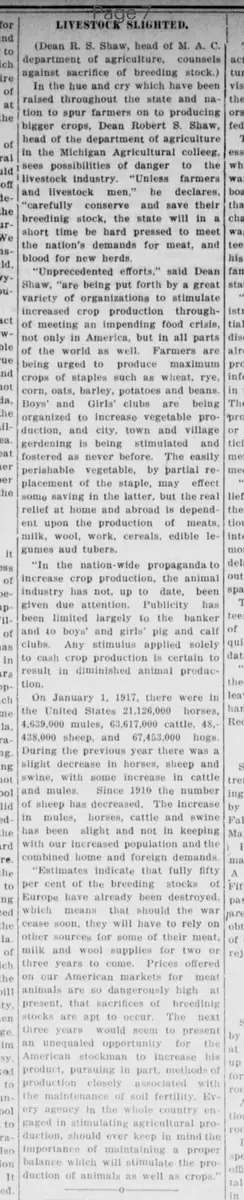
LIVESTOCK SLIGHTED.
(Dean R. S. Shaw, head of M. A. C. department of agriculture, counsels against sacrifice of breeding stock.)
In the hue and cry which have been raised throughout the state and nation to spur farmers on to producing bigger crops, Dean Robert S. Shaw, head of the department of agriculture in the Michigan Agricultural college, sees possibilities of danger to the livestock industry.
"Unless farmers and livestock men," he declares, "carefully conserve and save their breeding stock, the state will in a short time be hard pressed to meet the nation's demands for meat, and blood for new herds.
"Unprecedented efforts," said Dean Shaw, "are being put forth by a great variety of organizations to stimulate increased crop production through of meeting an impending food crisis, not only in America, but in all parts of the world as well. Farmers are being urged to produce maximum crops of staples such as wheat, rye, corn, oats, barley, potatoes and beans.
Boys' and Girls' clubs are being organized to increase vegetable production, and city, town and village gardening is being stimulated and fostered as never before. The easily perishable vegetable, by partial replacement of the staple, may effect some saving in the latter, but the real relief at home and abroad is dependent upon the production of meats, milk, wool, work, cereals, edible legumes and tubers.
"In the nation-wide propaganda to increase crop production, the animal industry has not, up to date, been given due attention. Publicity has been limited largely to the banker and to boys' and girls' pig and calf clubs. Any stimulus applied solely to cash crop production is certain to result in diminished animal production.
On January 1, 1917, there were in the United States 21,126,000 horses, 4,639,000 mules, 63,617,000 cattle, 48,438,000 sheep, and 67,453,000 hogs.
During the previous year there was a slight decrease in horses, sheep and swine, with some increase in cattle and mules. Since 1910 the number of sheep has decreased. The increase in mules, horses, cattle and swine has been slight and not in keeping with our increased population and the combined home and foreign demands.
"Estimates indicate that fully fifty per cent of the breeding stocks of Europe have already been destroyed, which means that should the war cease soon, they will have to rely on other sources for some of their meat, milk and wool supplies for two or three years to come. Prices offered on our American markets for meat animals are so dangerously high at present, that sacrifices of breeding stocks are apt to occur. The next three years would seem to present an unequaled opportunity for the American stockman to increase his product, pursuing in part, methods of production closely associated with the maintenance of soil fertility. Every agency in the whole country engaged in stimulating agricultural production, should ever keep in mind the importance of maintaining a proper balance which will stimulate the production of animals as well as crops."
(Dean R. S. Shaw, head of M. A. C. department of agriculture, counsels against sacrifice of breeding stock.)
In the hue and cry which have been raised throughout the state and nation to spur farmers on to producing bigger crops, Dean Robert S. Shaw, head of the department of agriculture in the Michigan Agricultural college, sees possibilities of danger to the livestock industry.
"Unless farmers and livestock men," he declares, "carefully conserve and save their breeding stock, the state will in a short time be hard pressed to meet the nation's demands for meat, and blood for new herds.
"Unprecedented efforts," said Dean Shaw, "are being put forth by a great variety of organizations to stimulate increased crop production through of meeting an impending food crisis, not only in America, but in all parts of the world as well. Farmers are being urged to produce maximum crops of staples such as wheat, rye, corn, oats, barley, potatoes and beans.
Boys' and Girls' clubs are being organized to increase vegetable production, and city, town and village gardening is being stimulated and fostered as never before. The easily perishable vegetable, by partial replacement of the staple, may effect some saving in the latter, but the real relief at home and abroad is dependent upon the production of meats, milk, wool, work, cereals, edible legumes and tubers.
"In the nation-wide propaganda to increase crop production, the animal industry has not, up to date, been given due attention. Publicity has been limited largely to the banker and to boys' and girls' pig and calf clubs. Any stimulus applied solely to cash crop production is certain to result in diminished animal production.
On January 1, 1917, there were in the United States 21,126,000 horses, 4,639,000 mules, 63,617,000 cattle, 48,438,000 sheep, and 67,453,000 hogs.
During the previous year there was a slight decrease in horses, sheep and swine, with some increase in cattle and mules. Since 1910 the number of sheep has decreased. The increase in mules, horses, cattle and swine has been slight and not in keeping with our increased population and the combined home and foreign demands.
"Estimates indicate that fully fifty per cent of the breeding stocks of Europe have already been destroyed, which means that should the war cease soon, they will have to rely on other sources for some of their meat, milk and wool supplies for two or three years to come. Prices offered on our American markets for meat animals are so dangerously high at present, that sacrifices of breeding stocks are apt to occur. The next three years would seem to present an unequaled opportunity for the American stockman to increase his product, pursuing in part, methods of production closely associated with the maintenance of soil fertility. Every agency in the whole country engaged in stimulating agricultural production, should ever keep in mind the importance of maintaining a proper balance which will stimulate the production of animals as well as crops."
What sub-type of article is it?
Agriculture
Economic
What keywords are associated?
Livestock
Breeding Stock
Crop Production
Michigan Agricultural College
Dean Shaw
Food Crisis
What entities or persons were involved?
Dean Robert S. Shaw
Where did it happen?
Michigan
Domestic News Details
Primary Location
Michigan
Key Persons
Dean Robert S. Shaw
Event Details
Dean Robert S. Shaw, head of the department of agriculture at Michigan Agricultural College, warns that the push for increased crop production may lead farmers to sacrifice breeding stock, endangering the livestock industry and the nation's ability to meet meat demands, especially with Europe's breeding stocks depleted by war.